The assassination of John Fitzgerald Kennedy, the 35th president of the United States, occurred on November 22, 1963, in Dallas, Texas. Kennedy was shot while travelling in a presidential motorcade through Dealey Plaza during an official visit to the city. He was pronounced dead shortly afterward at Parkland Memorial Hospital.
The assassination became one of the most significant events in modern American history. It led to a major federal investigation, the arrest and subsequent murder of the prime suspect, and decades of public debate about the circumstances surrounding the president’s death.
Who Was John F. Kennedy?
John Fitzgerald Kennedy was born on May 29, 1917, in Brookline, Massachusetts. He came from a prominent American political family and served in the United States Navy during the Second World War.
Kennedy entered politics after the war and was elected to the U.S. House of Representatives in 1946. He later served in the Senate before winning the 1960 presidential election as the Democratic Party’s candidate.
At 43, Kennedy became the youngest person elected president of the United States. He took office on January 20, 1961, with Lyndon B. Johnson as his vice president.
His presidency took place during the Cold War, a period of intense political and military rivalry between the United States and the Soviet Union. Major events during his administration included the Bay of Pigs invasion, the Cuban Missile Crisis, and the growing American involvement in Vietnam.
By November 1963, Kennedy was approaching the final year of his first presidential term.
Why Was Kennedy Visiting Dallas?
Kennedy travelled to Texas in November 1963 as part of a political trip intended to strengthen support for his administration and the Democratic Party ahead of the 1964 presidential election.
The visit included stops in several Texas cities, including San Antonio, Houston, and Fort Worth, before the presidential party arrived in Dallas on November 22.
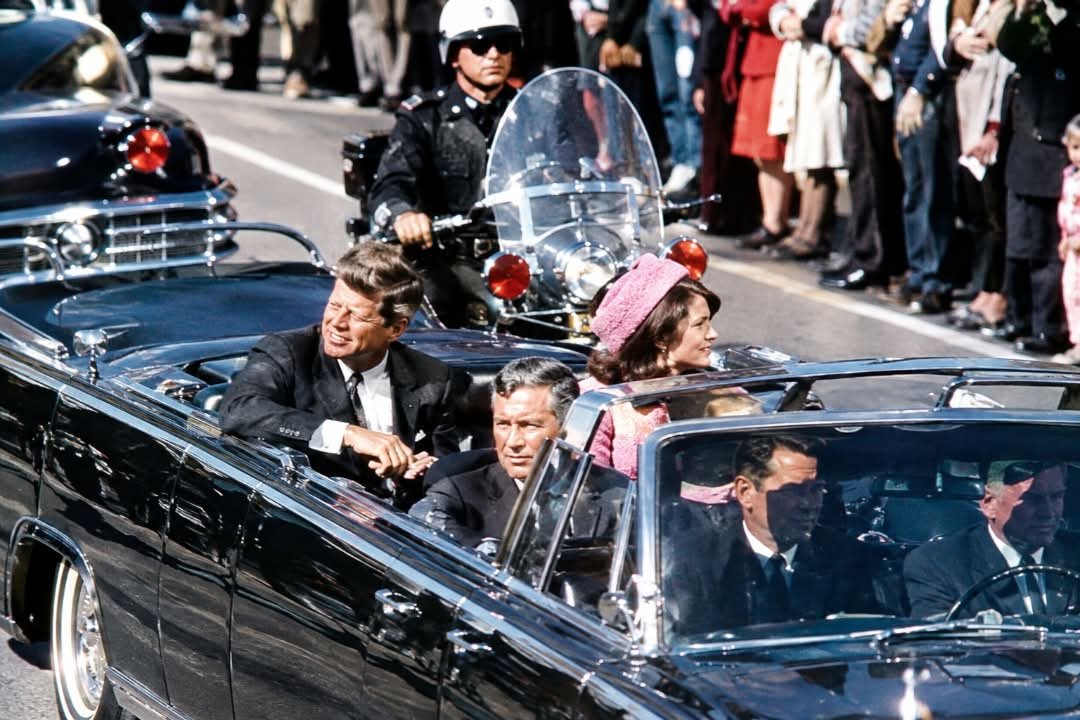
Kennedy was accompanied by First Lady Jacqueline Kennedy, Vice President Lyndon B. Johnson, and other members of his political and security entourage.
The presidential motorcade was scheduled to travel through central Dallas before reaching the Trade Mart, where Kennedy was expected to deliver a speech at a luncheon.
The route took the motorcade through Dealey Plaza, an open area near downtown Dallas.
The Assassination on November 22, 1963
On November 22, 1963, shortly after noon, Kennedy’s motorcade entered Dealey Plaza.
The president was riding in an open-top Lincoln Continental limousine with Jacqueline Kennedy. Texas Governor John Connally and his wife, Nellie Connally, were seated in the same vehicle.
At approximately 12:30 p.m. Central Standard Time, gunshots were fired as the limousine travelled along Elm Street.
Kennedy was struck by gunfire. Governor Connally was also wounded.
The presidential limousine accelerated toward Parkland Memorial Hospital, where medical personnel attempted to treat the injured president.
Despite their efforts, Kennedy was pronounced dead at 1:00 p.m.
He was 46 years old.
Governor Connally survived his injuries.
The assassination took place in front of witnesses, and several people in the surrounding area reported hearing the gunshots. Some witnesses also captured portions of the motorcade on film, including Abraham Zapruder, whose footage subsequently became an important piece of evidence in the investigation.
Where Was the Shooter?
Investigators focused on the Texas School Book Depository, a building overlooking part of the motorcade’s route.
A rifle was discovered on the sixth floor of the building after the shooting. Authorities subsequently identified Lee Harvey Oswald, an employee of the building, as the principal suspect.
Oswald had left the building after the shooting. Investigators later connected him to the assassination through witness accounts, physical evidence, and other findings gathered during the investigation.
Authorities also investigated the shooting of Dallas police officer J. D. Tippit, who was killed in a residential area of Dallas approximately 45 minutes after Kennedy was shot.
Oswald was arrested later that afternoon at the Texas Theatre in Dallas.
He was subsequently charged in connection with Kennedy’s murder and Tippit’s killing.
However, Oswald never stood trial for either death.
Who Was Lee Harvey Oswald?
Lee Harvey Oswald was born on October 18, 1939, in New Orleans, Louisiana.
He joined the United States Marine Corps in 1956 and served until 1959. After leaving the military, he travelled to the Soviet Union, where he lived for a period before returning to the United States in 1962.
Oswald became the central suspect in the Kennedy assassination because of the evidence gathered by investigators.
Authorities identified him as the person who fired the shots from the Texas School Book Depository. He denied shooting Kennedy and maintained that he was being made a scapegoat.
During his detention, Oswald was questioned by police and appeared before reporters on several occasions.
His case ended before a trial could take place.
The Murder of Lee Harvey Oswald
On November 24, 1963, two days after Kennedy’s assassination, Oswald was being transferred from the Dallas police headquarters to the county jail.
During the transfer, nightclub owner Jack Ruby emerged from a crowd in the police basement and shot Oswald at close range.
The shooting was broadcast live on television, and millions of Americans witnessed the incident.
Oswald was taken to Parkland Memorial Hospital, the same hospital where Kennedy had been treated, but died later that day.
Ruby was arrested immediately and charged with murder.
His actions prevented Oswald from standing trial, leaving many questions about the assassination to be examined through official investigations rather than a criminal trial of the principal suspect.
In 1964, a jury convicted Ruby of murder with malice and sentenced him to death. The conviction was later overturned on appeal, and a new trial was ordered. Ruby died of cancer on January 3, 1967, before the retrial could take place.
The Warren Commission Investigation
Following Kennedy’s death, President Lyndon B. Johnson established a federal commission to investigate the assassination.
The commission was created on November 29, 1963, and was chaired by Chief Justice Earl Warren of the United States Supreme Court.
Its official name was the President’s Commission on the Assassination of President Kennedy, commonly known as the Warren Commission.
The commission examined evidence, interviewed witnesses, reviewed investigative findings, and considered the circumstances surrounding Kennedy’s death and the killing of Oswald.
Its report was published in September 1964.
The commission concluded that Lee Harvey Oswald fired the shots that killed Kennedy and wounded Connally. It also concluded that Oswald acted alone and that there was no evidence establishing that he had participated in a conspiracy to assassinate the president.
The commission further concluded that Jack Ruby acted alone in killing Oswald.
The findings became the principal official account of the assassination.
However, the report did not end public controversy. Questions about the evidence, witness accounts, the sequence of events, and the investigation’s conclusions continued to attract attention.
The House Select Committee on Assassinations
In the 1970s, renewed public concern over the Kennedy assassination led Congress to undertake another investigation.
The United States House of Representatives established the House Select Committee on Assassinations in 1976. The committee investigated Kennedy’s assassination and the 1968 assassination of civil rights leader Martin Luther King Jr.
The committee released its principal findings in 1979.
It concluded that Kennedy was probably assassinated as a result of a conspiracy, while stating that it could not identify the other gunman or the extent of the conspiracy.
The committee nevertheless concluded that Oswald fired three shots at Kennedy and that one of those shots struck the president in the head.
Its conspiracy conclusion relied substantially on acoustic evidence that purportedly indicated a high probability of a second gunman.
Subsequent scientific reviews challenged the reliability of that acoustic evidence. A National Research Council review published in 1982 concluded that the acoustic evidence did not establish the existence of a second gunman.
Consequently, the Warren Commission’s conclusion that Oswald acted alone and the later House committee’s conspiracy finding remain important parts of the historical record. The evidence used to support the latter conclusion has been the subject of substantial scientific criticism.
The Zapruder Film and Other Evidence
One of the most important pieces of visual evidence associated with the assassination was a home movie recorded by Abraham Zapruder, a Dallas businessman who watched the motorcade from Dealey Plaza.
Zapruder’s film captured Kennedy’s limousine as it passed through the plaza and recorded the moments in which the president was shot.
The footage became an important part of subsequent investigations and public discussion.
Investigators also examined the rifle found in the Texas School Book Depository, bullets and bullet fragments, photographs, medical evidence, eyewitness testimony, and the physical layout of Dealey Plaza.
The interpretation of certain pieces of evidence, particularly the sequence of shots and the president’s movements, became central to disputes over the official findings.
The available evidence has been examined by investigators, researchers, historians, and government bodies over several decades.
What Happened After Kennedy’s Death?
Following Kennedy’s death, Vice President Lyndon B. Johnson was sworn in as president aboard Air Force One at Dallas Love Field.
The oath was administered by U.S. District Judge Sarah T. Hughes on November 22, 1963, before the aircraft departed for Washington, D.C.
Johnson became the 36th president of the United States and completed the remainder of Kennedy’s term before winning the 1964 presidential election.
Kennedy’s body was returned to Washington, where his funeral took place on November 25, 1963.
World leaders and representatives from numerous countries attended the funeral ceremonies. Kennedy was buried at Arlington National Cemetery in Virginia.
His death brought an abrupt end to a presidency that had been marked by major Cold War confrontations, domestic political debates, and efforts to advance civil rights legislation.
Johnson subsequently signed the Civil Rights Act of 1964 and the Voting Rights Act of 1965, major pieces of federal civil rights legislation.
The Release of Assassination Records
The Kennedy assassination continued to generate public interest long after the original investigations ended.
In 1992, the United States Congress passed the President John F. Kennedy Assassination Records Collection Act. The legislation established a process for identifying, collecting, reviewing, and making assassination-related government records publicly available.
The National Archives and Records Administration maintains the collection.
Over the following decades, additional records were released, including documents that had previously been withheld in whole or in part.
The records include materials relating to intelligence agencies, law enforcement, Oswald’s activities, and the government’s investigation.
The release of these documents has allowed researchers and the public to examine additional historical material. However, the publication of records does not, by itself, establish that a conspiracy occurred or prove any particular alternative explanation for the assassination.
Why the Assassination Remains Historically Significant
The assassination of John F. Kennedy was a major turning point in American political history.
It resulted in the death of a sitting president, the immediate transfer of executive power, and extensive federal investigations into the circumstances of the killing.
The assassination also changed the way Americans experienced major political events through television. News coverage of Kennedy’s death, Oswald’s arrest, and Oswald’s murder brought the unfolding events into millions of homes.
The inability to question Oswald at a criminal trial, combined with disputes over investigative evidence and later findings, contributed to enduring public interest in the case.
The assassination remains a major subject of historical research, with scholars examining the evidence, the investigations, the political climate of the early 1960s, and the event’s long-term consequences.
John F. Kennedy was assassinated on November 22, 1963, while travelling in a presidential motorcade through Dealey Plaza in Dallas, Texas.
Lee Harvey Oswald was identified as the principal suspect and charged with Kennedy’s murder, but he was killed by Jack Ruby before he could stand trial.
The Warren Commission concluded that Oswald acted alone, while a later congressional committee concluded that Kennedy was probably assassinated as the result of a conspiracy. The acoustic evidence central to the congressional committee’s conclusion was subsequently challenged by a scientific review.
Despite decades of investigations and the release of additional government records, the assassination remains one of the most extensively examined events in American history.
The Historabase Editorial Team is dedicated to exploring and sharing the stories that have shaped Africa and the wider world. Our work covers African history, ancient civilizations, empires, historical figures, wars, cultures, political movements, and important events from the past.
We aim to present history in a clear, engaging, and accessible way, combining historical records with careful research to help readers better understand the people, events, and civilizations that shaped our world.