On April 14, 1865, United States President Abraham Lincoln was shot while attending a performance at Ford’s Theatre in Washington, D.C. The assassination occurred just five days after Confederate General Robert E. Lee surrendered his army to Union forces, marking a major turning point in the American Civil War.
Abraham Lincoln and the American Civil War
Abraham Lincoln was born on February 12, 1809, in Hardin County, Kentucky. He became the 16th president of the United States in March 1861, at a time when the country was deeply divided over slavery, its expansion into new territories, and the relationship between the federal government and the states.
Lincoln opposed the expansion of slavery into the territories. His election in November 1860 contributed to the secession of Southern slaveholding states, which formed the Confederate States of America.
The American Civil War began in April 1861 when Confederate forces attacked Fort Sumter in South Carolina. Lincoln led the Union government throughout the conflict, which resulted in hundreds of thousands of military deaths and widespread destruction.
On January 1, 1863, Lincoln issued the Emancipation Proclamation, declaring enslaved people in areas still in rebellion against the United States to be free. The proclamation did not immediately abolish slavery throughout the country, but it transformed the war’s objectives and authorized the enlistment of Black men in the Union armed forces.
Lincoln won re-election in November 1864. By April 1865, Union forces had gained the upper hand, and Confederate armies were surrendering.
On April 9, 1865, Confederate General Robert E. Lee surrendered his Army of Northern Virginia to Union General Ulysses S. Grant at Appomattox Court House in Virginia.
Although the surrender did not immediately end all fighting, it marked the collapse of the Confederacy’s principal army.
Lincoln’s survival of the war had become closely associated with the Union victory. However, his policies, particularly his opposition to slavery and his determination to preserve the Union, had made him an enemy of committed Confederate supporters.
John Wilkes Booth was born on May 10, 1838, in Bel Air, Maryland. He came from a prominent theatrical family and established himself as an actor during the 1850s and 1860s.
Booth was a supporter of the Southern cause and strongly opposed the abolition of slavery. Although Maryland remained in the Union during the Civil War, Booth sympathized with the Confederacy.
In 1864, Booth became involved in a plan to abduct Lincoln and transport him into Confederate territory. The plan was intended to provide leverage for securing the release of Confederate prisoners of war.
The kidnapping scheme was never carried out. By 1865, as the Confederacy approached defeat, Booth’s plans changed.
He became increasingly determined to strike against the Union leadership. His hostility toward Lincoln intensified after the president publicly supported voting rights for certain Black men, including those who had served in the Union military.
Booth interpreted Lincoln’s position as a threat to the political and social order he wanted to preserve.
Rather than attempting to abduct the president, Booth and several associates developed a conspiracy to kill Lincoln and other senior members of the federal government.
The Conspiracy to Kill Lincoln
Booth did not act entirely alone. Several people became involved in the conspiracy, although their roles and intentions differed.
The principal figures included Lewis Powell, David Herold, George Atzerodt, and Mary Surratt.
The conspirators planned simultaneous attacks on Lincoln, Vice President Andrew Johnson, and Secretary of State William H. Seward on the night of April 14, 1865.
Their objective was to destabilize the Union government at a moment when the Confederacy was collapsing.
Booth was assigned to assassinate Lincoln. Powell was to attack Seward, while Atzerodt was expected to kill Vice President Johnson.
The plan depended on the successful execution of the separate attacks. However, the attempts against Johnson and Seward did not proceed as intended.
Atzerodt failed to carry out his assignment. Powell attacked Seward at his residence, seriously injuring him and several other people, but Seward survived.
The conspiracy therefore resulted in Lincoln’s death without eliminating the other targeted government leaders.
The Night of April 14, 1865
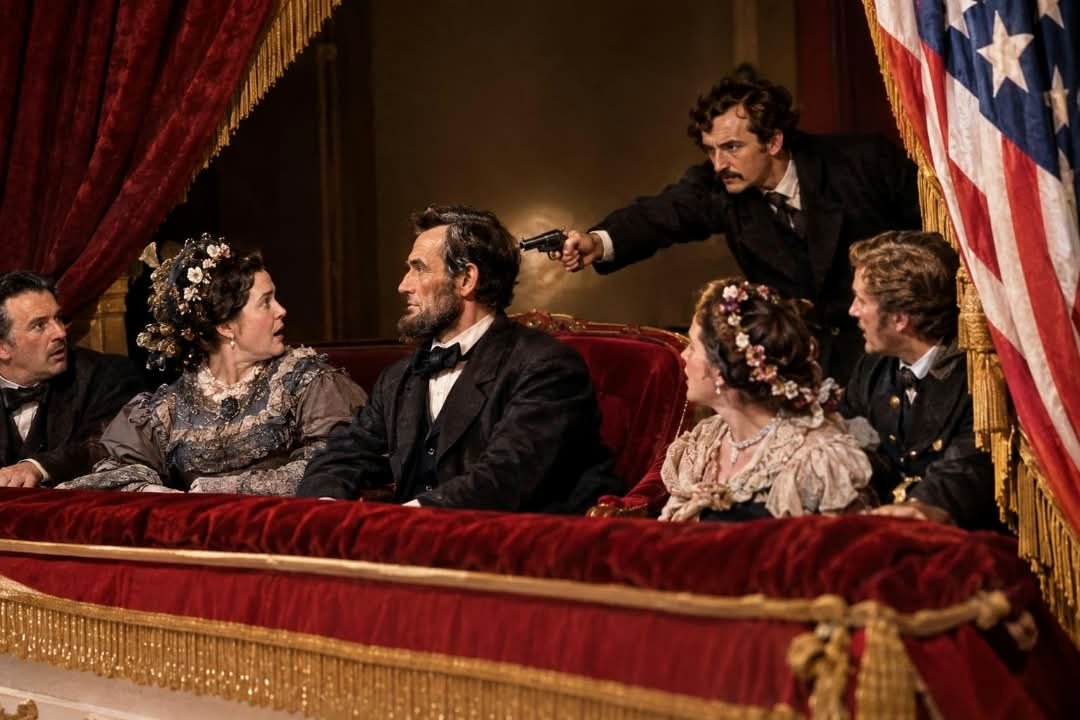
On the evening of April 14, 1865, Lincoln attended a performance of the comedy Our American Cousin at Ford’s Theatre in Washington, D.C.
He was accompanied by his wife, Mary Todd Lincoln, and two guests: Major Henry Rathbone and his fiancée, Clara Harris.
The presidential party occupied a private box overlooking the stage.
Lincoln’s attendance at the theater was publicly known, and Booth was familiar with the building because of his acting career.
During the performance, Booth entered the presidential box and approached Lincoln from behind.
At approximately 10:15 p.m., he fired a single shot into the back of the president’s head using a .44-caliber Deringer pistol.
After shooting Lincoln, Booth attacked Rathbone with a knife when Rathbone attempted to stop him. Booth then jumped from the presidential box onto the stage.
He injured his leg during the escape, although accounts differ about the precise circumstances of the injury. After reaching the stage, he shouted words commonly reported as “Sic semper tyrannis,” a Latin phrase meaning “Thus always to tyrants.”
Booth escaped from the theater through a rear exit and fled Washington.
The audience initially struggled to understand what had happened. Once the assassination became apparent, the theater descended into confusion as people attempted to help the wounded president and apprehend the attacker.
Lincoln’s Final Hours
Following the shooting, Lincoln was carried out of Ford’s Theatre and taken across the street to the Petersen House, a boardinghouse on Tenth Street.
Doctors examined him but determined that the bullet wound was fatal. The bullet had entered the back of his head and caused devastating brain injuries.
Because of the severity of the wound, physicians could do little to save him.
Mary Todd Lincoln remained deeply distressed as her husband lay unconscious. Members of the administration, military officers, and others gathered at the boardinghouse while doctors monitored the president.
Secretary of War Edwin M. Stanton helped coordinate the response and the investigation into the assassination.
Lincoln never regained consciousness.
At 7:22 a.m. on April 15, 1865, Abraham Lincoln died at the Petersen House. He was 56 years old.
Secretary of War Stanton is widely credited with saying, “Now he belongs to the ages,” although historical accounts have recorded variations in the wording.
Lincoln’s death made him the first United States president to be assassinated.
The Manhunt for John Wilkes Booth
Following the assassination, federal authorities launched a major manhunt for Booth and his associates.
Booth escaped Washington with assistance from people connected to the conspiracy. He crossed into Maryland and eventually reached Virginia, where Confederate sympathizers helped him evade capture.
On April 26, 1865, Union soldiers and federal investigators located Booth and David Herold at a tobacco barn on the property of Richard Garrett near Port Royal, Virginia.
The soldiers surrounded the barn and ordered the men to surrender.
Herold surrendered, but Booth refused to come out. The barn was set on fire in an effort to force him into the open.
During the confrontation, Sergeant Boston Corbett fired through an opening in the barn and struck Booth in the neck.
Booth was removed from the burning barn and examined by soldiers. He died several hours later on April 26, 1865.
His death ended the manhunt for Lincoln’s assassin, although investigators continued examining the conspiracy and identifying those who had assisted him.
The Arrest and Trial of the Conspirators
Federal authorities arrested numerous individuals suspected of involvement in the assassination conspiracy.
Eight defendants were brought before a military commission in 1865. They included Lewis Powell, David Herold, George Atzerodt, Mary Surratt, Samuel Arnold, Michael O’Laughlen, Edmund Spangler, and Dr. Samuel Mudd.
The defendants faced charges connected to the conspiracy to murder Lincoln and other senior government officials.
Lewis Powell had attacked Secretary of State William H. Seward. David Herold had accompanied Booth during the escape. George Atzerodt had been assigned to kill Vice President Johnson but abandoned the plan.
Mary Surratt operated a boardinghouse in Washington where members of the conspiracy had met. Investigators accused her of assisting the conspirators, although the extent of her knowledge and involvement became a subject of historical debate.
Dr. Samuel Mudd treated Booth’s injured leg after the assassination and was accused of aiding the fugitive.
The military commission found all eight defendants guilty of various charges. Four received death sentences: Powell, Herold, Atzerodt, and Surratt.
Surratt became the first woman executed by the United States federal government.
The other defendants received prison sentences. Arnold, O’Laughlen, and Spangler were later pardoned by President Andrew Johnson. Mudd was also pardoned in 1869.
The trial and executions remain significant in American legal history, particularly because the defendants were tried by a military commission rather than an ordinary civilian court.
What Happened to Andrew Johnson and William Seward?
Although Booth’s conspiracy included plans to kill Vice President Andrew Johnson and Secretary of State William H. Seward, both men survived.
Johnson was staying at the Kirkwood House hotel in Washington on the night of the assassination. Atzerodt, who had been assigned to kill him, went to the hotel but did not carry out the attack.
Seward, meanwhile, was recovering from injuries sustained in a carriage accident. Powell entered his residence and attacked him with a knife, injuring Seward and several other people.
Despite the seriousness of his injuries, Seward survived.
Johnson became president following Lincoln’s death and took office on April 15, 1865.
His presidency began during one of the most difficult periods in American history. The federal government faced the challenge of restoring the former Confederate states to the Union and determining the political, legal, and social status of formerly enslaved people.
Johnson’s approach to Reconstruction differed significantly from that of many congressional Republicans, resulting in major political conflicts during his administration.
The Funeral and Burial of Abraham Lincoln
Lincoln’s death triggered an extraordinary national period of mourning.
His body was placed in the White House before being transported to the Capitol, where the public was permitted to pay its respects.
A funeral procession carried Lincoln’s remains through Washington on April 19, 1865.
His body was subsequently transported by train on a lengthy funeral journey through several cities, including Baltimore, Philadelphia, New York, Cleveland, Columbus, Indianapolis, Chicago, and other communities along the route.
Large crowds gathered to see the funeral train and honor the president.
The journey ended in Springfield, Illinois, Lincoln’s former home. He was buried at Oak Ridge Cemetery on May 4, 1865.
His funeral became one of the most significant public mourning events in nineteenth-century American history.
The Historical Impact of Lincoln’s Assassination
Lincoln’s assassination occurred during the transition from civil war to national reconstruction.
The Confederacy’s principal armies had surrendered, but the United States still faced difficult questions about rebuilding the South, restoring political unity, and securing the rights of formerly enslaved people.
Lincoln had supported a relatively lenient approach to restoring the Southern states, although his precise plans for Reconstruction continued to evolve during the final months of his life.
His death transferred the presidency to Andrew Johnson, whose disagreements with congressional Republicans contributed to a prolonged political struggle over Reconstruction.
Congress eventually adopted measures intended to protect the civil and political rights of formerly enslaved people. The Fourteenth Amendment, ratified in 1868, established national citizenship and equal protection under the law. The Fifteenth Amendment, ratified in 1870, prohibited denying voting rights on the basis of race, color, or previous enslavement, although discriminatory practices continued to prevent many Black Americans from exercising those rights.
Lincoln’s assassination also influenced how Americans remembered his presidency. His leadership during the Civil War, his role in ending slavery, and the circumstances of his death contributed to his lasting historical reputation.
However, the assassination did not resolve the divisions that had caused the Civil War. Political conflict, racial violence, and disputes over the rights of formerly enslaved people continued long after Lincoln’s death.
The Historabase Editorial Team is dedicated to exploring and sharing the stories that have shaped Africa and the wider world. Our work covers African history, ancient civilizations, empires, historical figures, wars, cultures, political movements, and important events from the past.
We aim to present history in a clear, engaging, and accessible way, combining historical records with careful research to help readers better understand the people, events, and civilizations that shaped our world.






One Comment