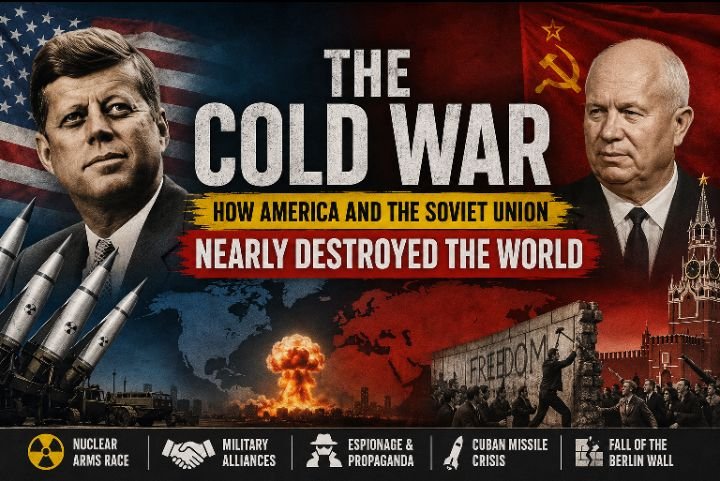
For nearly half a century, the world lived under the shadow of a conflict that never became a direct war between the two most powerful nations involved. From the end of World War II in 1945 until the collapse of the Soviet Union in 1991, the United States and the Soviet Union competed for global influence, military superiority and ideological dominance.
Unlike traditional wars, America and the Soviet Union rarely fought each other directly. Instead, they competed through nuclear weapons, military alliances, espionage, propaganda, economic pressure, technological achievements and wars fought through other countries.
At its most dangerous moments, however, the Cold War brought humanity frighteningly close to nuclear destruction.
How the Cold War Began
The roots of the Cold War can be traced to the final years of World War II.
The United States and the Soviet Union were allies against Nazi Germany, but their alliance was based largely on necessity. They had fundamentally different political and economic systems.
The United States supported liberal democracy and capitalism, while the Soviet Union was governed by a communist system dominated by the Communist Party.
When Nazi Germany was defeated in 1945, their common enemy disappeared. The differences between the two powers quickly became impossible to ignore.
Soviet forces occupied much of Eastern Europe after the war, and communist governments were established across countries including Poland, Hungary, Romania, Bulgaria and East Germany.
Western governments feared that Soviet influence would continue spreading across Europe and beyond. Moscow, meanwhile, feared that the United States and its allies were attempting to surround and weaken the Soviet Union.
The wartime alliance had effectively collapsed.
A Divided Europe
Europe became the main battlefield of the emerging political struggle.
Germany was divided into occupation zones controlled by the United States, Britain, France and the Soviet Union. Berlin, despite being located deep inside the Soviet occupation zone, was also divided among the four powers.
In 1948, the Soviet Union blocked land routes into West Berlin in an attempt to force the Western powers out.
The United States and its allies responded with the Berlin Airlift, supplying the city’s population by aircraft.
For almost a year, Western planes delivered food, fuel and other essential supplies. The Soviet blockade eventually ended in 1949.
The crisis demonstrated that the Cold War could rapidly turn into a confrontation between the world’s most powerful nations without a single shot being fired directly between their armies.
NATO and the Soviet Response
The growing tension led to the creation of military alliances.
In 1949, the United States, Canada and several Western European countries established the North Atlantic Treaty Organization (NATO). Its central principle was that an attack against one member would be treated as an attack against all.
The Soviet Union later responded by creating the Warsaw Pact in 1955, bringing together the Soviet Union and several communist states in Eastern Europe.
Europe was now divided into two major military blocs.
The possibility of a conflict between them became increasingly terrifying because both sides possessed nuclear weapons.
The Nuclear Arms Race
The United States had demonstrated the devastating power of nuclear weapons when it used atomic bombs against Hiroshima and Nagasaki in 1945.
The Soviet Union successfully tested its own atomic bomb in 1949.
This changed the Cold War forever.
Instead of one country possessing the ultimate weapon, both superpowers began developing increasingly powerful nuclear arsenals.
The United States developed the hydrogen bomb, followed by the Soviet Union. Both countries developed long-range missiles capable of delivering nuclear weapons across continents.
The result was a terrifying concept known as Mutually Assured Destruction, or MAD.
The basic idea was simple: if one side launched a nuclear attack, the other side would have enough weapons to retaliate and destroy the attacker.
Nuclear weapons therefore became both instruments of destruction and deterrence.
The superpowers were afraid to start a nuclear war because they understood that victory would be meaningless if civilization itself was destroyed.
The Korean War
The Cold War soon spread beyond Europe.
In 1950, North Korea, supported by the Soviet Union and China, invaded South Korea.
The United States and other countries intervened under a United Nations command to defend South Korea.
The conflict became one of the first major armed confrontations of the Cold War.
Millions of people were killed or displaced during the Korean War, which ended in 1953 with an armistice rather than a formal peace treaty.
Korea remained divided, and the conflict demonstrated an important feature of the Cold War: Washington and Moscow could compete without directly declaring war on each other by supporting opposing sides in conflicts around the world.
The Space Race
The Cold War was not fought only with soldiers and weapons.
It was also a battle for technological and ideological prestige.
In 1957, the Soviet Union shocked the world by launching Sputnik 1, the first artificial satellite to orbit Earth.
The achievement demonstrated the Soviet Union’s growing technological capabilities and raised fears in the United States that Moscow had gained an advantage in missile technology.
America responded by increasing investment in science, engineering and space exploration.
The competition eventually produced one of the most remarkable achievements in human history.
In 1969, the United States successfully landed astronauts on the Moon.
The Moon landing became a major symbolic victory for America and demonstrated the extraordinary technological progress produced by Cold War competition.
The Cuban Missile Crisis
The most dangerous moment of the Cold War came in October 1962.
After the Cuban Revolution brought Fidel Castro to power, Cuba developed close relations with the Soviet Union.
The United States had already become deeply concerned about communist influence only about 90 miles from its coast.
When American intelligence discovered Soviet nuclear missiles being installed in Cuba, President John F. Kennedy faced an extraordinary decision.
Removing the missiles by force could trigger a Soviet response. Doing nothing would allow nuclear weapons to remain dangerously close to the United States.
Kennedy ordered a naval blockade around Cuba and demanded the removal of the missiles.
For several days, the world watched anxiously as American and Soviet leaders confronted each other.
The crisis eventually ended through negotiations. The Soviet Union agreed to remove its missiles from Cuba, while the United States secretly agreed to remove American Jupiter missiles from Turkey and publicly pledged not to invade Cuba.
The Cuban Missile Crisis is widely regarded as the moment when the world came closest to nuclear war.
It also convinced both superpowers that they needed better ways to communicate and control their nuclear arsenals.
The Vietnam War
The Cold War continued to spread through Asia.
Vietnam became another major battleground between communist and anti-communist forces.
The United States became increasingly involved in supporting South Vietnam, while North Vietnam received assistance from communist allies including the Soviet Union and China.
The war became deeply controversial in the United States.
American military forces eventually withdrew, and communist North Vietnam captured Saigon in 1975.
The conflict demonstrated the limits of American military power and became one of the most divisive episodes in American history.
For the Soviet Union, Vietnam also demonstrated that Cold War competition could impose significant costs on the United States without a direct superpower war.
Espionage and Propaganda
Another major battlefield was intelligence.
American and Soviet intelligence agencies conducted extensive espionage operations around the world.
The CIA and KGB gathered information, recruited agents, monitored opponents and attempted to influence political developments.
The superpowers also used propaganda to convince people that their political and economic system represented the future.
Radio broadcasts, newspapers, films, education and cultural exchanges became tools of ideological competition.
Even athletes became part of the rivalry.
The Olympic Games frequently became symbolic contests between the two systems, with sporting achievements presented as evidence of national strength.
The Cold War Comes to Africa
Africa also became an important arena for Cold War competition, particularly as European colonial empires collapsed and newly independent nations emerged.
The United States and Soviet Union sought political influence across the continent.
In some countries, local conflicts became connected to the larger rivalry between capitalism and communism.
Angola became one of the most significant examples. After Angola gained independence from Portugal in 1975, rival political and military movements fought for control.
The Soviet Union and Cuba supported the MPLA, while the United States and other foreign powers supported opposing forces at different stages of the conflict.
The result was a devastating civil war that lasted for decades.
The Cold War therefore affected countries far beyond Washington and Moscow, often turning local political struggles into international conflicts.
The Berlin Wall
In 1961, East Germany constructed the Berlin Wall, separating East Berlin from West Berlin.
The wall became one of the most powerful symbols of the Cold War.
It represented the political and ideological division between communist Eastern Europe and capitalist Western Europe.
For nearly three decades, the wall stood as a physical reminder of the divided world.
Then, in 1989, it suddenly became a symbol of change.
Mass protests and political reforms weakened communist governments across Eastern Europe. On November 9, 1989, East German authorities announced new rules concerning travel.
Crowds quickly gathered at the border crossings.
The Berlin Wall was opened, and people began tearing it apart.
Its fall marked the beginning of the end of the Cold War.
The Collapse of the Soviet Union
By the 1980s, the Soviet Union was facing serious economic and political problems.
Soviet leader Mikhail Gorbachev introduced reforms known as glasnost and perestroika, aimed at increasing openness and restructuring the Soviet system.
The Soviet Union also became increasingly willing to reduce tensions with the West.
Meanwhile, communist governments across Eastern Europe began collapsing.
In 1990, East and West Germany were reunited.
By 1991, the Soviet Union itself was breaking apart.
On December 25, 1991, Gorbachev resigned as president of the Soviet Union. The following day, the Soviet Union formally ceased to exist.
After almost five decades, the Cold War was over.
A War That Never Happened — But Nearly Did
The Cold War is unusual in history because its two principal enemies never fought a full-scale war directly against each other.
Yet the danger was enormous.
The United States and Soviet Union accumulated nuclear weapons capable of killing millions of people. Their military alliances divided Europe. Their intelligence agencies fought secret battles. Their ideological competition influenced governments across the world.
Wars in Korea, Vietnam, Afghanistan, Angola and elsewhere caused enormous human suffering while the superpowers competed for influence.
Most frighteningly, several crises brought the world dangerously close to nuclear confrontation.
The Cuban Missile Crisis showed how quickly misunderstandings, military preparations and political pressure could bring humanity to the edge.
The Legacy of the Cold War
The Cold War ended in 1991, but its consequences remain visible today.
NATO survived the collapse of the Soviet Union and expanded into parts of Eastern Europe. Russia retained a large nuclear arsenal and remained a major military power.
Nuclear weapons remain central to international security, while the legacy of Cold War conflicts continues to shape politics in Europe, Asia, Africa and Latin America.
The Cold War also transformed science and technology. The space race accelerated developments in computing, telecommunications, aerospace engineering and satellite technology.
Perhaps its greatest lesson is that powerful nations can compete without necessarily going to war, but maintaining peace requires communication, restraint and an understanding of the catastrophic consequences of escalation.
The Cold War lasted nearly half a century. It was a struggle between two superpowers, but its consequences reached almost every corner of the globe.
Humanity survived not because nuclear war was impossible, but because leaders repeatedly stepped back from the brink.
The Historabase Editorial Team is dedicated to exploring and sharing the stories that have shaped Africa and the wider world. Our work covers African history, ancient civilizations, empires, historical figures, wars, cultures, political movements, and important events from the past.
We aim to present history in a clear, engaging, and accessible way, combining historical records with careful research to help readers better understand the people, events, and civilizations that shaped our world.