On October 17, 1961, thousands of Algerians gathered in Paris to protest a discriminatory nighttime curfew imposed on Algerians living in the French capital. The demonstration took place during the Algerian War of Independence, a conflict that had been raging since 1954.
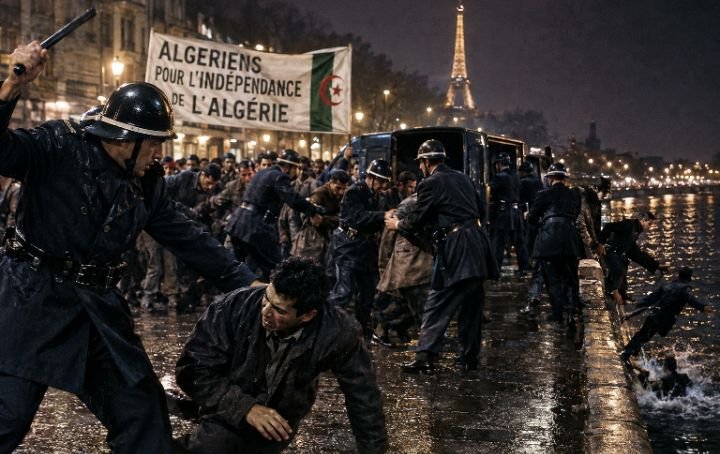
What followed was one of the darkest episodes in modern French history. French police violently attacked demonstrators, beating people, arresting thousands, and causing deaths. Some protesters were thrown into the River Seine, while others died from their injuries or disappeared into police custody.
For decades, the events remained a subject of political controversy, and the French authorities’ response to the massacre faced sustained criticism from historians, survivors, and human rights advocates.
The Algerian War of Independence
France invaded Algeria in 1830 and subsequently established colonial rule over the territory. Unlike many other French colonies, Algeria was administered as an integral part of France, although its Muslim population faced widespread political, economic, and legal inequalities.
The colonial system generated deep resentment among Algerians, particularly over land dispossession, discrimination, and restrictions on political participation.
On November 1, 1954, the National Liberation Front (FLN), an Algerian nationalist organization, launched an armed uprising against French rule. This marked the beginning of the Algerian War of Independence.
The conflict involved attacks by Algerian independence fighters, French military operations, arrests, torture, and violence against civilians. It also extended into mainland France, where the FLN organized among Algerian workers and communities.
Paris became an important centre of this struggle. The FLN established networks among Algerian residents, collected money to support the independence movement, and fought for influence against rival Algerian nationalist groups.
French authorities responded with extensive surveillance, arrests, and police operations targeting Algerians living in France.
The Discriminatory Curfew of October 1961
In the autumn of 1961, tensions between the FLN and French authorities intensified.
On October 5, 1961, the Paris police administration, under Police Prefect Maurice Papon, announced a nighttime curfew targeting Algerian Muslim workers and other people described at the time as French Muslims from Algeria.
The restrictions required the targeted population to remain indoors between 8:30 p.m. and 5:30 a.m. Algerians were also urged to avoid travelling in groups and entering central Paris.
The curfew was discriminatory because it singled out people on the basis of their origins and officially classified identity. It formed part of a broader campaign against the FLN and the Algerian independence movement.
The FLN called for a peaceful mass demonstration on the evening of October 17 to oppose the restrictions.
The organization instructed Algerians to take part in the protest without weapons. Demonstrators were expected to march through central Paris and gather at designated locations.
Thousands of men, women, and children responded to the call. Many travelled from working-class neighbourhoods and surrounding suburbs to participate in the demonstration.
October 17, 1961: The Demonstration Begins
On the evening of October 17, large numbers of Algerians entered central Paris despite the restrictions.
Demonstrators gathered at locations including the areas around the Grands Boulevards, the Étoile, and Saint-Michel. Many wore ordinary clothing and arrived in families or groups.
The protest was intended to challenge the curfew and demonstrate opposition to French rule in Algeria.
French police forces had been deployed throughout the capital in anticipation of the demonstration. Officers stopped demonstrators, blocked routes, and carried out mass arrests.
As the evening progressed, police violence spread across several parts of Paris.
Witnesses and survivors reported that officers beat demonstrators with batons, kicked people who had fallen to the ground, and forced large numbers into police vehicles and buses.
Many of those arrested were transported to police facilities, including the Palais des Sports and the Parc des Expositions, where detainees were held under harsh conditions.
Accounts of the night describe severe beatings, overcrowding, and mistreatment of prisoners.
The violence did not remain confined to a single demonstration site. Arrests and attacks occurred at different locations across the city as police moved against the crowds.
Protesters Thrown into the River Seine
Among the most disturbing accounts of October 17 were reports that Algerian demonstrators had been thrown into the River Seine.
Witnesses described police officers beating protesters before pushing or throwing some of them into the water. Other bodies were subsequently recovered from the Seine.
Some victims drowned, while others were killed through beatings or other forms of violence.
The river became one of the most enduring symbols of the massacre.
Reports of bodies found in the Seine continued in the days and weeks surrounding the demonstration. However, not every death discovered during that period could be conclusively connected to the events of October 17.
The full circumstances of many individual deaths remain difficult to establish because of incomplete records, disputed official accounts, and the treatment of victims during and after the crackdown.
Although the exact number of people killed remains disputed, the violence resulted in numerous deaths and widespread injuries.
The police operation involved the mass detention of Algerians throughout Paris.
Thousands of people were arrested during the demonstration and the subsequent crackdown. Many were transported to temporary detention sites, police stations, and other facilities.
Detainees reported being beaten and subjected to degrading treatment. Some were held for extended periods, while others were released after questioning.
The scale of the arrests reflected the French authorities’ determination to suppress the FLN’s activities in mainland France.
Maurice Papon, the Paris police prefect, played a central role in directing the police administration during this period. He had previously served in the French colonial administration in Algeria and was a controversial figure because of his record during the German occupation of France.
Papon maintained that the police operation was necessary to maintain public order and combat the FLN. However, the brutality reported by witnesses and the number of people detained became central to later criticism of the authorities’ actions.
The massacre also exposed the vulnerability of Algerian workers, many of whom lived in overcrowded housing and faced discrimination in employment and everyday life.
The immediate official response did not fully acknowledge the scale of the violence.
French authorities presented the events primarily as a police operation against an FLN-organized demonstration. Official accounts minimized the extent of police brutality, and the number of people killed was substantially disputed.
Information about the deaths and disappearances circulated through witnesses, families, journalists, and activists. However, the political circumstances of the Algerian War made open discussion difficult.
The French government was engaged in negotiations over Algeria’s future, while the FLN was fighting to secure independence. Both the war and the activities of the FLN were deeply controversial within France.
The treatment of Algerian demonstrators received limited public attention compared with the scale of the violence. For years, the events remained overshadowed by political divisions and official silence.
The difficulty of establishing a definitive death toll was compounded by incomplete documentation and the absence of a comprehensive, publicly acknowledged accounting of the victims.
The Massacre of February 8, 1962
The October 17 massacre was not the only major instance of deadly police violence against demonstrators in Paris during the Algerian War.
On February 8, 1962, French police violently suppressed a demonstration against the far-right Organisation armée secrète (OAS), which opposed Algerian independence and carried out terrorist attacks.
The demonstration was organized by left-wing groups and trade unions, including the French Communist Party and the General Confederation of Labour.
At the Charonne metro station, police attacked demonstrators, causing a crush and resulting in the deaths of eight people, with another victim dying later from injuries.
The Charonne massacre became a major public event in France and provoked widespread outrage.
Although the February 1962 killings involved a different demonstration and political context, they illustrated the broader crisis surrounding police violence, political extremism, and the Algerian War.
Algeria Wins Independence
The war continued into 1962, despite growing opposition to the conflict and mounting political pressure within France.
On March 18, 1962, representatives of France and the FLN signed the Évian Accords, establishing the framework for a ceasefire and a process leading to Algerian independence.
A referendum held in Algeria on July 1 overwhelmingly supported independence. France recognized Algerian independence on July 3, 1962, and Algeria formally celebrated its independence on July 5.
The end of colonial rule did not immediately resolve the consequences of the war. Violence, displacement, and political tensions continued to affect both Algeria and France.
For Algerian families whose relatives had been killed, injured, detained, or disappeared during the conflict, the events of October 17, 1961, remained a painful part of that history.
The Long Struggle for Recognition
For decades, the Paris massacre received limited official recognition in France.
Survivors, families of victims, historians, and activists continued to investigate the events and challenge accounts that minimized police responsibility.
Historical research, witness testimony, and renewed public discussion gradually brought greater attention to the massacre.
In 1998, the French government officially acknowledged that 40 people had died in Paris during the autumn of 1961 in circumstances connected to the events surrounding the crackdown. Historians have disputed the adequacy of the official accounting, and estimates of the number killed on October 17 itself vary.
On October 17, 2012, President François Hollande issued a statement recognizing that Algerians demonstrating for independence had been killed during a bloody crackdown on October 17, 1961.
In 2021, President Emmanuel Macron attended a commemoration marking the sixtieth anniversary of the massacre. The French presidency acknowledged the responsibility of the state in the events and described the killings as inexcusable.
These acknowledgments represented important steps in the public recognition of the massacre, although debates over accountability, historical documentation, and the full number of victims have continued.
The Paris Massacre of October 17, 1961, remains one of the darkest episodes in the history of modern France.
Thousands of Algerians had gathered to protest a discriminatory curfew during the struggle for independence. Instead of a peaceful demonstration, the night became a scene of police violence, mass arrests, severe beatings, and deaths.
The precise number of victims remains disputed, but the historical record establishes that demonstrators were subjected to a violent crackdown and that the French authorities failed for decades to provide full public recognition of what had happened.
The Historabase Editorial Team is dedicated to exploring and sharing the stories that have shaped Africa and the wider world. Our work covers African history, ancient civilizations, empires, historical figures, wars, cultures, political movements, and important events from the past.
We aim to present history in a clear, engaging, and accessible way, combining historical records with careful research to help readers better understand the people, events, and civilizations that shaped our world.




One Comment