Few inventions have changed human communication as dramatically as the telephone. Before it appeared, communicating over long distances often meant sending letters, telegrams or relying on messengers. The telephone introduced something revolutionary: the ability to hear another person’s voice from far away almost instantly.
But who invented it?
The name most commonly associated with the telephone is Alexander Graham Bell. In 1876, Bell received a U.S. patent for a device designed to transmit human speech electrically. However, the story is far more complicated than the familiar image of Bell simply inventing the telephone.
Several inventors were experimenting with electrical voice communication around the same time. One of Bell’s most important rivals was Elisha Gray, while Antonio Meucci had also developed an earlier voice-transmission device that has become an important part of the historical debate.
The invention of the telephone was therefore not just a technological breakthrough. It was also the center of a fierce race involving patents, competing ideas and legal battles.
For centuries, humans had searched for faster ways to communicate over long distances.
The invention of the telegraph in the 19th century was a major breakthrough. Telegraph operators could send coded messages through electrical wires, allowing information to travel far faster than physical mail.
However, the telegraph had an important limitation: it transmitted signals rather than actual human speech.
Inventors began asking a much more ambitious question:
Could electricity be used to transmit the human voice?
During the 1800s, researchers experimented with vibrating membranes, electrical signals and different forms of acoustic technology in an attempt to answer that question.
Among them was Alexander Graham Bell.
Alexander Graham Bell’s Early Work
Alexander Graham Bell was born in Scotland in 1847 and later moved to North America. He had a strong interest in speech, sound and communication.
His family was deeply involved in teaching speech and working with people who had hearing and speech difficulties. This influenced Bell’s scientific interests and eventually led him toward experiments involving sound and electrical communication.
Bell initially became interested in improving the telegraph.
At the time, telegraph companies wanted technology capable of sending multiple messages simultaneously over the same wire. Bell believed that electrical signals might be manipulated in a way that could reproduce different sounds.
His experiments gradually moved beyond the telegraph and toward the possibility of transmitting speech.
The Race to Invent the Telephone
Bell was not working alone.
Other inventors were attempting to solve the same problem, creating an intense race to develop a practical speaking telephone.
One of his most significant competitors was Elisha Gray, an American inventor who had developed numerous technologies related to electrical communication.
Gray was also experimenting with methods for transmitting speech electronically.
The rivalry between Bell and Gray would eventually become one of the most controversial episodes in the history of invention.
The Famous Patent Day
On February 14, 1876, Bell’s lawyer submitted a patent application for an invention designed to transmit speech electrically.
On the same day, Elisha Gray’s representatives submitted a document known as a caveat to the U.S. Patent Office describing a similar concept for transmitting vocal sounds electrically.
The timing was extraordinarily close.
Bell’s application ultimately became the famous U.S. Patent No. 174,465, granted on March 7, 1876.
The patent described an apparatus for transmitting vocal sounds telegraphically.
This patent became the foundation of Bell’s claim to the invention of the telephone.
The First Famous Telephone Call
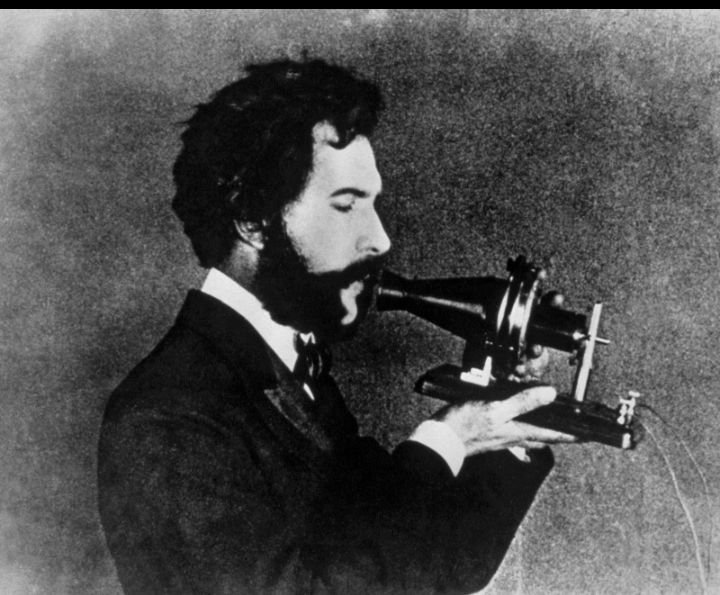
Just days after receiving his patent, Bell and his assistant Thomas Watson achieved one of the most famous moments in communication history.
On March 10, 1876, Bell was working with Watson in Boston.
According to the historical record, Bell spoke into his experimental device and said:
“Mr. Watson, come here, I want to see you.”
Watson heard Bell’s voice through the device and came into the room.
The experiment demonstrated that recognizable human speech could be transmitted electrically between two locations.
The telephone had moved from an ambitious scientific idea toward a practical communication technology.
What About Elisha Gray?
The rivalry with Elisha Gray did not disappear after Bell received his patent.
Gray argued that he had developed an important telephone concept and that his work deserved recognition.
The dispute became part of a much larger legal and historical controversy surrounding Bell’s patent.
However, Bell’s patent remained legally valid through numerous challenges, and Bell Telephone Company was established in 1877.
The commercial development of the telephone accelerated rapidly.
Antonio Meucci’s Forgotten Contribution
Another important figure in the telephone story is Antonio Meucci, an Italian inventor who later lived in the United States.
Meucci reportedly developed a voice communication system that connected different rooms in his home during the 1850s.
He called his device a telettrofono.
Meucci did not obtain a full telephone patent. In 1871, he filed a temporary patent document, known as a caveat, relating to his communication device, but he was unable to maintain it after 1874.
Decades later, Meucci became the subject of renewed historical attention.
In 2002, the U.S. House of Representatives passed a resolution recognizing his work and stating that his life and achievements should be acknowledged in the history of the invention of the telephone.
However, the resolution did not legally overturn Bell’s patent or declare Meucci the sole inventor of the telephone.
The history therefore remains more complicated than simply naming one person.
Bell’s Commercial Breakthrough
Bell’s greatest achievement was not merely producing a device that transmitted sound.
He helped turn the telephone into a practical communication system.
In 1877, the Bell Telephone Company was established.
Telephone exchanges soon began appearing, allowing users to communicate with other subscribers without having to establish a direct private line between every pair of users.
Operators connected calls manually through switchboards.
This created the foundation for telephone networks.
As the technology improved, telephone services expanded from local communities to cities and eventually across countries.
How the Telephone Worked
The basic principle behind the early telephone was surprisingly elegant.
A microphone converted sound waves from a person’s voice into changing electrical signals.
Those electrical variations traveled through a wire.
At the receiving end, a speaker converted the electrical signals back into vibrations that reproduced the sound of the speaker’s voice.
The quality of the earliest devices was limited, but the underlying concept was revolutionary.
For the first time, people could hold a conversation across significant distances without waiting for a written message to arrive.
The Telephone Changes Society
The telephone quickly transformed business and everyday life.
Businesses could communicate with customers and suppliers much more rapidly.
Doctors could be contacted more easily. Newspapers could gather information from distant locations. Governments and emergency services gained faster communication capabilities.
Families separated by distance could hear one another’s voices.
The telephone also changed the structure of cities.
Telephone exchanges became important pieces of urban infrastructure, while telephone companies built enormous networks of wires connecting communities.
Communication was becoming increasingly immediate.
Bell’s Legacy
Alexander Graham Bell became one of the most famous inventors of the 19th century.
His name became closely associated with the telephone, and the companies that grew from his invention eventually became major forces in telecommunications.
However, Bell’s legacy extends beyond the telephone.
He continued researching sound, communication and aviation and was involved in numerous scientific projects.
His work demonstrated the enormous commercial and social potential of electrical communication.
So, Who Really Invented the Telephone?
The simplest answer is Alexander Graham Bell, because he received the landmark 1876 U.S. patent and successfully demonstrated a practical telephone system.
But the complete historical answer is more complicated.
Antonio Meucci had experimented with voice communication years earlier. Elisha Gray was developing a competing telephone concept at almost exactly the same time as Bell. Other inventors also contributed to the development of technologies that made electrical voice communication possible.
The telephone was therefore not created in isolation.
It emerged from years of experimentation by multiple people who were trying to solve the same fundamental problem: how to transmit the human voice over electrical wires.
Bell’s success came at a crucial moment when the technology, patent system and commercial opportunities were coming together.
Conclusion
The invention of the telephone was one of the defining technological achievements of the 19th century.
Alexander Graham Bell deserves major credit for developing and patenting a practical telephone and helping establish the industry that followed. But the story also includes Elisha Gray, Antonio Meucci and numerous other researchers whose experiments contributed to the evolution of voice communication.
The rivalry surrounding the invention demonstrates an important truth about technological progress: great inventions are often the result of many people working toward the same breakthrough at the same time.
From Bell’s first successful experiments in the 1870s to today’s smartphones and internet-based calls, the basic dream has remained remarkably similar, allowing people separated by distance to communicate with one another.
The Historabase Editorial Team is dedicated to exploring and sharing the stories that have shaped Africa and the wider world. Our work covers African history, ancient civilizations, empires, historical figures, wars, cultures, political movements, and important events from the past.
We aim to present history in a clear, engaging, and accessible way, combining historical records with careful research to help readers better understand the people, events, and civilizations that shaped our world.