For more than a decade, Sierra Leone was trapped in one of the most brutal civil wars in modern African history. From 1991 to 2002, the country experienced massacres, mutilations, forced recruitment, sexual violence, displacement and the destruction of entire communities.
At the centre of the conflict was the Revolutionary United Front (RUF), a rebel movement that initially claimed it was fighting corruption and authoritarian rule. But as the war progressed, the struggle became increasingly violent, with diamonds helping armed groups finance their campaigns and children being abducted and forced into combat.
Yet the story of Sierra Leone’s war is more complicated than simply calling it a “war over diamonds.” The country’s Truth and Reconciliation Commission concluded that years of corruption, poor governance, political repression and the denial of basic rights created the conditions for the conflict, while diamonds helped fuel and prolong it.
How the War Began
Sierra Leone gained independence from Britain in 1961, but the decades that followed were marked by political instability, corruption and growing dissatisfaction with government.
By the late 1980s, many young people faced unemployment, poverty and limited political opportunities. The country’s institutions had weakened considerably.
In March 1991, fighters belonging to the Revolutionary United Front crossed into eastern Sierra Leone from neighbouring Liberia and launched an armed rebellion against the government.
The RUF was initially presented as a revolutionary movement seeking political change. But the conflict quickly developed into a brutal struggle in which civilians became major targets.
The government struggled to contain the rebellion, while neighbouring countries and regional forces became increasingly involved.
The Rise of the RUF
The RUF’s early military campaign was closely connected to the wider conflict in Liberia.
Liberian warlord Charles Taylor and his National Patriotic Front of Liberia played an important role in the regional conflict. The Sierra Leone Truth and Reconciliation Commission identified external actors, including Taylor’s forces, as important factors in intensifying the war.
As the RUF expanded its influence, it captured territory in eastern and southern Sierra Leone.
The movement became notorious for its attacks on villages and civilians.
Homes were destroyed. People were abducted. Communities were displaced.
The conflict became particularly horrifying because of the deliberate use of terror against civilians, including mutilations, forced labour, sexual violence and the recruitment of children.
The Blood Diamond Connection
Sierra Leone possessed valuable diamond deposits, particularly in the eastern and southern parts of the country.
For the rebels, controlling diamond-producing areas meant access to a valuable source of income.
The RUF seized diamond fields and used the proceeds from illicit diamond trading to acquire weapons and other supplies.
The United Nations later reported that diamonds were a major source of income for the RUF and that much of the illicit diamond trade passed through Liberia.
This gave rise to the term “blood diamonds diamonds mined or traded in circumstances connected to armed conflict and human suffering.
But there is an important historical distinction.
Diamonds did not single-handedly cause the Sierra Leone Civil War.
The country’s Truth and Reconciliation Commission specifically rejected the idea that diamonds were the fundamental cause of the conflict. Instead, it concluded that diamonds helped finance and prolong the fighting after deeper political and social problems had already created the conditions for war.
Children Turned Into Soldiers
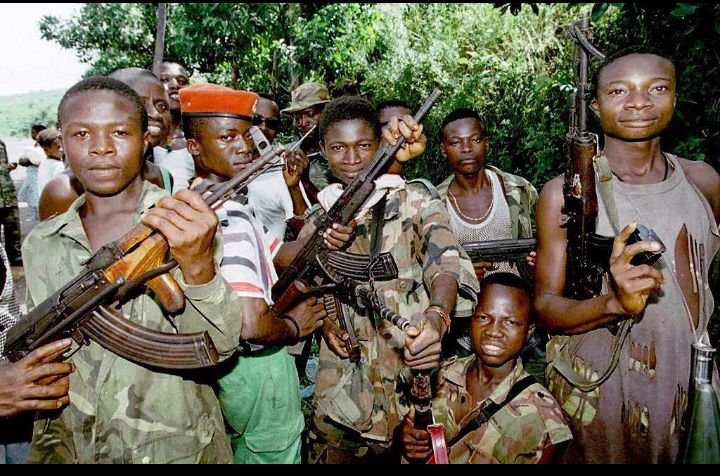
Perhaps the most tragic feature of the conflict was the widespread use of children by armed groups.
Thousands of children were abducted from their homes and communities.
Some were forced to carry weapons. Others served as messengers, porters, labourers or were forced to work in diamond-mining areas.
The Sierra Leone Truth and Reconciliation Commission documented the forcible recruitment of children by several armed factions, including the RUF, Armed Forces Revolutionary Council, Sierra Leone Army and some Civil Defence Forces.
The RUF established units known as the Small Boys Units and Small Girls Units.
Children were particularly vulnerable because they could be intimidated and controlled more easily than adults.
Some abducted children were subjected to violence and forced to participate in atrocities against their own communities.
Girls suffered additional abuses, including sexual slavery and forced domestic labour.
A United Nations official reported in 1999 that more than 10,000 children had been serving with various fighting groups, while thousands more had been abducted.
The war effectively stole childhood from an entire generation.
The 1997 Coup
The conflict became even more complicated in 1997 when soldiers of the Sierra Leone Army overthrew President Ahmad Tejan Kabbah.
The military junta, known as the Armed Forces Revolutionary Council (AFRC), subsequently formed an alliance with the RUF.
This alliance brought the rebels even closer to the country’s political centre.
Regional forces under the Economic Community of West African States (ECOWAS), particularly ECOMOG, intervened to restore Kabbah’s government.
The struggle continued.
The Horrors of Freetown
One of the most devastating episodes occurred in January 1999, when RUF and AFRC forces launched a major assault on Freetown.
The capital descended into chaos.
Civilians were killed, abducted and mutilated. Thousands of people fled their homes.
Children were among the victims.
The scale of the violence shocked the international community and demonstrated that the conflict was no longer simply a rural insurgency.
It had reached the heart of the country.
The Lomé Peace Agreement
After years of fighting, negotiations produced the Lomé Peace Agreement in July 1999.
The agreement attempted to end the conflict and provided for the disarmament and reintegration of combatants.
It also established the framework for a Truth and Reconciliation Commission to investigate the abuses committed during the war.
But peace remained fragile.
In 2000, the RUF resumed hostilities and even abducted hundreds of United Nations peacekeepers, creating a major crisis for the international peacekeeping operation.
The international response eventually strengthened.
British forces intervened to help stabilize the situation, while the United Nations increased its peacekeeping presence.
The End of the War
The United Nations Mission in Sierra Leone, known as UNAMSIL, played a major role in the final stages of the conflict.
Its mission included monitoring the ceasefire, assisting with disarmament and helping rebuild state institutions.
By early 2002, UNAMSIL had disarmed and demobilized more than 75,000 former combatants, including child soldiers. Sierra Leone’s government formally declared the war over in 2002.
The conflict had lasted roughly eleven years.
But ending the fighting did not immediately end the consequences.
Thousands of people had been killed, countless others had been injured or mutilated, and millions had been displaced.
Children who had spent years in armed groups faced enormous difficulties returning to ordinary life.
Between 2001 and 2002, a major disarmament and reintegration programme released more than 6,500 children from armed forces and groups.
Remembering the Victims
In the aftermath of the war, Sierra Leone established a Truth and Reconciliation Commission to document the conflict and help the country confront its past.
The Commission examined killings, torture, rape, mutilation, forced labour, sexual slavery, child recruitment and other abuses.
Its findings emphasized that the war could not be explained simply by diamonds.
Years of corruption, political exclusion, weak institutions and poor governance had created a society vulnerable to violent rebellion. Diamonds then became a powerful resource for sustaining the conflict.
The story of Sierra Leone is therefore not simply the story of diamonds.
It is the story of a country whose political and social institutions weakened until violence became possible, and of how a valuable natural resource helped turn that violence into a prolonged nightmare.
A Dark Chapter in African History
The Sierra Leone Civil War remains one of the darkest chapters in modern African history.
It showed how natural resources can become instruments of war when institutions are weak and armed groups are able to exploit them.
It also revealed the devastating consequences of using children as weapons.
The phrase “blood diamonds” became internationally recognized because of Sierra Leone, but behind those diamonds were real people: families driven from their homes, children forced into combat, communities destroyed and survivors left to rebuild their lives.
Today, Sierra Leone’s history stands as both a warning and a testament to recovery.
The war ended in 2002, but its memory remains deeply embedded in the country’s national history.
For the generations who survived it, the diamonds were never simply stones.
The Historabase Editorial Team is dedicated to exploring and sharing the stories that have shaped Africa and the wider world. Our work covers African history, ancient civilizations, empires, historical figures, wars, cultures, political movements, and important events from the past.
We aim to present history in a clear, engaging, and accessible way, combining historical records with careful research to help readers better understand the people, events, and civilizations that shaped our world.





One Comment