Every time the Nigerian flag flies, its simple green-and-white design represents one of the most recognisable symbols of the country.
But who designed Nigeria’s flag?
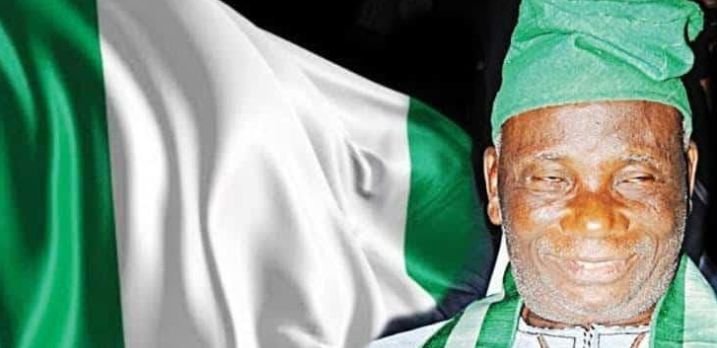
The answer is Michael Taiwo Akinkunmi, a young Nigerian student whose design was selected in a national competition in 1959, just one year before Nigeria gained independence.
His story is remarkable, not only because he created Nigeria’s national flag, but because he did so while studying thousands of kilometres away from home.
Who Was Michael Taiwo Akinkunmi?
Michael Taiwo Akinkunmi was born in Ibadan, Nigeria, in 1936.
He later travelled to the United Kingdom to study at Norwood Technical College in London, where he studied electrical engineering.
While in Britain, Akinkunmi came across an advertisement for a competition to design a new national flag for Nigeria.
Nigeria was approaching independence, and the country needed a flag that could represent the emerging nation.
According to accounts of the story, Akinkunmi was inspired while looking through a magazine and developed his design for the competition.
His original proposal consisted of three vertical sections.
The central section contained a red sunburst, while the two outer sections were green.
The green represented agriculture and Nigeria’s natural wealth, while the white represented peace.
His design was eventually selected from numerous submissions.
However, the flag Nigerians know today is slightly different from Akinkunmi’s original design.
The Red Sun Was Removed
The original design included a red sun in the centre.
When the competition-winning design was reviewed, the sun was removed.
What remained was the now-famous green-white-green vertical tricolour.
The final design consists of three equal vertical panels:
Green | White | Green
The flag’s simplicity made it easy to reproduce and instantly recognisable.
Why Green and White?
The colours have become deeply associated with Nigeria.
The green is commonly understood to represent Nigeria’s agricultural wealth and natural resources.
The white represents peace and unity.
This symbolism was particularly appropriate for a country preparing to become independent after decades of British colonial rule.
Nigeria needed a national symbol that could represent its diverse peoples and its hopes for the future.
When Was the Nigerian Flag First Officially Used?
Nigeria became independent from Britain on 1 October 1960.
The new national flag was raised during the independence celebrations, replacing the British colonial flag.
For millions of Nigerians, this was a powerful moment.
The raising of the green-white-green flag represented the birth of an independent Nigerian state.
The flag quickly became a symbol of Nigerian sovereignty, identity and national pride.
Did Akinkunmi Become Famous Immediately?
Not exactly.
Although his design won the competition, Akinkunmi did not initially become a household name.
Over the decades, however, his contribution became increasingly recognised.
He became popularly known as “Mr. Flag Man.”
The Nigerian government later honoured him for his contribution to the country.
In 2014, President Goodluck Jonathan reportedly granted him a lifetime salary equivalent to that of a presidential special assistant, recognising his contribution to Nigeria.
Akinkunmi lived long enough to see the flag he designed become one of the country’s most important national symbols.
He died on 29 August 2023, at the age of 87.
More Than Just a Flag
The Nigerian flag has witnessed some of the most important moments in the country’s history.
It has flown during independence celebrations, military coups, political transitions, sporting victories, national tragedies and major international events.
It has also become an important symbol for Nigerians living outside the country.
From football jerseys to national celebrations, the green-white-green is instantly associated with Nigeria.
Yet behind the familiar colours is the story of a young Nigerian student who entered a competition and produced a design that would eventually become a permanent part of the country’s identity.
The Legacy of Michael Taiwo Akinkunmi
Michael Taiwo Akinkunmi’s story is an unusual part of Nigeria’s independence history.
He was not a politician, military officer or nationalist leader.
He was a young engineering student who submitted an idea for a national symbol.
His design was chosen at a crucial moment in Nigerian history, and although the original design was modified, its central concept survived.
Today, whenever the Nigerian flag is raised, it carries a piece of his legacy.
The Nigerian Flag at a Glance
Designer: Michael Taiwo Akinkunmi
Year designed: 1959
Original design: Green-white-green with a red sunburst in the centre
Final design: Green-white-green
Independence: 1 October 1960
Meaning: Green is associated with Nigeria’s agricultural/natural wealth; white represents peace and unity.
Conclusion
Nigeria’s flag was not created by a committee of politicians or foreign colonial officials.
It came from the imagination of Michael Taiwo Akinkunmi, a young Nigerian studying in London who entered a competition in 1959.
His original design was modified, but the green-white-green concept remained.
More than six decades later, that design has become one of the most recognisable symbols of Nigeria.
The Historabase Editorial Team is dedicated to exploring and sharing the stories that have shaped Africa and the wider world. Our work covers African history, ancient civilizations, empires, historical figures, wars, cultures, political movements, and important events from the past.
We aim to present history in a clear, engaging, and accessible way, combining historical records with careful research to help readers better understand the people, events, and civilizations that shaped our world.








One Comment