In 1926, Italian writer and poet Filippo Tommaso Marinetti, the founder of the Futurist movement, travelled to South America as part of a highly publicised lecture tour. He arrived not simply as a literary celebrity, but as one of Europe’s most controversial cultural figures, a man whose artistic movement celebrated speed, technology, violence, masculinity and the destruction of the old world.
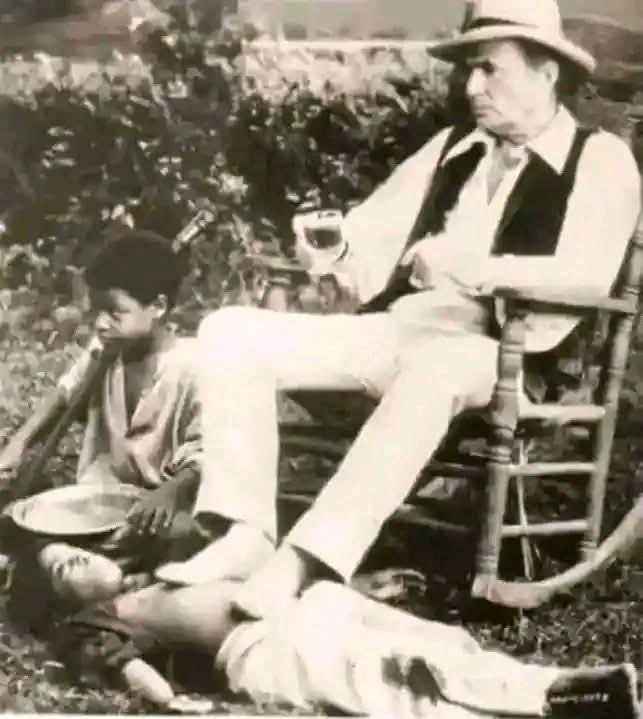
Among the surviving images from his South American tour is a striking photograph that has attracted attention because of its unusual composition. Marinetti sits comfortably in a rocking chair, holding a glass in his hand. At his feet, a young boy holds a plate, while another person is seen lying on the ground.
At first glance, it may appear to be an ordinary photograph documenting a moment of relaxation. Viewed through the historical context of the period, however, the image raises broader questions about race, social hierarchy, colonial culture and the way Europeans were represented when travelling through parts of the Global South.
Who Was Filippo Tommaso Marinetti?
Born in Alexandria, Egypt, in 1876, Marinetti became one of the most influential and controversial figures of the European avant-garde.
In 1909, he published the Futurist Manifesto, announcing the emergence of a movement that rejected many of the cultural traditions of the past. Futurists admired modern technology, machinery, speed, youth and aggressive energy.
Marinetti famously called for the destruction of museums, libraries and other symbols of what he considered an outdated cultural order.
Futurism was not merely an artistic experiment. Over time, its ideas became increasingly intertwined with politics. Marinetti embraced Italian nationalism and became an enthusiastic supporter of Benito Mussolini and Fascism.
By the time of his South American journey in 1926, Marinetti was therefore travelling as both a celebrated European avant-garde intellectual and a prominent supporter of Italian Fascism.
That political identity was impossible to completely separate from his public image.
Marinetti’s 1926 South American Tour
Marinetti arrived in Buenos Aires on June 7, 1926, during a period when Argentina and Brazil were experiencing intense political and cultural debates.
His visit was promoted primarily as a literary and artistic event. He gave lectures and spoke about Futurism, modern art and the future of culture.
But his political affiliations generated controversy.
In Buenos Aires, sections of the press and political community criticised Marinetti’s association with Fascism. The anarchist newspaper La Protesta, for example, mocked him as the “chiflado del futurismo y del fascismo”, roughly, the “lunatic of Futurism and Fascism.”
The avant-garde publication Martín Fierro was more complicated in its response. While recognising Marinetti’s importance to modern artistic culture, it also maintained a distance from his political positions.
His appearances consequently became more than literary events. They were cultural spectacles involving admirers, critics, journalists and political opponents.
The Photograph of Marinetti and the Young Boy
It is within this setting that the famous photograph becomes historically interesting.
The image shows Marinetti reclining in a rocking chair, apparently at ease, with a glass in his hand. A young boy is positioned near his feet holding a plate, while another figure is visible on the ground.
The exact circumstances surrounding the photograph are important. A single historical photograph rarely provides enough evidence to determine precisely what happened immediately before or after the shutter was pressed.
Therefore, it would be misleading to automatically describe the photograph as evidence of an act of physical violence.
What the photograph does provide, however, is evidence of how social relationships and hierarchies could be visually represented.
Marinetti occupies the most comfortable and elevated position in the composition. The young figures are positioned below him, apparently serving or assisting him.
His extended leg and foot make the difference in status particularly noticeable.
Rather than necessarily representing an act of aggression, the posture can be examined as part of the visual culture of the period—one in which European travellers and elites were frequently photographed in positions of comfort and authority while local people appeared as servants, attendants or background figures.
Colonialism and the Language of Photography
Photography in the late 19th and early 20th centuries did more than record events. It could also reproduce the social assumptions of the societies in which the photographs were created.
Across colonial and formerly colonial societies, photographs often placed Europeans in elevated or dominant positions while local populations appeared serving, working or standing behind them.
Such images reflected the unequal political and economic structures of the period.
The important point is that the meaning of an image does not necessarily depend on whether the photographer or subject consciously intended to make a political statement.
A photograph can unintentionally preserve the assumptions of its time.
In Marinetti’s photograph, the contrast is striking: the famous European intellectual is seated comfortably with a drink, while the young boy is positioned near the floor holding a plate.
The image therefore invites questions about who was permitted to occupy space comfortably, who was expected to serve, and whose body was treated as part of the background to another person’s experience.
Futurism and Imperial Ideas
The photograph becomes even more significant when considered alongside Marinetti’s ideology.
Futurism celebrated strength, speed, youth, masculinity and technological power. Its early writings also contained highly aggressive and militaristic language.
Marinetti was not simply fascinated by modern machines. He also embraced Italian nationalism and supported Fascist Italy’s political ambitions.
This connection matters because European modernism did not develop independently from the political realities of its era.
The early 20th century was a period of European imperial expansion. European powers controlled territories across Africa and Asia, while European political and intellectual movements frequently debated ideas of racial hierarchy, national strength and imperial power.
Marinetti’s Futurism emerged from this environment.
Consequently, historians examining Futurism today often look beyond its paintings, manifestos and poems to examine the movement’s relationship with nationalism, militarism, colonialism and Fascism.
South America Was Not Simply a Passive Audience
It is also important not to portray Marinetti’s South American audiences as passive observers.
His visit generated both enthusiasm and opposition.
Some members of the artistic and intellectual community were interested in his revolutionary ideas about art. Others rejected his political beliefs or viewed Fascism with suspicion.
This is an important part of the story because Marinetti’s tour was not simply a European intellectual arriving in an unquestioning foreign environment.
He entered societies with their own political movements, artistic traditions and intellectual debates.
His presence became part of those debates.
What the Photograph Can, and Cannot, Tell Us
Historical photographs can be powerful, but they must be treated carefully.
The image of Marinetti, the young boy and the other figure does not, by itself, prove exactly what Marinetti was thinking or what occurred outside the frame.
Nor can a single photograph establish that the people pictured were deliberately participating in a particular colonial ritual.
What it can demonstrate is the visual hierarchy captured in the moment.
Marinetti is relaxed and seated. The young boy is below him. The arrangement reflects a social relationship in which one person occupies a position of comfort and authority while another appears to be performing a service.
That distinction is historically meaningful.
It also reminds us that photographs can preserve attitudes that were considered ordinary at the time but appear deeply uncomfortable when viewed from the perspective of the present.
A Photograph From an Age of Contradictions
Marinetti’s 1926 South American tour represents a fascinating intersection of art, politics and global history.
He travelled thousands of kilometres promoting a movement that claimed to represent the future. Yet the social world surrounding that movement still contained deeply rooted hierarchies inherited from imperial and colonial societies.
That contradiction is part of what makes the photograph so historically valuable.
Marinetti wanted Futurism to break with the past. But the image also raises questions about how much of the old world remained embedded within the culture of European modernity.
The photograph therefore should not be viewed simply as a strange or shocking picture of a famous writer relaxing abroad.
It is a small visual record from a much larger historical story, one involving European modernism, Fascism, colonial attitudes, social hierarchy and the encounter between European intellectuals and the wider world.
Nearly a century later, the image continues to provoke discussion because it captures something that written manifestos cannot always reveal: the everyday ways in which power, privilege and social status could become visible in ordinary moments.
And that is perhaps the greatest historical lesson of the photograph.
The Historabase Editorial Team is dedicated to exploring and sharing the stories that have shaped Africa and the wider world. Our work covers African history, ancient civilizations, empires, historical figures, wars, cultures, political movements, and important events from the past.
We aim to present history in a clear, engaging, and accessible way, combining historical records with careful research to help readers better understand the people, events, and civilizations that shaped our world.