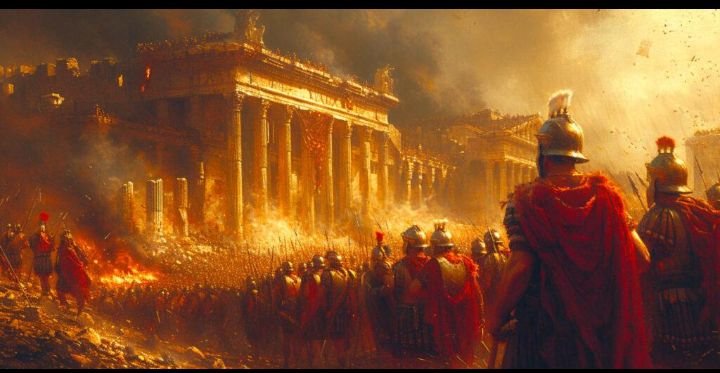
The Battle of Thermopylae, fought in 480 BC, is one of the most famous battles of the ancient world. It has become legendary for the courage of a small Greek force that resisted the enormous Persian army of King Xerxes I at a narrow mountain pass.
At the center of the story were 300 Spartan warriors, led by King Leonidas I. Although the popular version of the battle often focuses entirely on the 300 Spartans, they were not alone. Thousands of other Greek soldiers participated in the defense of Thermopylae, including troops from Thespiae, Thebes, and several other Greek city-states.
The Greeks ultimately lost the battle, but their resistance delayed the Persian advance and became an enduring symbol of military courage, sacrifice, and resistance against overwhelming odds.
Why Did the Battle of Thermopylae Happen?
The Battle of Thermopylae was part of the Greco-Persian Wars, a series of conflicts between the Persian Empire and the Greek city-states.
The conflict had begun years earlier when several Greek cities in Asia Minor rebelled against Persian rule during the Ionian Revolt. Athens supported the rebellion, angering the Persian king Darius I.
In 490 BC, Darius sent a Persian expedition against Greece. The invasion ended with the famous Greek victory at the Battle of Marathon, where Athenian forces defeated the Persian army.
Darius died before launching another major invasion, but his successor, Xerxes I, continued the plan to conquer Greece.
In 480 BC, Xerxes assembled one of the largest invasion forces of the ancient era and marched toward Greece.
The Greek city-states, despite their rivalries, recognized the danger. Athens, Sparta, Corinth, and several other states formed an alliance to resist the Persian invasion.
Why Was Thermopylae Important?
The Greeks needed a defensive position where their smaller army could limit the advantage of the much larger Persian force.
Thermopylae was ideal for this purpose.
The name Thermopylae means “Hot Gates,” referring to the area’s famous hot springs. More importantly, the region contained a narrow passage between steep mountains and the sea.
The restricted terrain meant that the Persians could not easily surround the Greek defenders or use their numerical superiority effectively.
Leonidas and his forces therefore took up positions at the pass while the Greek fleet attempted to block the Persian navy at nearby Artemisium.
The strategy was simple: hold the pass long enough to slow the Persian advance and give the Greek forces time to organize their wider defense.
Who Was King Leonidas?
Leonidas I was one of Sparta’s two kings and belonged to the Agiad royal dynasty.
Sparta was famous throughout ancient Greece for its military culture. Spartan male citizens underwent a rigorous education and training system known as the agoge, which prepared them for military service.
Leonidas was chosen to lead the Spartan force sent to Thermopylae.
According to ancient accounts, the Spartans were also influenced by religious considerations. The timing of the Persian invasion coincided with the Carneia, a major Spartan religious festival during which certain military activities were restricted.
As a result, Sparta initially sent only a relatively small force of 300 Spartan citizens with Leonidas, while a larger Greek force gathered at Thermopylae.
The 300 Spartans
The most famous part of the story is the 300 Spartans.
These were not ordinary soldiers randomly selected for the mission. They were experienced Spartan warriors and members of the citizen elite.
Leonidas reportedly selected men who had living sons, ensuring that their families would not leave Sparta without descendants if they died.
However, it is important to correct a common misconception: the 300 Spartans were not the only Greek soldiers at Thermopylae.
Ancient sources describe a larger Greek force made up of contingents from different city-states.
Among them were approximately 700 Thespians, who became particularly notable because they chose to remain and fight alongside Leonidas during the final phase of the battle.
There were also Theban troops and soldiers from several other Greek communities.
The exact numbers involved remain debated by historians, particularly because ancient sources sometimes provide figures that are difficult to verify.
The Persian Army Arrives
Xerxes’ army eventually reached Thermopylae.
Ancient Greek historian Herodotus gives enormous figures for the Persian forces, but modern historians generally consider the largest ancient estimates exaggerated.
The Persian army was nevertheless vastly larger than the Greek force.
Xerxes reportedly expected the Greeks to surrender or retreat when confronted by such overwhelming numbers.
Instead, Leonidas and his allies held their position.
The narrow battlefield prevented the Persians from deploying their entire army at once.
This gave the heavily armed Greek hoplites a significant defensive advantage.
Greek Hoplites vs. Persian Soldiers
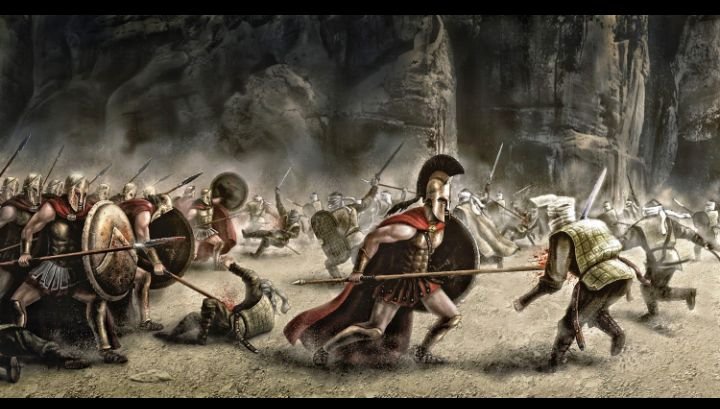
The Greeks fought primarily as hoplites, heavily armed infantrymen who carried large round shields and fought with spears and swords.
Their greatest advantage was the phalanx formation.
The soldiers stood close together, overlapping their shields and presenting a wall of defensive protection to the enemy.
The Persians had a more diverse army, including infantry, archers, cavalry, and troops from many different regions of the empire.
Although the Persian forces were highly organized and experienced, their light infantry was at a disadvantage when attacking heavily armed Greek hoplites in such a confined space.
The terrain at Thermopylae therefore helped neutralize some of the Persian army’s numerical superiority.
The First Persian Attacks
Xerxes initially waited, apparently expecting the Greeks to withdraw.
When they refused, he ordered attacks against them.
The Persian soldiers advanced toward the Greek line, but the narrow passage prevented them from overwhelming the defenders.
The Greeks held their formation and inflicted heavy casualties on the attacking troops.
Persian units, including the famous Immortals, were also committed to the fighting.
Despite their reputation, they struggled to break through the Greek defensive position.
The first day of fighting demonstrated the difficulty of attacking the Greek force directly.
The Persians had the numbers, but Thermopylae prevented them from using those numbers effectively.
The Betrayal That Changed the Battle
The Greek position might have held much longer if not for a local Greek named Ephialtes.
According to Herodotus, Ephialtes revealed to the Persians the existence of a mountain path that led around the main Greek defensive position.
The path allowed Persian troops to move behind the Greek army.
This was a disaster for Leonidas.
The Greeks could no longer safely remain at the pass because they risked being surrounded.
When Leonidas learned that the Persians were approaching from behind, he made the decision to remain with a smaller force while many of the other Greek troops withdrew.
The exact circumstances of the withdrawal and Leonidas’ decisions remain subjects of historical discussion.
The Final Stand
On the final day, Leonidas and his remaining troops prepared for their last battle.
The surviving force included the 300 Spartans, the Thespian contingent, and Theban soldiers, although the precise composition and numbers are debated.
Rather than simply waiting to be surrounded, the Greeks moved forward to fight the Persians more aggressively.
Leonidas was eventually killed in the fighting.
The Greeks fought desperately to protect his body, and the battle became increasingly brutal.
After Leonidas’ death, the remaining defenders withdrew to a smaller position.
Eventually, the Persians surrounded them.
The Greek resistance was finally crushed.
Thermopylae had fallen.
How Did the Spartans Lose?
The Spartans did not lose because they were simply weaker soldiers.
Their position had become strategically impossible after the Persian forces discovered the mountain path.
Once the Persians could attack from both the front and rear, the Greek defenders were effectively trapped.
The battle demonstrates an important military principle: even a superior defensive position can become vulnerable when the enemy finds a way around it.
The Greeks had successfully used the terrain to counter Persian numbers, but the discovery of the mountain route removed that advantage.
Was the Battle a Persian Victory?
Technically, yes.
The Persian army captured Thermopylae and continued its advance into central Greece.
However, the battle had consequences far beyond the battlefield.
The Greek resistance demonstrated that the Persian army could be challenged and slowed.
The fighting also bought valuable time for the Greek alliance to prepare its next defensive moves.
The Persian advance continued south, and Athens was eventually evacuated and occupied.
But the war was far from over.
What Happened After Thermopylae?
The Persian victory at Thermopylae was followed by major developments in the war.
The Greek fleet fought the Persian navy at the Battle of Salamis, where the Greeks achieved a decisive naval victory.
The Persian army later suffered another major defeat at the Battle of Plataea in 479 BC.
Together, these Greek victories eventually ended Xerxes’ invasion of Greece.
Thermopylae was therefore not the battle that defeated Persia.
Instead, it was one part of a much larger military campaign.
Why Is Thermopylae So Famous?
The fame of Thermopylae comes from the dramatic contrast between the small Greek force and the much larger Persian army.
The story of Leonidas and the 300 Spartans became particularly powerful because they knowingly faced almost certain death.
Their sacrifice was later celebrated as an example of courage and loyalty.
Ancient Greek writers, especially Herodotus, helped preserve the memory of the battle.
Over centuries, Thermopylae became more than a historical event. It became a symbol.
The battle has been interpreted as a story about courage in the face of overwhelming odds, defending one’s homeland, and choosing resistance rather than surrender.
The Role of the Thespians
One of the most overlooked aspects of Thermopylae is the role of the Thespians.
Popular culture often presents the final stand as exclusively a Spartan sacrifice.
In reality, approximately 700 Thespians are traditionally said to have remained with Leonidas.
Their decision to stay was extraordinary because they were not bound by the same political circumstances as the Spartans.
Their sacrifice has sometimes been overshadowed by the fame of the 300.
Modern historical discussions increasingly emphasize that Thermopylae was a collective Greek effort rather than simply a Spartan story.
The Legacy of the Battle
The legacy of Thermopylae has survived for more than two thousand years.
The battle has inspired military leaders, historians, writers, filmmakers, and political movements.
Leonidas became one of the most recognizable figures of ancient Greek history, while the phrase “300 Spartans” became synonymous with heroic resistance against impossible odds.
However, the real history is more complex than the popular legend.
The Persian army was not simply a massive, disorganized mob, and the Greeks were not represented only by 300 Spartans.
Thermopylae was a carefully chosen defensive position, supported by a broader Greek military strategy.
Its outcome was determined not only by courage but also by geography, intelligence, military organization, and strategic decisions.
Conclusion
The Battle of Thermopylae was a Persian victory on the battlefield, but its historical significance extends far beyond the final defeat of Leonidas and his men.
In 480 BC, a relatively small Greek force used the narrow terrain of Thermopylae to hold back a vastly larger Persian army. The 300 Spartans became the most famous symbol of the resistance, but they fought alongside thousands of other Greek soldiers, including the courageous Thespians.
Leonidas and his men were ultimately defeated after the Persians discovered a mountain route that allowed them to outflank the Greek position.
The Historabase Editorial Team is dedicated to exploring and sharing the stories that have shaped Africa and the wider world. Our work covers African history, ancient civilizations, empires, historical figures, wars, cultures, political movements, and important events from the past.
We aim to present history in a clear, engaging, and accessible way, combining historical records with careful research to help readers better understand the people, events, and civilizations that shaped our world.