In the history of Nigerian Christianity, few names are as closely associated with revival, divine healing and extraordinary religious claims as Joseph Ayodele Babalola.
Born in 1904, Babalola became the central figure in one of the most remarkable Christian revivals Nigeria had witnessed. His preaching attracted enormous crowds, while reports of healings, visions and other miracles spread rapidly across southwestern Nigeria.
But Babalola’s story was more than a story of miracles.
It was also a story of colonial Nigeria, indigenous Christianity, religious independence and the emergence of one of the country’s most influential Pentecostal movements.
From Steamroller Driver to Preacher
Joseph Ayodele Babalola was born on 25 April 1904 at Odo-Owa in present-day Kwara State. He grew up in a Christian family connected with the Anglican Church.
After leaving school, Babalola eventually became a worker with the colonial Public Works Department, where he operated a steamroller.
His life reportedly changed dramatically in 1928.
According to accounts preserved by the Christ Apostolic Church and historical biographies, Babalola experienced a religious vision while working with his steamroller. He believed that Jesus Christ was calling him to abandon his occupation and preach the gospel.
His decision initially brought suspicion. Some people reportedly considered his behaviour unusual, and historical accounts say he was even briefly imprisoned.
Eventually, however, he became associated with the Faith Tabernacle, an indigenous Christian movement that emphasized prayer, fasting, visions and divine healing.
This would become the beginning of something much larger.
The Oke-Oye Revival of 1930
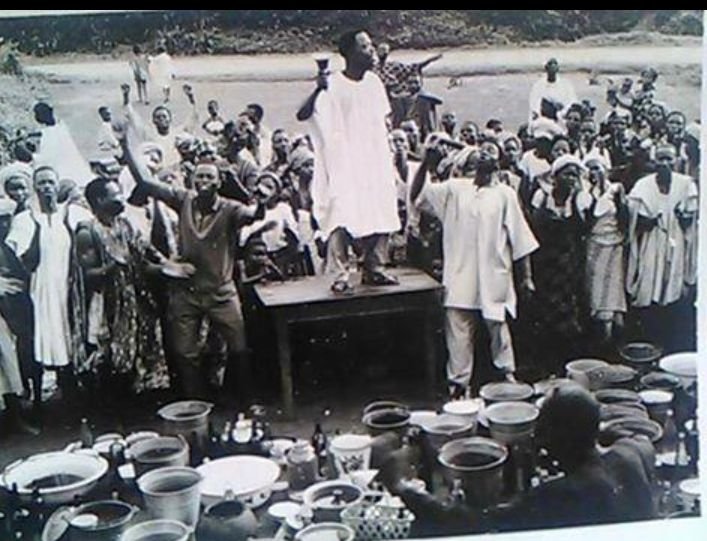
The defining moment of Babalola’s ministry came in 1930 at Oke-Oye, Ilesa, in present-day Osun State.
At the time, the Faith Tabernacle movement was already active in Nigeria. Its members emphasized intense prayer and believed strongly in God’s ability to heal people without relying solely on conventional medicine.
Babalola arrived at Oke-Oye during a period of disagreement and uncertainty within the movement.
What happened next transformed Nigerian religious history.
Babalola began preaching repentance, prayer and the Christian faith. Reports of extraordinary healings spread rapidly, attracting people from surrounding towns and eventually from much farther away.
The Christ Apostolic Church’s historical account describes thousands of people as having been healed during the revival. The Dictionary of African Christian Biography likewise records Babalola’s healing ministry and describes the Oke-Oye revival as unprecedented in its impact.
The revival quickly became a phenomenon.
Crowds gathered to hear the young preacher.
People brought the sick.
Others came seeking prayer.
Traditional religious practitioners and converts also became part of the movement’s story.
The Reported Miracle That Changed Everything
Among the most famous stories connected with the revival is an account of Babalola praying for a dead person who was subsequently said to have come back to life.
Different accounts give different details about this incident, and historians should therefore treat the resurrection claim as a reported miracle rather than independently verified medical fact.
Nevertheless, the story became extremely influential within the movement.
According to a historical account preserved by the Christ Apostolic Church, the incident occurred during the Oke-Oye gathering and contributed to the dramatic expansion of the revival.
Whether one accepts the supernatural interpretation or not, there is little doubt that stories of miraculous healings and extraordinary religious experiences helped attract enormous numbers of people.
The stories themselves became part of the revival’s power.
Thousands Came Looking for Healing
Babalola’s reputation spread rapidly.
People travelled considerable distances to attend his meetings. His message combined preaching with prayer, fasting and claims of divine healing.
The revival also challenged traditional religious practices.
Babalola preached against idolatry and encouraged converts to abandon traditional religious objects and practices that he considered incompatible with Christianity.
According to accounts from the period and later church histories, people reportedly destroyed or abandoned objects associated with traditional worship.
The revival therefore affected not only individual believers but entire communities.
It became a religious and cultural transformation.
Why Was Babalola So Different?
Babalola’s significance cannot be understood simply by describing him as a miracle worker.
He represented something much bigger: indigenous African Christianity.
At the time, Christianity in Nigeria was heavily associated with European missionary organizations.
Babalola and other Aladura leaders demonstrated that African Christians could create powerful religious movements with their own leadership, worship styles and spiritual traditions.
Their Christianity placed extraordinary emphasis on prayer, fasting, visions, prophecy and divine healing.
This appealed strongly to many Nigerians living under colonial rule.
It also helped establish a distinctly Nigerian expression of Pentecostal Christianity.
The Colonial Authorities Became Concerned
The enormous popularity of the movement did not go unnoticed by colonial authorities.
Historical sources indicate that British officials became concerned about the growing influence of Aladura leaders.
Babalola himself encountered legal trouble.
One historical biography records that he was imprisoned in 1932 after being charged in connection with a witch-eradication ordeal. He was reportedly released after approximately six months.
The incident demonstrates the complicated environment in which Babalola operated.
His movement was religious, but its rapid growth inevitably affected traditional authority, established churches and colonial institutions.
From Revival to Church
The movement surrounding Babalola did not disappear after the revival.
Instead, it evolved.
The Faith Tabernacle initially developed connections with international Pentecostal organizations. But disagreements eventually emerged over issues including doctrine, divine healing and the direction of the movement.
These disputes contributed to divisions within the movement.
Eventually, Babalola became one of the major figures associated with the formation of the Christ Apostolic Church (CAC).
It is important, however, not to describe Babalola as the sole founder of CAC.
Historical sources identify several important figures in the church’s development, including D. O. Odubanjo, Isaac B. Akinyele, Joseph Sadare and Sophia Odunlami. Babalola was one of the central figures whose revival ministry helped shape the movement that became CAC.
A Revival That Changed Nigerian Christianity
The impact of the 1930 revival extended far beyond Ilesa.
Babalola travelled and preached in different parts of Nigeria. His influence spread through Yoruba communities and beyond, while other revivalists inspired by the movement developed their own ministries.
The Aladura movement became one of the major expressions of indigenous Christianity in West Africa.
Prayer meetings multiplied.
Healing services became prominent.
Fasting and spiritual visions became important elements of worship.
The revival also demonstrated that a Nigerian preacher could attract crowds on a scale that rivalled or exceeded many established missionary organizations.
That was a significant development in colonial Nigeria.
Miracle or Historical Belief?
This question is important when telling Babalola’s story today.
There are numerous historical accounts of people who believed they were healed during his ministry. There are also stories of visions, prophecies and supernatural events.
But historical documentation of a reported miracle is not the same thing as scientific proof that a supernatural event occurred.
For example, the story of a person allegedly being raised from the dead is preserved in church traditions, but historians cannot simply present it as medically proven fact.
The responsible historical approach is to say:
Babalola’s followers reported miracles, and those reports played a major role in the growth of his movement.
That distinction allows us to appreciate both the religious significance and the historical evidence.
His Final Years
Babalola continued his religious work for decades after the great revival.
He remained an influential figure within the developing Christ Apostolic Church and its healing and evangelistic tradition.
He died on 26 July 1959, aged 55.
But his movement did not die with him.
The Christ Apostolic Church continued to expand, eventually becoming one of Nigeria’s major indigenous Christian denominations.
Babalola’s name became permanently connected with the Oke-Oye revival and the history of Nigerian Pentecostalism.
The Legacy of Joseph Ayo Babalola
Nearly a century after the 1930 revival, Joseph Ayo Babalola remains an extraordinary figure in Nigerian religious history.
His story brings together several important chapters of Nigeria’s past:
Colonialism.
Christianity.
Traditional religion.
Indigenous religious movements.
Divine healing.
Prophecy.
Mass revival.
And the struggle for African religious identity.
Whether someone regards his reported miracles as genuine supernatural events, religious testimonies, or stories shaped by the beliefs of his followers, their historical impact is undeniable.
Babalola’s preaching helped ignite a movement that transformed thousands of lives and contributed to the emergence of one of Nigeria’s most important indigenous churches.
The Historabase Editorial Team is dedicated to exploring and sharing the stories that have shaped Africa and the wider world. Our work covers African history, ancient civilizations, empires, historical figures, wars, cultures, political movements, and important events from the past.
We aim to present history in a clear, engaging, and accessible way, combining historical records with careful research to help readers better understand the people, events, and civilizations that shaped our world.






One Comment