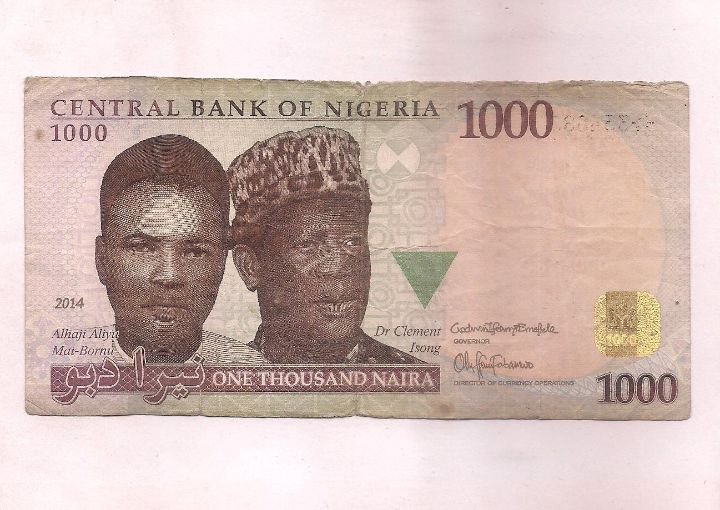
For many Nigerians, the ₦1,000 note is simply one of the highest-value banknotes they carry. But the two men whose portraits appear on it represent an important chapter in the history of Nigeria’s financial system.
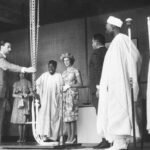
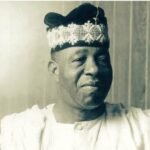
The faces are those of Alhaji Aliyu Mai-Bornu, Nigeria’s first indigenous Governor of the Central Bank of Nigeria (CBN), and Dr. Clement Nyong Isong, the governor who succeeded him and later became a civilian governor of Cross River State.
Their appearance on the ₦1,000 note is not accidental. Both men played significant roles in building and managing Nigeria’s central banking system during its formative years.
Alhaji Aliyu Mai-Bornu: From Teacher to Nigeria’s First Indigenous CBN Governor
Aliyu Mai-Bornu was born in 1919 and began his education in Yola. He later attended Kaduna College, graduating in 1942 as a qualified English-language teacher.
He initially built his career in education, teaching at Yola Middle School and Kaduna College. In 1954, he moved to the Veterinary School in Vom as a House Tutor before travelling to the United Kingdom to study Economics at the University of Bristol.
He graduated in 1957 and returned to Nigeria, where he joined the Northern Nigeria Public Service as an administrative officer.
His career took a major turn in 1959.
That year, Nigeria’s newly established Central Bank began operations, and Mai-Bornu was seconded to the institution as an Assistant Secretary. He rose through several positions, becoming Deputy Secretary and then Secretary.
In 1962, he became the first Nigerian appointed Deputy Governor of the Central Bank.
The following year, on 25 July 1963, he made history again when he became the first indigenous Governor of the Central Bank of Nigeria.
He remained in the position until 1967.
His appointment was significant because the CBN was still a relatively young institution. It had only begun full operations in 1959, following the Central Bank Act of 1958.
Mai-Bornu was therefore part of the generation of Nigerians who helped establish the country’s monetary and banking institutions after independence.
What Happened After the CBN?
After leaving the Central Bank in 1967, Mai-Bornu became Director and General Manager of the Nigerian Tobacco Company.
He resigned from the company’s management in 1969 but remained on its board.
He died on 23 February 1970, aged 50.
His legacy, however, continued through the institution he helped lead.
Today, his portrait appears on Nigeria’s ₦1,000 banknote alongside that of another former CBN governor who followed him.
Dr. Clement Nyong Isong: The Economist Who Led the CBN Through War
The other face on the ₦1,000 note belongs to Dr. Clement Nyong Isong.
Born on 20 April 1920 in what is now Akwa Ibom State, Isong followed a very different educational path from Mai-Bornu.
He studied at University College, Ibadan, before travelling to the United States, where he studied Economics at Iowa Wesleyan College. He subsequently obtained postgraduate degrees in Economics at Harvard University.
After completing his studies, Isong worked as an Assistant Economist at the Federal Reserve Bank in New York before returning to Nigeria, where he lectured in Banking and Economics at the University of Ibadan.
In 1958, as Nigeria prepared for independence, he joined the newly established Central Bank of Nigeria.
He first served as Secretary and later became Director of Research.
His expertise eventually took him outside Nigeria. In 1962, he joined the International Monetary Fund (IMF), where he served in several capacities, including International Adviser for Africa.
Leading Nigeria’s Central Bank During the Civil War
In August 1967, Isong returned to Nigeria to become Governor of the Central Bank.
The timing could hardly have been more difficult.
The Nigerian Civil War had begun only weeks earlier, placing enormous pressure on the country’s economy and financial system.
Isong served as CBN governor throughout the Civil War, which lasted from 1967 to 1970, and remained in office until September 1975. The CBN describes his tenure as spanning both the war and the subsequent oil boom.
His period as governor therefore covered one of the most turbulent and transformative periods in Nigeria’s economic history.
He also presided over the transition from Nigeria’s old currency system to the naira and kobo.
In 1973, Nigeria replaced the pound system with the naira as its major currency unit. One naira was equivalent to ten shillings, while 100 kobo made one naira.
This was a major moment in Nigeria’s economic history, and Isong was at the head of the country’s central bank during the transition.
From Central Banker to Governor of Cross River State
Isong retired from the CBN in 1975, but his public career was far from over.
Four years later, he entered electoral politics.
In 1979, he became the first democratically elected Governor of the old Cross River State, serving during Nigeria’s Second Republic from 1979 to 1983.
His career therefore crossed two very different worlds: central banking and partisan politics.
In 1982, he was awarded the national honour of Commander of the Federal Republic (CFR).
He died in 2000.
Why Are Both Men on the ₦1,000 Note?
The ₦1,000 note was introduced in October 2005, becoming Nigeria’s highest denomination at the time.
The decision to feature Mai-Bornu and Isong reflects their contribution to the development of Nigeria’s monetary and financial institutions.
The Central Bank itself lists both men among the heroes and heroines represented on Nigerian currency. It specifically describes Mai-Bornu as the first indigenous CBN governor and identifies Isong as the governor who led the institution during the Civil War and oil boom.
Their pairing on the same note is also historically appropriate.
Mai-Bornu came first. Isong succeeded him.
One helped establish the tradition of Nigerian leadership at the Central Bank, while the other took charge during a period of war, economic disruption, currency transition and rapid economic change.
Together, their portraits represent two important generations of Nigeria’s early central banking history.
The ₦1,000 Note Is More Than Money
There is another interesting aspect of Nigerian currency: banknotes are designed to communicate more than monetary value.
According to the CBN, Nigerian currency incorporates images connected to culture, agriculture, mineral resources, national heroes and heroines, as well as security features.
The ₦1,000 note therefore carries a piece of institutional history.
Every time the note changes hands, the portraits of two men who helped shape Nigeria’s monetary system travel with it.
Mai-Bornu’s journey, from teacher to economist and eventually Nigeria’s first indigenous CBN governor, reflects the emergence of Nigerian professionals into leadership positions after colonial rule.
The Historabase Editorial Team is dedicated to exploring and sharing the stories that have shaped Africa and the wider world. Our work covers African history, ancient civilizations, empires, historical figures, wars, cultures, political movements, and important events from the past.
We aim to present history in a clear, engaging, and accessible way, combining historical records with careful research to help readers better understand the people, events, and civilizations that shaped our world.