The Roman Empire was one of the most powerful and influential civilizations in world history. At its height, Rome controlled vast territories across Europe, North Africa and the Middle East, connecting different peoples through roads, trade, law, military power and administration.
Rome did not become a superpower overnight. Its rise took centuries, beginning with a small settlement that grew into a republic and eventually became an enormous empire.
Its fall was equally complex.
The Roman Empire did not simply collapse because of one battle, one emperor or one invading army. Instead, political instability, economic problems, military pressures, civil wars, administrative difficulties and external invasions gradually weakened the Western Roman Empire.
Yet Rome never completely disappeared.
Its laws, language, architecture, political ideas, engineering and culture continued to influence Europe and much of the world long after the Western Empire ceased to exist.
The Origins of Rome
According to Roman tradition, Rome was founded in 753 BCE by the legendary brothers Romulus and Remus.
The historical origins of Rome were more complicated.
Archaeological evidence indicates that settlements existed in the area around Rome before the traditional foundation date. The city developed near the Tiber River in central Italy, a location that provided access to trade routes and agricultural land.
Rome was initially ruled by kings.
According to Roman tradition, the monarchy ended in 509 BCE, when Romans established a republic.
The Roman Republic would eventually become the foundation for Rome’s expansion across the Mediterranean.
The Roman Republic
During the Roman Republic, Rome developed a political system involving elected officials, assemblies and the Senate.
Roman society was divided into different social groups, including powerful patrician families and the broader population known as plebeians.
Political struggles between these groups gradually resulted in reforms that gave ordinary Roman citizens greater political rights.
At the same time, Rome developed one of the most effective military systems of the ancient world.
The Roman army played a central role in expanding Roman territory.
Rome’s Expansion Across Italy
Rome first concentrated on conquering and securing the Italian peninsula.
Through a combination of military campaigns, alliances and political arrangements, Rome gradually gained control over much of Italy.
Roman expansion brought Rome into conflict with other powerful states.
One of its most famous opponents was Carthage, a wealthy North African power with territories and interests across the western Mediterranean.
The rivalry between Rome and Carthage eventually produced the Punic Wars.
The Punic Wars
The Punic Wars were a series of three major conflicts fought between Rome and Carthage.
The most famous figure associated with these wars was Hannibal, the brilliant Carthaginian general who famously crossed the Alps with an army that included war elephants.
Hannibal defeated Roman forces in several major battles.
However, Rome refused to surrender.
The Romans eventually recovered and carried the war to Carthaginian territory. Roman general Scipio Africanus defeated Hannibal at the Battle of Zama in 202 BCE.
Rome’s victory dramatically increased its power.
After the Third Punic War, Carthage was destroyed in 146 BCE.
Rome had become the dominant power in the western Mediterranean.
Rome Becomes a Mediterranean Superpower
Roman expansion continued.
Rome conquered territories in places including Spain, Greece, North Africa and parts of the eastern Mediterranean.
But expansion brought new problems.
The Republic had been designed to govern a relatively small city-state and its surrounding territory. Rome was now controlling enormous lands inhabited by millions of people.
Wealth from conquest flowed into Rome, but the benefits were not distributed equally.
Large landowners became increasingly powerful, while many small farmers struggled.
Enslaved people were brought into Roman territories in enormous numbers, providing labor for agriculture, households and other economic activities.
These social and economic changes contributed to growing political tensions.
Julius Caesar and the Crisis of the Republic
One of the most important figures in Rome’s transformation was Julius Caesar.
Caesar was a successful military commander who gained enormous popularity and political influence.
He became part of a political alliance known as the First Triumvirate, alongside Pompey and Crassus.
The alliance eventually collapsed.
Caesar’s military successes in Gaul made him extremely powerful. When the Senate ordered him to give up his command, Caesar refused.
In 49 BCE, he crossed the Rubicon River with his army, beginning a civil war.
Caesar eventually defeated his political opponents and became the dominant political figure in Rome.
He introduced a series of reforms and was eventually appointed dictator for life.
However, many Roman senators feared that Caesar was destroying the Republic and attempting to become a king.
On March 15, 44 BCE, known as the Ides of March, Caesar was assassinated by a group of senators.
His assassination did not restore the Republic.
Instead, Rome entered another period of civil war.
The Rise of Augustus
Following Caesar’s assassination, political and military struggles continued.
Eventually, Octavian, Caesar’s adopted heir, defeated his rivals.
In 31 BCE, Octavian’s forces defeated those of Mark Antony and Cleopatra at the Battle of Actium.
Octavian became the undisputed ruler of Rome.
In 27 BCE, he received the title Augustus.
This marked the beginning of the Roman Empire in the traditional historical sense.
Augustus carefully maintained the appearance of Republican institutions while concentrating enormous political power in his own hands.
He became the first Roman emperor.
The Roman Empire at Its Height
Under Augustus and his successors, Rome entered a period of enormous expansion and relative stability.
The empire eventually stretched across three continents.
At its greatest extent, Roman territory included much of:
– Southern and Western Europe
– The Balkans
– North Africa
– Egypt
– Asia Minor
– The Levant
– Parts of Mesopotamia
Rome connected these territories through an enormous network of roads, ports and trade routes.
The Mediterranean effectively became the center of a vast imperial economic system.
Romans called the Mediterranean Mare Nostrum, meaning “Our Sea.”
The Pax Romana
The first and second centuries CE are often associated with the Pax Romana, meaning “Roman Peace.”
This was not a period without warfare. Rome continued fighting wars along its borders and suppressing rebellions
However, large parts of the empire experienced extended periods of relative political stability.
This stability encouraged trade, urban development and cultural exchange.
Cities expanded.
Roads connected distant provinces.
Merchants moved goods across the Mediterranean.
Roman law and administrative practices spread throughout the empire.
Roman Engineering and Infrastructure
One of Rome’s greatest achievements was its engineering.
The Romans constructed enormous networks of roads, bridges, aqueducts, ports and public buildings.
Roman roads were essential to both military operations and commerce.
Aqueducts transported fresh water over considerable distances to cities.
Public baths, amphitheaters, temples and forums became important parts of Roman urban life.
The famous Colosseum, completed under Emperor Titus in the first century CE, remains one of the most recognizable symbols of ancient Roman
Roman engineering demonstrated the empire’s ability to organize enormous amounts of labor and resources.
Roman Law
Roman civilization also had an enormous influence on legal history.
Roman legal principles developed over centuries and influenced later European legal systems.
Roman jurists examined concepts involving property, contracts, citizenship, inheritance and obligations.
Although modern legal systems are not simply copies of Roman law, many legal traditions were influenced by Roman concepts.
This is one reason Rome’s influence continued long after the empire disappeared.
The Roman Army
The Roman military was essential to the empire’s survival.
Roman soldiers were highly organized and trained.
The army built fortifications, roads and camps as it expanded into new territories.
Military service could also provide opportunities for social advancement.
However, the army eventually became part of the empire’s political problems.
As emperors competed for power, soldiers sometimes supported different candidates for the throne.
This contributed to civil wars and political instability.
Christianity and the Roman Empire
Another major development during Roman history was the rise of Christianity.
Christianity began in the eastern part of the Roman Empire during the first century CE and gradually spread across the Mediterranean world.
Early Christians sometimes faced persecution from Roman authorities, although the intensity and extent of persecution varied considerably across different periods and regions.
A major turning point came under Emperor Constantine.
In the early fourth century, Constantine supported Christianity and issued policies that ended the systematic persecution of Christians within the empire.
Later in the fourth century, Christianity became increasingly dominant within the Roman state.
Under Theodosius I, Nicene Christianity became the official religion of the Roman Empire.
The spread of Christianity profoundly influenced Roman society and eventually European history.
The Crisis of the Third Century
By the third century CE, the Roman Empire entered a period of severe instability.
Between approximately 235 and 284 CE, Rome experienced repeated civil wars, rapidly changing emperors, economic difficulties and external military threats.
Some emperors ruled for only a short time before being overthrown or killed.
The empire also faced pressure from groups along its borders and powerful rival states.
This period became known as the Crisis of the Third Century.
The empire survived, but it emerged changed.
Diocletian and the Division of Power
Emperor Diocletian, who came to power in 284 CE, introduced major reforms.
He reorganized the empire’s administration and strengthened imperial authority.
Diocletian also created a system known as the Tetrarchy, in which four rulers shared power.
The purpose was to make governing the enormous empire easier and to respond more quickly to military threats.
Although the system did not last permanently, Diocletian’s reforms helped stabilize the empire for a time.
Constantine and Constantinople
Another major turning point came under Constantine the Great.
Constantine became emperor after a series of civil wars and eventually controlled the Roman world.
He supported Christianity and established a new imperial capital at Constantinople, formerly the Greek city of Byzantium.
The city was strategically located between Europe and Asia and became one of the most important cities in the medieval world.
Constantinople later became the capital of what historians call the Byzantine Empire, or Eastern Roman Empire.
Why Was the Roman Empire Divided?
The Roman Empire had become extremely large and difficult to govern from a single center.
During the late fourth century, the empire increasingly operated as two major administrative halves.
In 395 CE, after the death of Emperor Theodosius I, the empire was permanently divided between his sons into eastern and western administrations.
The division did not mean that Romans suddenly considered themselves members of completely separate civilizations.
Both halves continued to regard themselves as Roman.
However, the eastern half was generally wealthier, more urbanized and better able to withstand external pressures.
The western half became increasingly vulnerable.
The Fall of the Western Roman Empire
The fall of the Western Roman Empire was a gradual process rather than a single event.
During the fourth and fifth centuries, the western empire faced increasingly serious military and political problems.
Various Germanic peoples entered Roman territory through migration, settlement and military conflict.
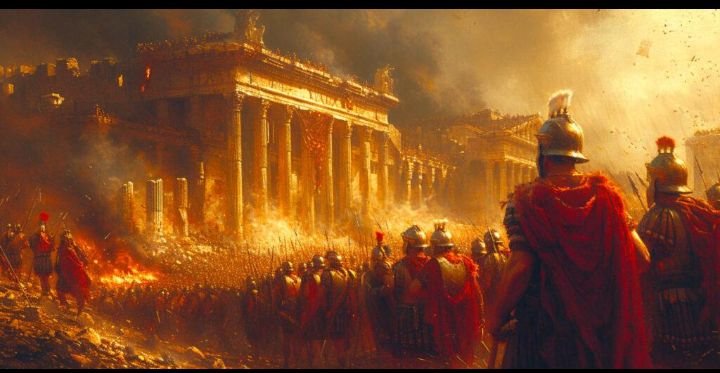
In 410 CE, the Visigoths under Alaric famously captured and sacked Rome.
The event shocked the Roman world because Rome had rarely been successfully attacked for centuries.
In 455 CE, the Vandals also sacked the city.
The Western Empire continued to lose territory and political authority.
Finally, in 476 CE, the Germanic military leader Odoacer deposed the young emperor Romulus Augustulus.
This event is traditionally used by historians to mark the fall of the Western Roman Empire.
However, it is important to understand that Roman civilization did not suddenly disappear in 476.
Why Did the Roman Empire Fall?
Historians have debated the causes of Rome’s decline for centuries.
There was no single explanation.
1. Political Instability
The empire experienced repeated struggles for power.
Emperors were frequently overthrown, assassinated or replaced.
Political instability weakened the central government and consumed enormous resources.
2. Civil Wars
Roman armies increasingly became involved in conflicts between rival political leaders.
Soldiers sometimes fought other Roman soldiers instead of defending the empire’s borders.
3. Economic Problems
The empire faced inflation, heavy taxation and financial pressures.
Maintaining the army and administration of such a huge territory was extremely expensive.
4. Military Pressure
Rome faced increasing challenges from groups along its borders.
The empire also had to defend an enormous frontier stretching across Europe, North Africa and Asia.
5. Migration and Invasions
Large-scale migrations of peoples into Roman territory created enormous pressure on the western empire.
Groups such as the Visigoths, Vandals, Franks and others established themselves within former Roman territories.
6. Administrative Difficulties
The empire’s enormous size made it difficult to govern effectively.
The division between eastern and western administrations eventually became increasingly permanent.
7. Changing Economic and Social Structures
The Roman economy depended heavily on agriculture, taxation and enslaved labor.
As territorial expansion slowed, the supply of enslaved people obtained through conquest changed.
Meanwhile, economic power became concentrated in certain regions and among wealthy landowners.
8. Loss of Western Territories
As the western government lost control of provinces, it also lost tax revenue and military resources.
The empire entered a cycle in which declining resources made defense increasingly difficult.
Did the Roman Empire Completely Fall?
Not exactly.
This is one of the most important points about Roman history.
When the Western Roman Empire ended in the fifth century, the Eastern Roman Empire continued for almost another thousand years.
Its capital was Constantinople.
The people of this empire continued to call themselves Romans, and their emperors considered themselves successors of the ancient Roman emperors.
Modern historians commonly call this state the Byzantine Empire, but its inhabitants generally did not use that name for themselves.
The Eastern Roman Empire survived until 1453, when Constantinople was conquered by the Ottoman Empire.
Rome’s Lasting Legacy
Although the Western Roman Empire disappeared, Rome’s influence remained enormous.
Roman Law
Roman legal ideas influenced legal traditions throughout Europe and beyond.
Latin
Latin became the language of administration and education across much of Western Europe.
It eventually developed into the Romance languages, including:
– Italian
– Spanish
– French
– Portuguese
– Romanian
Architecture
Roman arches, domes, roads, aqueducts and public buildings influenced architecture for centuries.
Government
Roman political institutions and concepts influenced later European political thinkers and governments.
Christianity
The Roman Empire played a major role in the development and spread of Christianity.
Engineering
Roman infrastructure demonstrated techniques that continued to influence construction and engineering.
Culture
Roman literature, philosophy, art and history continued to influence later civilizations.
The Roman Empire in Perspective
Rome’s story lasted for more than a thousand years if we consider the Roman Kingdom, Roman Republic and Roman Empire together.
Its history includes extraordinary achievements as well as serious contradictions.
Rome built impressive cities, roads, bridges and legal institutions, but it also relied heavily on conquest, slavery and military domination.
It brought different peoples into a common political system, while also violently suppressing rebellions and resistance.
The empire created opportunities for trade and cultural exchange, but imperial rule often came at a tremendous human cost.
Understanding Rome therefore requires looking beyond its monuments and military victories.
Conclusion
The story of Rome is ultimately a story of transformation.
A small settlement in Italy became a republic. The republic became a Mediterranean superpower. That superpower developed into one of the largest empires of the ancient world.
Rome’s military strength, political organization, economic networks, engineering achievements and legal traditions allowed it to dominate enormous territories for centuries.
But the same enormous size that demonstrated Rome’s power also created weaknesses.
Political instability, civil wars, economic pressures, military threats, administrative challenges and the loss of western territories gradually weakened the empire.
In 476 CE, the traditional date associated with the fall of the Western Roman Empire, the Roman world entered a new era.
Yet Rome did not truly vanish.
Its eastern empire survived until 1453, while Roman law, language, Christianity, architecture, political ideas and cultural traditions continued to shape later civilizations.
Rome fell, but its influence never truly disappeared.
Frequently Asked Questions
When was the Roman Empire founded?
The Roman Empire traditionally begins in 27 BCE, when Octavian became Augustus. Rome itself was traditionally founded in 753 BCE, while the Roman Republic began in 509 BCE.
Who was the first Roman emperor?
Augustus, formerly known as Octavian, is generally regarded as the first Roman emperor.
How large was the Roman Empire?
At its greatest extent during the reign of Emperor Trajan in the early second century CE, the Roman Empire controlled a vast territory covering much of Europe, North Africa and parts of Asia.
Why did the Roman Empire fall?
The Western Roman Empire declined because of a combination of political instability, civil wars, economic problems, military pressures, administrative difficulties, migration and the loss of territory and resources.
When did the Roman Empire fall?
476 CE is traditionally used as the date of the fall of the Western Roman Empire, when Odoacer deposed Romulus Augustulus.
Did the Roman Empire exist after 476 CE?
Yes. The Eastern Roman Empire continued from Constantinople until 1453.
What happened to Rome after the empire fell?
Rome remained an important city but lost much of its political importance in the West. It later became a major center of Christianity and eventually the seat of the papacy.
What is Rome’s greatest legacy?
Rome left lasting influences in law, government, architecture, engineering, language, Christianity, literature and culture.
Historabase — Discover the Past. Understand the Present.
The Historabase Editorial Team is dedicated to exploring and sharing the stories that have shaped Africa and the wider world. Our work covers African history, ancient civilizations, empires, historical figures, wars, cultures, political movements, and important events from the past.
We aim to present history in a clear, engaging, and accessible way, combining historical records with careful research to help readers better understand the people, events, and civilizations that shaped our world.