Few natural forces are as unpredictable and frightening as lightning. A single strike can cause severe burns, cardiac arrest or death within seconds. For most people, being struck once would be an extraordinarily rare event.
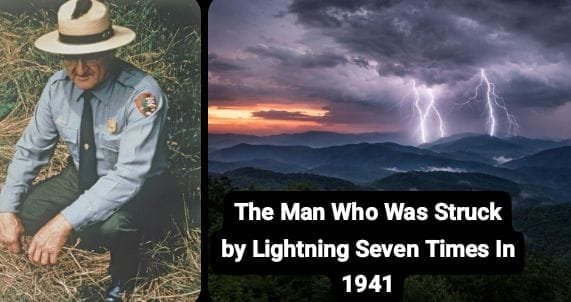
Roy Cleveland Sullivan experienced it seven times.
An American park ranger from Virginia, Sullivan became known as the “Human Lightning Conductor” after surviving seven separate lightning strikes between 1942 and 1977. Guinness World Records recognizes him as the person who survived the most lightning strikes.
His story remains one of the strangest survival records ever documented.
The First Strike — 1942
Roy Sullivan worked as a ranger at Shenandoah National Park in Virginia, an area known for thunderstorms and lightning activity.
His first encounter with lightning occurred in April 1942.
According to Guinness World Records, Sullivan was working near a fire lookout tower when the tower was struck by lightning and caught fire. As Sullivan fled the burning structure, lightning struck him in the right leg.
The strike left burn marks on his leg and knocked off the nail of his big toe.
Most people would probably consider surviving such an incident enough for a lifetime. For Sullivan, however, it was only the beginning.
Lightning Found Him Again — 1969
For the next 27 years, Sullivan apparently avoided another direct strike.
Then, in July 1969, lightning struck him again.
This time, he was driving his truck when lightning hit the vehicle. Sullivan was knocked unconscious. His eyebrows were burned, and his wristwatch was damaged.
Surviving a second strike was remarkable enough. But Sullivan’s extraordinary encounters with lightning were far from over.
The Third Strike — 1970
Just one year later, in July 1970, lightning struck Sullivan for the third time.
He was in his garden when the lightning hit him, burning his left shoulder.
Three separate lightning strikes over nearly three decades would already be an astonishing story. Sullivan, however, would experience four more.
His Hair Caught Fire — 1972
On April 16, 1972, Sullivan was inside a guardhouse at work when lightning struck again.
This time, the electricity caused his hair to catch fire.
The incident became another painful reminder that Sullivan seemed to have an extraordinary relationship with thunderstorms.
According to Guinness World Records, Sullivan’s hair was literally set on fire during this fourth strike.
Yet once again, he survived.
Lightning Struck Him Again — 1973
Sullivan’s fifth lightning strike happened on August 7, 1973.
He was driving when lightning struck him.
His hair caught fire again, while his legs were injured by the strike.
By this point, Sullivan had survived five separate lightning strikes.
He had also acquired the nickname “Spark Ranger” because of his unusual history with lightning.
The phrase “lightning never strikes twice” certainly did not describe Sullivan’s life.
The Sixth Strike — 1976
On June 5, 1976, Sullivan was struck for the sixth time.
He was walking when lightning hit him, injuring his ankle and once again burning his hair.
At this point, Sullivan had survived lightning strikes in remarkably different circumstances: near a burning lookout tower, while driving, in his garden, inside a guardhouse and while walking.
But there was still one more strike to come.
The Seventh Strike — 1977
On June 25, 1977, Sullivan was on a fishing trip when lightning struck him for the seventh and final recorded time.
The strike burned his chest and stomach.
Seven lightning strikes. Seven separate incidents. And Sullivan survived every one of them.
Guinness World Records lists June 25, 1977, as the date on which Sullivan completed his record of seven lightning strikes survived.
How Did He Survive?
Lightning can carry enormous electrical energy, but being struck does not always mean instant death.
A lightning strike can travel across the outside of the body rather than passing entirely through internal tissues, a phenomenon known as a flashover. The consequences can still be devastating, including burns, neurological injuries, heart problems and trauma caused by the force of the strike or a person’s fall.
Sullivan’s injuries were serious but, remarkably, none of the seven strikes killed him.
His survival should not be interpreted as evidence that lightning strikes are relatively safe. The U.S. National Park Service warns that there is no safe place outdoors during a thunderstorm and advises people to seek shelter when thunder is heard.
Lightning Wasn’t Finished With His Family
There is another remarkable detail in Sullivan’s story.
His wife was also struck by lightning once while she was outside hanging laundry. Sullivan was reportedly nearby helping her but escaped being struck during that incident.
Considering Sullivan’s history, that almost sounds impossible.
His Final Years
After the seventh strike in 1977, Sullivan was never recorded as being struck by lightning again.
He died in 1983 at the age of 71. His extraordinary record of surviving seven lightning strikes remains recognized by Guinness World Records.
The fact that all seven incidents happened during a period of about 35 years makes his story even more extraordinary.
The Record That Sounds Impossible
Roy Sullivan’s life demonstrates just how unpredictable nature can be.
He was not struck once, twice or even three times. Between 1942 and 1977, lightning struck him seven separate times, leaving him with burns, injuries and other physical damage—but never killing him.
His story also challenges one of the most familiar sayings about lightning: lightning can strike the same person more than once.
The National Park Service notes that lightning strikes are a serious danger and recommends avoiding exposed areas during thunderstorms. In Shenandoah National Park, where Sullivan worked, park officials specifically advise visitors to stay away from high, exposed places when lightning is active.
The Historabase Editorial Team is dedicated to exploring and sharing the stories that have shaped Africa and the wider world. Our work covers African history, ancient civilizations, empires, historical figures, wars, cultures, political movements, and important events from the past.
We aim to present history in a clear, engaging, and accessible way, combining historical records with careful research to help readers better understand the people, events, and civilizations that shaped our world.








One Comment