Imagine living in ancient Rome and hearing that the emperor was preparing to give one of the most important political positions in the empire to a horse.
It sounds like a joke.
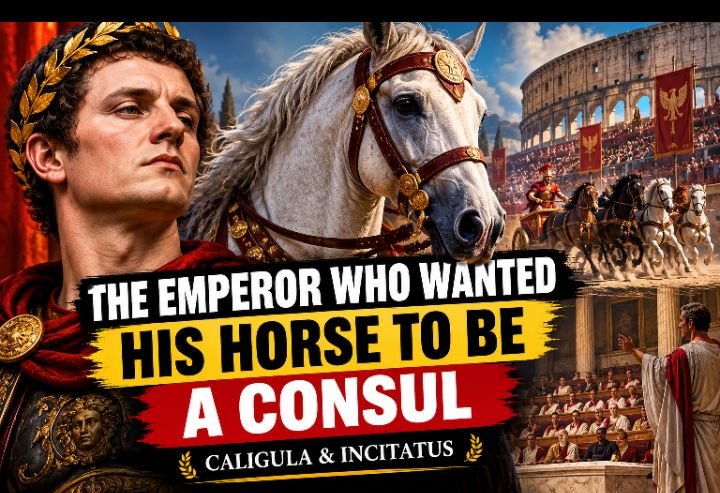
But more than 2,000 years ago, Roman writers recorded a remarkable story about Emperor Caligula and his beloved racehorse, Incitatus.
According to the ancient historian Suetonius, Caligula treated the horse with extraordinary luxury and was even said to have planned to make him consul, one of the highest political offices in the Roman state.
The story has survived for centuries and has become one of the most famous anecdotes about Caligula.
But there is an important detail often left out: Incitatus was never actually made consul.
So what really happened?
Who Was Caligula?
Caligula was born Gaius Julius Caesar Augustus Germanicus in AD 12 and became Roman emperor in AD 37.
He was the third emperor of Rome and ruled for only about four years before being assassinated in AD 41.
Ancient writers portray his reign as increasingly extravagant and unpredictable. However, modern historians caution that many stories about Caligula were written years after his death and may have been shaped by political hostility, rumor and sensational storytelling.
One of the strangest stories concerned his favorite horse.
Its name was Incitatus, a Latin name meaning roughly “swift” or “speedy.”
Caligula apparently became extremely attached to the animal.
And he did not treat it like an ordinary horse.
A Horse With a Marble Stable
According to Suetonius, Incitatus lived in remarkable luxury.
The horse reportedly had a marble stable, an ivory manger, expensive purple coverings and a jeweled collar.
But the privileges did not end there.
Caligula supposedly gave Incitatus a house, servants and furniture.
The emperor even ordered soldiers to maintain silence around the horse’s stable before chariot races so that Incitatus would not be disturbed by noise.
In other words, this was not simply a valuable racehorse.
The animal was treated almost like a member of the imperial household.
Caligula’s obsession with chariot racing helps explain some of this behavior. He was reportedly a passionate supporter of the racing faction associated with the color green and spent considerable time around the racing stables.
Incitatus was apparently one of his favorite horses.
But then came the part that turned the horse into a legend.
The Horse Who Was Supposed to Become Consul
The Roman consulship was one of the most prestigious offices in Rome.
During the Republic, consuls were the highest elected magistrates, and although the political system had changed considerably under the emperors, the title remained enormously prestigious.
According to Suetonius, Caligula was said to have intended to make Incitatus consul.
That does not mean the horse actually became consul.
It is an important distinction.
Suetonius did not write that Incitatus served as consul. He reported that Caligula intended to appoint him.
The later historian Cassius Dio similarly described the plan as something Caligula would have carried out had he lived longer. Modern scholarship therefore treats the story as an alleged plan rather than an actual appointment.
Still, the idea was extraordinary.
Why would a Roman emperor even say such a thing?
Was Caligula Seriously Going to Do It?
Historians have proposed several explanations.
One possibility is that Caligula was genuinely behaving in an extravagant and provocative manner.
Another possibility is that the entire episode was a joke.
The ancient sources themselves do not clearly explain what Caligula intended.
A 2014 study published in The Classical Quarterly by historian David Woods noted that both Suetonius and Cassius Dio preserved the allegation, but neither explains exactly what Caligula said or did that led people to believe he intended to make Incitatus consul.
That uncertainty matters.
The popular version of the story says:
“Caligula made his horse a consul.”
The historical evidence does not support that statement.
A more accurate version is:
Caligula was reported to have intended to make his favorite horse, Incitatus, consul.
Perhaps the Joke Was Actually About the Senate
One fascinating interpretation is that Caligula may have been mocking Rome’s political establishment.
The University of Queensland’s discussion of the story notes that one explanation is that Caligula’s proposed appointment was intended to insult the Roman Senate.
The message could have been deliberately humiliating:
If a horse could supposedly perform the duties of a consul, what did that say about the people already holding the office?
Under this interpretation, Incitatus was not being seriously prepared to govern Rome.
Instead, Caligula was using the horse to make a political point, or simply to provoke the senators.
Historian Aloys Winterling has similarly argued that some of Caligula’s apparently bizarre behavior may have been deliberate provocation directed at Rome’s political elite rather than simply evidence of irrational behavior.
The Horse Even Had Dinner Guests
The story becomes even stranger.
Suetonius wrote that Incitatus had a house with servants and furniture, supposedly so that guests invited in the horse’s name could dine there.
This detail is particularly revealing because it shows how the story was presented by ancient writers: not merely as an account of a pampered animal, but as an illustration of imperial extravagance.
Cassius Dio later added other extraordinary details about the horse’s treatment.
These stories helped create the image of Caligula as an emperor who had taken luxury and royal behavior to absurd extremes.
But again, historians have to be careful.
The ancient accounts were written after Caligula’s death, and some details may have been exaggerated.
Caligula’s Horse Never Ruled Rome
Despite the popular legend, there was no equine consul sitting in the Roman Senate.
Incitatus never governed Rome.
He never presided over political meetings.
He never commanded an army.
He never signed Roman laws.
And there is no reliable evidence that he ever formally held the consulship.
The surviving ancient accounts describe a plan or intention, not a completed appointment.
That distinction has largely disappeared from the popular version of the story.
Over time, “Caligula made his horse consul” became much easier to remember than the more complicated historical reality.
The Historabase Editorial Team is dedicated to exploring and sharing the stories that have shaped Africa and the wider world. Our work covers African history, ancient civilizations, empires, historical figures, wars, cultures, political movements, and important events from the past.
We aim to present history in a clear, engaging, and accessible way, combining historical records with careful research to help readers better understand the people, events, and civilizations that shaped our world.