Long before modern perfumes, medicines and religious ceremonies developed into the forms familiar today, oil already held an important place in the ancient world.
Olive oil and other scented oils were used on the body, in medicine, during ceremonies and in royal settings. In several ancient religious traditions, however, oil acquired a deeper meaning. To anoint someone or something with oil could signify consecration, honor, purification, appointment to an important position or association with the divine.
The practice was especially significant in ancient Israel, but evidence from Egypt and the wider ancient Near East shows that the use of oils and unguents in ceremonial settings was much broader.
What Did “Anointing” Mean?
Anointing generally involved applying oil or another prepared substance to a person’s body, usually the head, although objects could also be anointed.
The Hebrew Bible uses the verb mashach, meaning to smear or anoint, from which the word “Messiah” is ultimately derived. In ancient Israel, anointing could mark someone as having been set apart for a particular role. Kings were famously anointed, and priests could also receive anointing as part of their consecration.
But anointing was not exclusively religious.
Oil had ordinary practical uses. People applied it to their skin after bathing, used it as a cosmetic and employed oil-based preparations for medicinal purposes. In the hot climate of the ancient Near East, oil could help protect and soften the skin.
Religious anointing therefore developed within a culture in which oil already had considerable practical and social importance.
Oil in Ancient Egypt
Ancient Egypt provides some of the earliest surviving evidence for the importance of oils and ointments.
Egyptians used perfumed oils and ointments for cosmetics, personal care, religious activities and funerary practices. Archaeological discoveries include specialized vessels designed to contain oils and ointments.
The Metropolitan Museum of Art, for example, has an Egyptian ointment jar dating to approximately 1878–1749 BCE. The museum notes that ancient Egyptians used stone containers to store perfumed oils, ointments and cosmetics, which were considered important in both life and the afterlife.
Another Egyptian artifact, an offering tablet dating to approximately 1981–1550 BCE, contains seven small wells corresponding to different sacred oils associated with embalming and funerary rites.
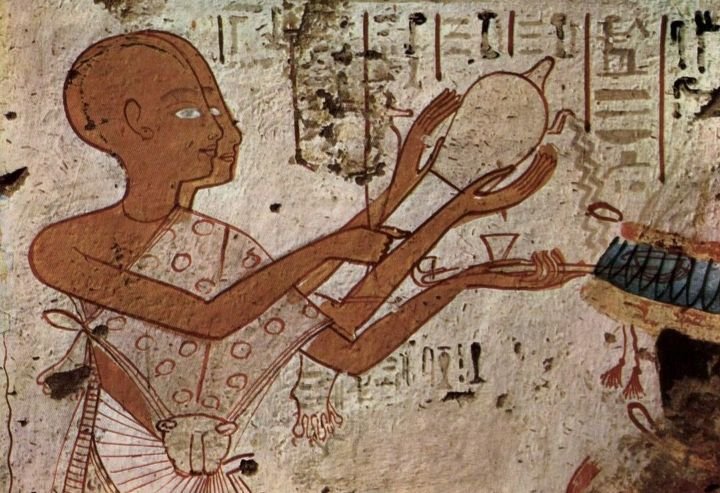
Egyptian tomb paintings from the New Kingdom also depict servants anointing guests with perfumed oils and ointments. The Metropolitan Museum notes that similar containers were associated with royal gifts during the reign of Thutmose III.
These discoveries demonstrate that oils were deeply integrated into Egyptian ritual and elite culture.
Part of oil’s importance came from its physical qualities.
Oil could be poured, spread and absorbed into the skin. When mixed with aromatic substances, it could also produce a powerful fragrance.
In a world without modern deodorants and synthetic perfumes, fragrant oils were valuable. Their smell could distinguish a ceremonial occasion from ordinary life.
Olive oil was particularly important around the Mediterranean. It served as food, fuel, cosmetic, medicine, lubricant and religious substance. The Metropolitan Museum describes olive oil as having been used for religious anointing as well as many everyday purposes.
This combination of usefulness, fragrance and value helped give oil a powerful symbolic presence.
Anointing Kings
One of the most important religious uses of anointing was the installation of rulers.
In ancient Israel, kings including Saul, David and Solomon were anointed with oil. The ceremony was not simply a physical act. It marked the king as someone appointed to a special office.
The phrase “the Lord’s anointed” subsequently became closely associated with the king. Biblical accounts describe Samuel anointing Saul and David, while Solomon was anointed during his accession to the throne.
The practice was not unique to Israel. Evidence indicates that royal anointing existed elsewhere in the ancient Near East. The Encyclopedia Judaica, for example, notes that anointing was widespread in ancient Israel and its surrounding cultures and that Israel continued practices of royal anointing found in the wider region.
The symbolism was powerful: oil marked a transition from an ordinary person to someone occupying a special position.
Anointing Priests
Oil was also associated with religious officials.
In the biblical tradition, Aaron and other priests were anointed as part of their consecration. Exodus describes the preparation of a special anointing oil made from olive oil and aromatic ingredients, including myrrh, cinnamon, aromatic cane and cassia.
The oil was not treated like ordinary household oil. The biblical instructions specifically restricted its use and associated it with sacred purposes.
The Tabernacle and objects used in worship were also anointed. This extended the concept beyond people: objects could be set apart for religious service through the same ritual.
Anointing as a Symbol of Consecration
One of the central ideas behind religious anointing was setting something apart.
An ordinary person could become a king. An ordinary object could become part of a sanctuary. A religious official could be formally installed.
The oil provided a visible and physical symbol of that transformation.
This is why anointing appears repeatedly in ancient religious texts. The ceremony communicated something that words alone could not easily express: this person, place or object now had a special status.
In ancient Israel, anointing could therefore carry both religious and political significance.
Oil and Healing
The association between oil and religion was also strengthened by its practical uses.
Ancient people already knew that oil could be used on the skin and in various medicinal preparations. Biblical texts refer to oil being applied to wounds and to the sick.
This meant that oil could carry several meanings simultaneously.
It could represent comfort, health, beauty, celebration and religious dedication.
Because of this overlap, it is sometimes difficult for historians to determine whether a particular ancient reference to oil was primarily medicinal, cosmetic or religious without examining its context.
Oil, Fragrance and Sacred Space
Scent was especially important in ancient religious life.
Religious ceremonies often involved incense, perfumes, oils and other aromatic substances. These created distinctive sensory environments that separated sacred ceremonies from everyday activities.
Ancient Near Eastern religious practices included offerings of liquids such as water, wine, beer and oil. Archaeological evidence and written sources demonstrate the importance of ritual liquids in temple ceremonies.
In ancient Israel, fragrant spices were combined with oil for cultic purposes. The ingredients described in Exodus 30 demonstrate how carefully prepared sacred oil could become part of religious ritual.
From Ancient Traditions to Christianity
The symbolic meaning of anointing continued beyond the ancient Israelite period.
Early Christianity inherited the Jewish tradition of sacred anointing and developed its own uses of holy oils. Over time, anointing became associated with rites including baptism, confirmation and the consecration of clergy in various Christian traditions.
The Metropolitan Museum notes that the liturgical use of holy oils and the anointing of kings in medieval Christianity inherited traditions from Judaism.
The terminology also survived. The Greek word Christos, meaning “anointed,” became the title “Christ,” corresponding to the Hebrew concept of the Messiah, or anointed one.
Thus, a ritual that had existed in the ancient world became embedded in later religious vocabulary and practice.
Was Anointing Oil Believed to Have Magical Power?
It is important not to simplify ancient beliefs.
People in different societies understood ritual oil differently. Some saw it as a symbol of divine appointment or sacred status; others associated particular oils with healing, protection or ritual purity.
Ancient religious systems also frequently combined what modern people would classify as medicine, religion and ritual.
That does not mean every ancient person believed oil itself possessed supernatural powers. The meaning depended on the culture, ceremony and historical period.
What can be established is that oil repeatedly served as a material symbol through which ancient societies expressed ideas about holiness, authority, healing, beauty and transformation.
Why the Tradition Survived
Anointing survived because it was more than simply putting oil on someone’s head.
It combined a physical substance with a powerful social and religious message.
The oil was visible. Its fragrance could be noticed by everyone nearby. Its application could be performed publicly. And the ceremony could mark a person’s transition into a new role.
For ancient communities, these characteristics made oil an effective ritual symbol.
From Egyptian funerary practices and Near Eastern royal ceremonies to Israelite kings and priests, anointing became one of the most enduring ritual practices of the ancient world.
The Historabase Editorial Team is dedicated to exploring and sharing the stories that have shaped Africa and the wider world. Our work covers African history, ancient civilizations, empires, historical figures, wars, cultures, political movements, and important events from the past.
We aim to present history in a clear, engaging, and accessible way, combining historical records with careful research to help readers better understand the people, events, and civilizations that shaped our world.







One Comment