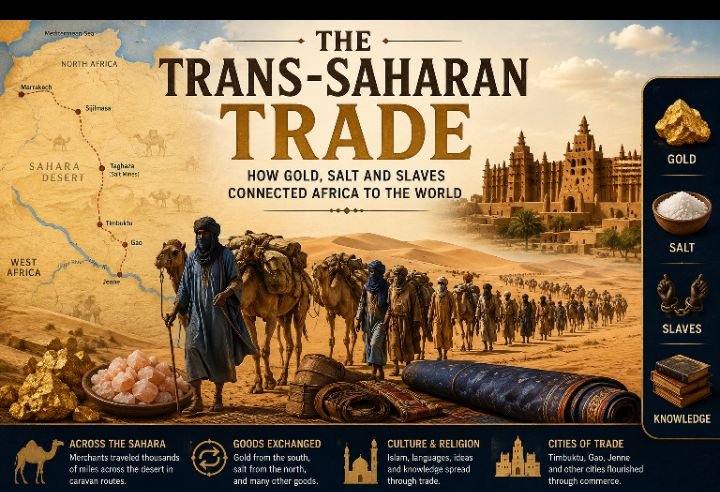
For centuries, the Sahara Desert was not simply a vast barrier separating North and West Africa. It was also a major commercial highway that connected communities, kingdoms and distant regions through one of the most important trading networks in African history.
Known as the Trans-Saharan trade, this network linked West Africa with North Africa and, through the Mediterranean and Middle East, with wider parts of the world. Merchants crossed enormous distances carrying gold, salt, ivory, leather, textiles, horses and other goods.
The trade also included enslaved people, whose forced movement became a major and deeply damaging part of the region’s economic history.
The wealth generated by this commerce helped powerful West African states such as the Ghana Empire, Mali Empire and Songhai Empire rise to prominence. Cities including Timbuktu, Gao and Jenne became major centres of trade, scholarship and culture.
How the Trans-Saharan Trade Began
Long-distance trade across the Sahara existed before the rise of the great medieval West African empires. However, the network expanded significantly after merchants began using camels to cross the desert more efficiently.
Camels were particularly suited to the harsh Saharan environment. They could travel long distances while carrying heavy loads and survive for extended periods with limited water.
This made regular commercial journeys across the desert more practical.
By the early medieval period, networks of merchants had developed routes connecting North African cities with commercial centres south of the Sahara.
The trade was never controlled by one group. It involved African kingdoms, Berber and Arab merchants, local communities and traders from different parts of the Islamic world.
Gold: The Treasure of West Africa
Gold was one of the most important commodities in the Trans-Saharan trade.
West Africa possessed rich gold-producing regions, particularly around areas corresponding to parts of modern-day Mali, Guinea, Senegal and Burkina Faso.
For centuries, gold moved northward through established trade routes. In exchange, West African merchants and rulers obtained goods that were scarce or unavailable in the region.
The abundance of gold helped make West Africa extremely important to international commerce.
The Ghana Empire, which flourished roughly between the 8th and 13th centuries, became wealthy partly because it controlled important trade routes and taxed merchants passing through its territory.
Later, the Mali Empire became even more famous for its gold wealth.
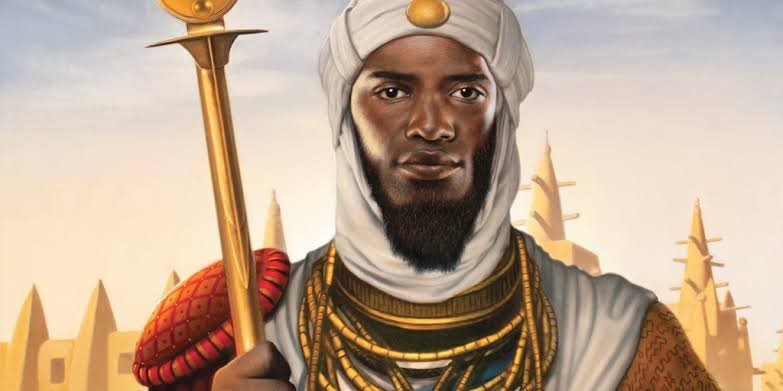
The legendary pilgrimage of Mansa Musa, the ruler of Mali, to Mecca in the 14th century demonstrated the extraordinary wealth of the region. His journey through Egypt attracted widespread attention because of the amount of gold he reportedly distributed and spent.
Salt: The Valuable Commodity of the Sahara
While gold moved north, another extremely important commodity travelled in the opposite direction: salt.
Salt was essential for preserving food and maintaining the human body’s health, making it particularly valuable in regions where natural salt supplies were limited.
Large salt deposits existed in the Sahara. One of the best-known sources was Taghaza, located in present-day Mali.
Workers extracted large blocks of salt from the desert, which were then transported south by camel caravans.
The exchange of gold for salt became one of the defining features of the Trans-Saharan economy.
In some parts of West Africa, salt was so valuable that large pieces were used as a form of exchange.
The trade therefore connected two very different environments: the gold-producing regions of the south and the salt-producing areas of the Sahara.
The Role of Enslaved People
The Trans-Saharan trade also involved the trafficking of enslaved people.
Enslaved Africans were taken from different parts of sub-Saharan Africa and transported across the Sahara to North Africa and other regions. Some were forced into domestic labour, agricultural work, military service or other forms of servitude.
This trade existed for centuries and was conducted through different political and commercial systems.
It is important to recognise that slavery in Africa had many forms and varied across societies and periods. However, the forced movement of people through trans-Saharan networks caused enormous human suffering and became an important part of the region’s historical economy.
The trade in enslaved people also connected West and North Africa to wider markets in the Mediterranean and Middle East.
The Great Caravan Routes
Crossing the Sahara was extremely dangerous.
Merchants travelled in large caravans, sometimes consisting of hundreds or even thousands of people and animals. Travelling together offered greater protection against bandits, helped merchants navigate the desert and allowed them to share supplies.
The caravans relied on knowledge of wells, oases and established routes.
Some major routes connected cities such as Sijilmasa and Marrakesh in North Africa with centres such as Awdaghost, Timbuktu, Gao and other West African settlements.
The journey could take weeks or months depending on the route, weather and conditions.
A mistake in navigation or a shortage of water could have deadly consequences.
Despite these risks, the enormous profits available from long-distance trade encouraged merchants to continue making the journey.
The Rise of the Ghana Empire
The Ghana Empire, sometimes called Wagadu by its inhabitants, became one of the earliest major powers to benefit greatly from Trans-Saharan commerce.
Its strategic position allowed it to control important trade routes between the gold-producing south and North African markets.
Rather than producing all the goods itself, the empire benefited heavily from taxing merchants and controlling access to important commercial routes.
This revenue helped rulers maintain armies, administer territories and strengthen their political authority.
The prosperity associated with trade helped Ghana become one of the most influential states in medieval West Africa.
Mali and the Golden Age of West African Trade
After the decline of Ghana, the Mali Empire emerged as a dominant power.
Founded in the 13th century, Mali expanded across a large portion of West Africa and gained control over important gold-producing regions and trade routes.
Under rulers such as Sundiata Keita and Mansa Musa, the empire became one of the most powerful states in the region.
Mali’s control of gold and its access to trans-Saharan commerce made its rulers enormously wealthy.
Cities such as Timbuktu and Jenne developed into major commercial centres.
Merchants brought books, textiles, horses, metals and other products into the region while gold and other African commodities moved north.
Timbuktu: A City Built by Trade
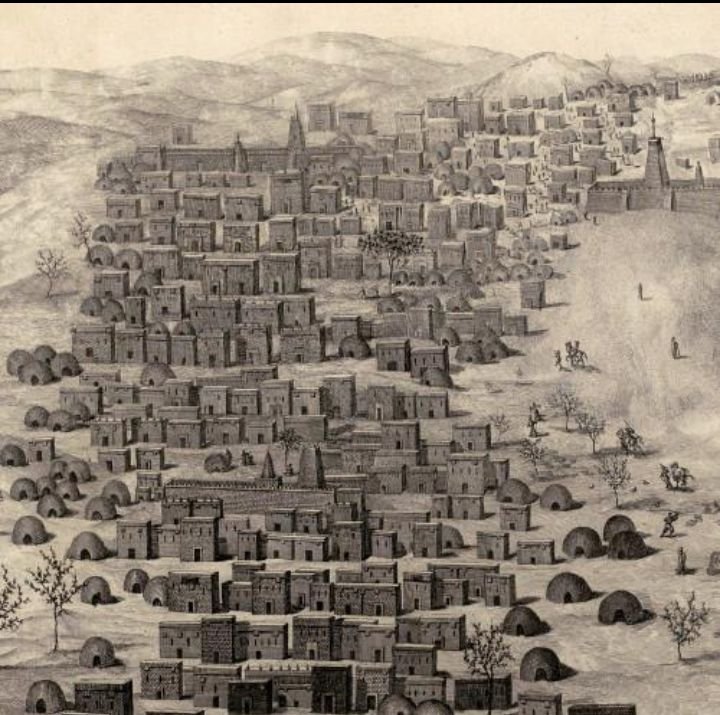
Timbuktu became one of the most famous cities associated with the Trans-Saharan trade.
Located near the Niger River and close to the southern edge of the Sahara, Timbuktu occupied a strategic position.
Merchants arrived with salt from the desert and exchanged it for gold and other products from southern regions.
But Timbuktu was more than a marketplace.
Its wealth supported mosques, schools and scholars. Over time, the city became an important centre of Islamic learning, attracting intellectuals from different parts of Africa and the wider Muslim world.
Thousands of manuscripts were produced and preserved in the region, covering subjects such as religion, law, mathematics, astronomy and literature.
This demonstrates how trade did more than move commodities. It also helped move ideas, knowledge, languages, technologies and religious traditions.
The Songhai Empire Takes Control
After Mali’s decline, the Songhai Empire became the dominant power in much of West Africa.
Its rulers captured important commercial centres, including Timbuktu and Jenne.
Under Sonni Ali and later Askia Muhammad, Songhai controlled extensive territory and major sections of the Niger River.
The empire benefited from taxation and commerce, making trade an important source of state revenue.
Its prosperity was closely connected to the wider Trans-Saharan network.
However, the importance of the trade routes also meant that powerful states constantly competed for control of strategic cities, mines and commercial corridors.
More Than Gold and Salt
Although gold and salt are often presented as the main products of the Trans-Saharan trade, the network carried many other commodities.
Merchants traded:
Gold
Salt
Enslaved people
Ivory
Leather goods
Ostrich feathers
Kola nuts
Horses
Copper
Textiles
Weapons
Books and manuscripts
Dates and other food products
The direction of trade varied depending on the route and period.
North African merchants brought manufactured goods and desert products south, while West African regions supplied valuable natural resources.
This created an economic relationship between different ecological zones.
How Islam Spread Through Trade
Trade also contributed significantly to the spread of Islam across West Africa.
Many merchants travelling across the Sahara were Muslims. As they established commercial relationships with West African rulers and communities, Islamic beliefs and practices gradually became more influential.
West African rulers sometimes adopted Islam for religious reasons, but also because it could strengthen diplomatic and commercial relationships with Muslim states and merchants across North Africa.
Islamic scholars and teachers travelled along the same networks as merchants.
As a result, important trading cities became centres of Islamic education.
However, the spread of Islam was gradual and uneven. Traditional African religions remained important in many communities, and local societies often combined Islamic practices with existing cultural traditions.
How Trade Connected Africa to the Wider World
The Trans-Saharan trade was part of a much larger international system.
Goods from West Africa reached North African markets and could then move towards Egypt, the Mediterranean and the Middle East.
Similarly, products originating outside Africa entered West Africa through these commercial networks.
This meant that West African societies were not isolated from the wider medieval world.
They were active participants in international commerce.
Gold from West Africa, for example, became an important part of monetary systems beyond the region. African commodities helped support commercial activity across North Africa and parts of Europe and the Middle East.
The Dangers and Costs of the Trade
Despite its economic importance, the Trans-Saharan trade came with significant human and environmental costs.
Caravans faced extreme heat, sandstorms, dehydration, disease and attacks by raiders.
Political instability could also make certain routes dangerous.
The trade in enslaved people added another devastating dimension. Individuals were forcibly removed from their communities, separated from families and transported over enormous distances.
The economic benefits of the trade therefore came at a considerable human cost.
The Decline of the Trans-Saharan Trade
The Trans-Saharan trade did not disappear overnight, but its importance gradually changed.
From the late 15th century onward, European maritime powers increasingly established direct sea routes around the coast of Africa.
Portuguese merchants, followed by other European powers, developed Atlantic trading networks that reduced the Sahara’s position as the main link between West Africa and the outside world.
The Atlantic trade eventually became increasingly important.
Political changes also weakened some of the great West African empires that had previously protected and taxed the caravan routes.
The Moroccan invasion of the Songhai Empire in 1591 further disrupted political control in the western Sudan.
Nevertheless, trans-Saharan commerce continued for centuries and never completely disappeared.
The Lasting Legacy
The Trans-Saharan trade shaped the political, economic and cultural history of Africa.
It helped create powerful empires, encouraged the growth of cities and connected communities separated by thousands of kilometres.
It also contributed to the spread of Islam and scholarship while creating networks through which goods, languages, technologies and ideas travelled.
But its history also includes the suffering caused by the trafficking of enslaved people and the exploitation associated with long-distance commerce.
Today, the ancient trading cities and caravan routes remain reminders of an era when the Sahara was not simply a desert separating societies, but a bridge connecting them.
The Historabase Editorial Team is dedicated to exploring and sharing the stories that have shaped Africa and the wider world. Our work covers African history, ancient civilizations, empires, historical figures, wars, cultures, political movements, and important events from the past.
We aim to present history in a clear, engaging, and accessible way, combining historical records with careful research to help readers better understand the people, events, and civilizations that shaped our world.