Sexual positions are often treated as a modern subject, but the human fascination with intimacy, pleasure and sexual behavior is thousands of years old. Ancient civilizations recorded ideas about sexual relationships in literature, art, medical writings and religious traditions.
Among the most famous historical sources is the Kama Sutra, an ancient Indian text traditionally associated with Vātsyāyana. However, India was not the only civilization to document sexual practices. Ancient Greek and Roman writers and artists also left evidence showing that people in the Mediterranean world thought carefully, and sometimes humorously, about sexual behavior.
The history of sexual positions is therefore not simply a catalogue of ancient techniques. It is a story about how different societies understood pleasure, marriage, gender, intimacy, status and human relationships.
Did Ancient People Really Write About Sexual Positions?
Yes, although the surviving evidence is limited.
Ancient writers did not always describe sexual practices in the same detailed way modern books or websites might. Instead, information appears in poetry, comedy, medical literature, philosophical discussions, mythology and artwork.
Some ancient artworks show couples in intimate situations, while literary works sometimes refer to particular sexual arrangements indirectly.
Historians must be cautious, however. An image showing a sexual act does not necessarily prove that it was common among the general population. Likewise, a writer mentioning a particular practice does not mean that everyone in that society practiced it.
The evidence tells us that people knew about different sexual positions and discussed them, but it cannot provide a complete picture of everyday private life.
Ancient Mesopotamia and Egypt
Some of the earliest civilizations left behind evidence concerning sexuality, although detailed descriptions of sexual positions are much less common than modern readers might expect.
In ancient Mesopotamia, sexuality appeared in mythology, poetry and religious traditions. Fertility and reproduction were important themes, and sexual relationships could be connected with ideas about the continuation of life and agricultural abundance.
Ancient Egyptian culture also connected sexuality with fertility and creation. Egyptian mythology contains stories involving gods whose sexual powers were associated with the creation of life.
Egyptian artwork occasionally depicts intimate relationships, but interpreting such images requires caution. Religious symbolism, artistic conventions and everyday life were often closely connected.
The surviving evidence suggests that ancient Egyptians recognized sexuality as an important part of human and divine life, but historians cannot reconstruct an exact list of commonly practiced sexual positions.
Sexuality in Ancient Greece
Ancient Greece provides considerably more evidence.
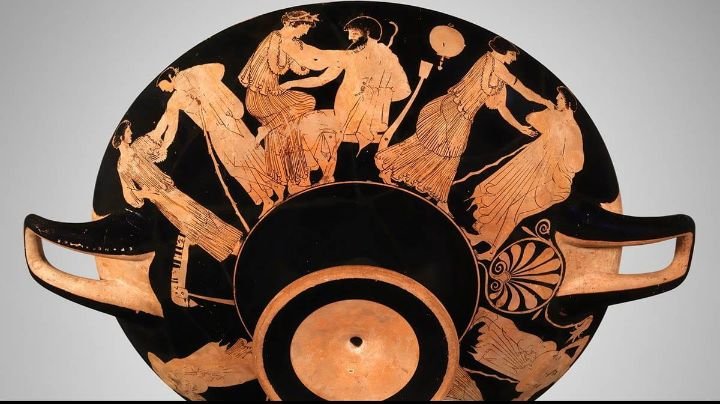
Greek pottery, sculpture, literature and comedy contain numerous references to sexuality. Some surviving vessels contain erotic imagery, demonstrating that sexual subjects could appear openly in particular artistic settings.
Greek writers also discussed love and desire extensively.
However, ancient Greek sexuality was not organized around modern concepts of sexual orientation. Relationships were influenced by gender, age, social status and cultural expectations.
This is important when studying sexual positions because the physical act itself was only one part of the story.
Ancient Greeks could also be concerned with who took which role, who possessed social power and whether behavior was considered appropriate for a particular person.
The Role of Greek Comedy
Comedy provides some of the most entertaining evidence about ancient sexuality.
Greek playwrights frequently made jokes about sexual behavior. Sexual references could be used to embarrass characters, make audiences laugh or criticize social expectations.
This tells historians that audiences were familiar with a wide range of sexual ideas.
But comedy should not be treated as a straightforward description of ordinary behavior.
A joke about a particular sexual practice does not prove that everyone practiced it. Instead, it shows that the audience understood the reference well enough for the joke to work.
Sexual Positions in Ancient Rome
Roman society inherited considerable cultural influence from Greece but developed its own attitudes toward sexuality.
Roman literature and art contain numerous references to sexual behavior. Erotic paintings have been discovered at sites such as Pompeii, providing evidence that sexual imagery existed in Roman domestic and public environments.
Roman writers also discussed sex in poetry, satire and comedy.
Yet Roman sexuality was strongly connected with status, masculinity and power.
A Roman citizen’s sexual behavior could be judged differently from that of an enslaved person or prostitute.
Consequently, understanding Roman sexual positions requires understanding the social structure surrounding them.
Pompeii and the Roman Evidence
The ancient city of Pompeii has become one of the most important archaeological sources for understanding Roman sexuality.
When Mount Vesuvius erupted in AD 79, buildings, paintings and objects were preserved beneath volcanic material.
Some Roman houses and other locations contained erotic paintings and objects. These discoveries provide historians with unusual visual evidence about Roman attitudes toward sexuality.
However, these images should not be interpreted as photographs of ordinary Roman life.
They may have served decorative, humorous, religious or private purposes.
Still, their existence demonstrates that Romans were capable of representing sexual behavior openly in certain contexts.
When people hear the phrase “ancient sexual positions,” the Kama Sutra is usually the first historical work that comes to mind.
The Kama Sutra was composed in ancient India and is traditionally attributed to Vātsyāyana. Scholars generally place its composition in the early centuries of the Common Era.
Despite its modern reputation, the Kama Sutra is much more than a collection of sexual positions.
It discusses courtship, marriage, relationships, pleasure, social behavior and the broader art of living.
Sexual techniques form an important part of the work, but reducing the entire text to a “sex manual” misses much of its historical significance.
Why the Kama Sutra Was Written
The Kama Sutra belongs to a wider Indian intellectual tradition concerned with kama, broadly associated with desire, pleasure and enjoyment.
Ancient Indian thought recognized different goals and responsibilities in human life.
The Kama Sutra explores how pleasure could exist alongside other social responsibilities.
It therefore provides historians with a valuable window into how at least one ancient intellectual tradition approached relationships and sexual pleasure.
It should not, however, be treated as a description of how every person in ancient India lived.
India was home to numerous communities, religions, languages and social traditions. The Kama Sutra represents one particular literary tradition rather than the behavior of an entire civilization.
Ancient India and the Study of Pleasure
One of the most interesting features of the Kama Sutra is that it treats sexual pleasure as a subject worthy of systematic discussion.
Rather than presenting sexuality only as reproduction, the text considers pleasure, attraction and relationships.
This distinguishes it from many ancient sources that mention sex only within mythology, law, comedy or medical discussions.
The Kama Sutra therefore occupies an important place in world history because it demonstrates that ancient writers could approach human sexuality as a subject involving pleasure, social relationships and personal behavior.
Were Ancient Sexual Positions the Same as Modern Ones?
Some basic physical arrangements described or depicted in ancient sources would naturally resemble practices known today.
Human anatomy has not fundamentally changed.
However, the meaning attached to those practices could be very different.
For example, a particular position could be associated with ideas about masculinity, fertility, dominance, intimacy or social status.
The historical significance therefore lies not simply in discovering that an ancient position resembles something practiced today.
The more interesting question is:
What did that position mean to the people who practiced or described it?
Sexual Positions and Gender
Gender expectations played a major role in ancient sexual culture.
In both Greek and Roman societies, ideas about masculinity were closely connected with authority and self-control.
Sexual behavior could therefore influence how a person was perceived socially.
Women also faced different expectations. Marriage, family, reproduction and social reputation were extremely important in many ancient societies.
The surviving historical record is heavily influenced by male writers, which makes it difficult to determine exactly how women themselves experienced sexuality.
This is one reason historians avoid making sweeping statements about ancient sexual behavior.
Sexual Positions and Marriage
Sexuality was also closely connected with marriage.
In many ancient societies, marriage served purposes extending beyond romantic love. Families could use marriage to establish alliances, preserve property and produce heirs.
Sexual relationships within marriage were therefore connected with reproduction and family structure.
At the same time, ancient literature demonstrates that people also experienced attraction and desire outside formal marriage.
The tension between social responsibility and personal desire appears repeatedly in ancient literature.
Sexuality, Medicine and Ancient Knowledge
Ancient medical traditions also discussed sexual activity.
Greek and Roman physicians developed theories about reproduction, fertility and bodily fluids. Their understanding was very different from modern medicine, but their writings demonstrate that sexual behavior was considered a legitimate subject of medical discussion.
Ancient Indian medical traditions likewise developed sophisticated ideas about the body, reproduction and sexual health.
These traditions remind us that the history of sexual positions cannot be separated completely from the history of medicine.
People wanted to understand not only pleasure but also fertility, reproduction and the physical consequences of sexual activity.
The Medieval and Early Modern Changes
After the ancient world, attitudes toward sexuality continued to change.
In medieval Europe, Christian teachings increasingly influenced ideas about sexual morality. Sexual activity became strongly associated with marriage and reproduction in many religious discussions.
Meanwhile, other cultures continued developing their own traditions concerning sexuality and relationships.
During the Renaissance and early modern periods, European scholars rediscovered and reinterpreted many classical texts.
The history of sexuality therefore did not move in a straight line from “ancient freedom” to “modern freedom.” Different societies repeatedly changed their attitudes toward sex.
Why Ancient Sexuality Is Often Misunderstood
Modern popular culture frequently exaggerates ancient sexuality.
One popular myth is that ancient Romans were completely sexually liberated.
Another is that the Kama Sutra was simply an ancient book devoted entirely to unusual sexual positions.
Neither is accurate.
Ancient societies had their own moral rules, social restrictions and expectations.
Sexual behavior could be celebrated in one context and condemned in another.
The historical reality was much more complicated than either extreme.
What the Ancient Sources Really Reveal
The surviving evidence demonstrates that people in ancient civilizations were interested in sexual pleasure and relationships.
The Greeks and Romans represented sexuality through art, literature and comedy.
Ancient Indian writers created detailed discussions of pleasure and relationships in the Kama Sutra.
Egyptian and Mesopotamian traditions connected sexuality with fertility and creation.
Together, these sources show that sexual behavior has always been part of human culture.
But they also reveal something more important: people have never interpreted sexuality in exactly the same way.
Culture determines how people understand intimacy, gender, marriage and pleasure.
Conclusion
The history of sexual positions stretches back thousands of years, long before modern sexology existed.
Ancient Greece and Rome left behind literature and artwork showing that people were familiar with a variety of sexual practices. Ancient Indian civilization produced the Kama Sutra, one of the world’s most famous works concerning sexual pleasure and relationships.
Yet these sources should not be viewed simply as ancient versions of modern sex manuals.
They were products of their own societies, shaped by religion, philosophy, gender, social class, marriage and ideas about pleasure.
The Kama Sutra, in particular, was far broader than its modern reputation suggests. It explored relationships and the pursuit of pleasure within a larger social and philosophical framework.
The ancient history of sexual positions therefore tells us much more than what people did in private.
It reveals how civilizations understood love, desire, marriage, pleasure, gender and the human body.
The Historabase Editorial Team is dedicated to exploring and sharing the stories that have shaped Africa and the wider world. Our work covers African history, ancient civilizations, empires, historical figures, wars, cultures, political movements, and important events from the past.
We aim to present history in a clear, engaging, and accessible way, combining historical records with careful research to help readers better understand the people, events, and civilizations that shaped our world.








One Comment