Pearl Harbor Attack. On December 7, 1941, the Imperial Japanese Navy launched a surprise military attack on the United States naval base at Pearl Harbor, Hawaii. The assault killed more than 2,400 Americans, damaged or destroyed numerous military vessels and aircraft, and brought the United States directly into World War II.
The attack marked a turning point in American history. Before Pearl Harbor, the United States had remained formally outside the war, although it had provided substantial economic and military assistance to countries fighting the Axis powers. Japan’s assault changed American public opinion, prompted a declaration of war against Japan, and transformed the country’s military and industrial priorities.
Background to the Attack
Tensions between the United States and Japan had increased throughout the 1930s as Japan expanded its military operations in East Asia.
In 1931, Japan seized Manchuria in northeastern China. In 1937, Japanese forces launched a full-scale invasion of China, beginning a prolonged and destructive war. Japan’s military expansion threatened American interests in the Pacific and challenged the international order supported by the United States.
The United States responded to Japanese aggression through diplomatic pressure and economic restrictions. American officials opposed Japan’s expansion in China and sought to limit its access to resources needed to sustain its military campaigns.
In July 1941, Japan occupied southern French Indochina, now part of Vietnam, Cambodia, and Laos. The United States subsequently froze Japanese assets and imposed restrictions that effectively cut off Japan’s access to American oil supplies.
Oil was essential to Japan’s military operations, including its navy and air force. Japanese leaders faced a choice between negotiating with the United States and pursuing further expansion to secure access to natural resources.
Diplomatic negotiations continued during the months leading up to the attack, but the two governments failed to reach an agreement. Japanese military planners began preparing an operation intended to weaken American naval power in the Pacific.
Japan’s Plan to Attack Pearl Harbor
Pearl Harbor, located on the Hawaiian island of Oahu, served as the principal base of the United States Pacific Fleet. Its concentration of battleships, aircraft, and other military facilities made it a major target for Japanese planners.
Admiral Isoroku Yamamoto, commander-in-chief of Japan’s Combined Fleet, supported the plan to attack the American fleet before the United States could effectively interfere with Japanese military operations in Southeast Asia and the western Pacific.
The operation was designed to disable American naval power long enough for Japan to establish control over territories it considered strategically important.
Vice Admiral Chuichi Nagumo commanded the Japanese carrier striking force. Six aircraft carriers participated in the operation, carrying fighters, bombers, and torpedo aircraft.
The Japanese force approached Hawaii across the North Pacific while maintaining radio silence. It launched its aircraft before dawn on December 7, 1941, Hawaii time.
Japan intended the assault to achieve surprise and inflict severe damage on American military forces before the United States could respond.
December 7, 1941: The Attack Begins
At approximately 7:48 a.m. Hawaii time on December 7, Japanese aircraft began attacking American military installations on Oahu.
The assault targeted Pearl Harbor and nearby airfields, including Hickam Field, Wheeler Field, and Bellows Field. Japanese aircraft attacked battleships, cruisers, destroyers, aircraft, and military infrastructure.
The first wave concentrated on naval vessels and airfields. Japanese pilots attacked American aircraft on the ground, destroying many before they could take off. Bombs and torpedoes struck ships anchored in the harbor.
American military personnel initially struggled to understand the scale of the assault. As the attack developed, sailors, soldiers, airmen, and Marines attempted to organize a defense.
American anti-aircraft guns opened fire, and some American aircraft managed to take off and engage the attackers. However, the surprise and intensity of the assault severely limited the effectiveness of the initial response.
A second wave of Japanese aircraft attacked later that morning, causing additional damage to ships and military installations.
The Japanese aircraft withdrew after completing the two attack waves. The operation lasted approximately two hours.
The Destruction at Pearl Harbor
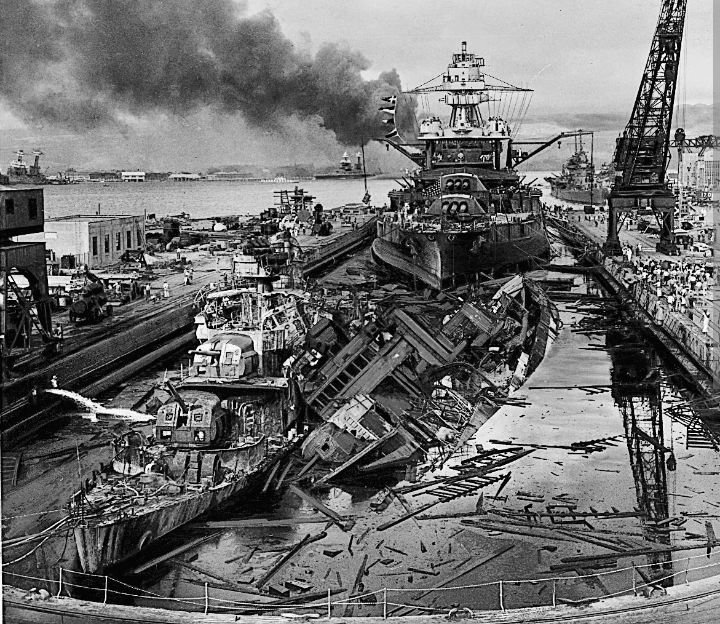
The attack inflicted severe damage on the United States Pacific Fleet.
Eight American battleships were damaged, including USS Arizona, USS Oklahoma, USS West Virginia, USS California, USS Nevada, USS Tennessee, USS Maryland, and USS Pennsylvania. Several other naval vessels also suffered damage.
USS Arizona suffered a catastrophic explosion after a Japanese bomb penetrated its forward ammunition magazine. The resulting explosion destroyed much of the battleship and killed 1,177 crew members.
USS Oklahoma was struck by multiple torpedoes and capsized. Hundreds of sailors died aboard the vessel, while survivors attempted to escape through the overturned hull.
USS West Virginia and USS California sank in shallow water after sustaining multiple hits. USS Nevada attempted to leave the harbor but was damaged and eventually grounded to prevent it from sinking in a vulnerable channel.
The Japanese attack also destroyed or damaged hundreds of American aircraft. Many were struck while parked at airfields, where they had been positioned close together partly to protect against sabotage.
Despite the destruction, the attack did not eliminate the entire American Pacific Fleet. Three American aircraft carriers—USS Enterprise, USS Lexington, and USS Saratoga—were not at Pearl Harbor during the assault. Their absence became significant in subsequent Pacific naval operations.
American submarine facilities and important shore-based infrastructure also survived, allowing the United States to retain capabilities needed to continue the war.
Casualties of the Pearl Harbor Attack
The attack killed 2,403 Americans and wounded 1,178 others.
The dead included members of the United States Navy, Army, Marine Corps, and civilian personnel. Many victims died when ships were bombed, torpedoed, or engulfed in explosions and fires.
The destruction of USS Arizona accounted for a substantial proportion of American deaths. Hundreds of crew members aboard USS Oklahoma also perished when the ship capsized.
Japanese losses were considerably smaller. Twenty-nine Japanese aircraft were destroyed, and five Japanese midget submarines were lost. Japanese personnel were also killed or captured.
The difference in casualties reflected the effectiveness of the surprise attack and the concentration of American forces at the naval base.
Although Japan inflicted heavy damage, the attack did not achieve all its strategic objectives.
The absence of the American aircraft carriers was particularly important. By December 1941, aircraft carriers were becoming central to naval warfare, and their survival preserved a major component of American fighting power in the Pacific.
The Japanese operation also left important American facilities intact. The harbor’s fuel storage facilities, repair yards, and submarine base were not destroyed on the scale necessary to prevent the United States from continuing naval operations.
Several damaged American battleships were subsequently repaired and returned to service. Although USS Arizona and USS Oklahoma were total losses, other vessels were salvaged and restored.
The attack therefore inflicted a serious immediate defeat without permanently eliminating the United States’ capacity to fight a prolonged war.
December 8, 1941: The United States Declares War on Japan
On December 8, 1941, President Franklin D. Roosevelt addressed a joint session of Congress.
He described December 7 as a date that would live in infamy and asked Congress to recognize that a state of war existed between the United States and Japan.
Congress approved the declaration of war that day, with only one member, Representative Jeannette Rankin of Montana, voting against it.
Roosevelt’s address helped consolidate public support for American entry into the conflict. The attack transformed public opinion, and the policy debate over direct participation in the war gave way to a national commitment to defeat Japan.
On December 11, 1941, Germany and Italy declared war on the United States in accordance with their alliance with Japan. The United States responded by declaring war on both countries.
The conflict consequently expanded America’s formal participation in World War II across both the Pacific and European theaters.
Pearl Harbor accelerated the transformation of the United States into a wartime nation.
The federal government expanded military recruitment, increased defense spending, and mobilized industrial production on an unprecedented scale. American factories converted to wartime manufacturing, producing aircraft, ships, tanks, weapons, ammunition, and other military supplies.
Millions of Americans entered the armed forces or worked in industries supporting the war effort. Women took on expanded roles in factories and other jobs traditionally dominated by men, while military service and industrial mobilization affected communities throughout the country.
The attack also intensified suspicion and hostility toward Japanese Americans.
On February 19, 1942, Roosevelt signed Executive Order 9066, which authorized military authorities to designate areas from which people could be excluded. The policy contributed to the forced removal and incarceration of approximately 120,000 people of Japanese ancestry, most of whom were American citizens or legal residents. Many lost homes, businesses, and personal property.
The incarceration was not a military necessity established by evidence of individual disloyalty; it reflected wartime prejudice, fear, and government policy. The United States later formally acknowledged the injustice. In 1988, Congress passed the Civil Liberties Act, which included a government apology and provisions for compensation for eligible survivors.
The Pacific War After Pearl Harbor
Japan continued its military expansion after the attack. Japanese forces advanced across Southeast Asia and the western Pacific, capturing territories including the Philippines, British Malaya, Singapore, and the Dutch East Indies during the early months of 1942.
American forces subsequently began rebuilding their position in the Pacific.
In May 1942, the Battle of the Coral Sea halted a Japanese attempt to advance toward Port Moresby by sea. The following month, the Battle of Midway dealt Japan a major naval defeat. American forces sank four Japanese aircraft carriers, weakening Japan’s ability to conduct large-scale carrier operations.
The United States and its allies later pursued a prolonged campaign across the Pacific, using naval operations, amphibious assaults, air power, and advances through strategically important islands.
The war against Japan continued until August 1945, when the United States dropped atomic bombs on Hiroshima and Nagasaki. The Soviet Union also entered the war against Japan in August, launching military operations in Japanese-occupied territories in Asia.
Japan announced its surrender on August 15, 1945, following the atomic bombings and Soviet entry into the war. The formal surrender ceremony took place aboard USS Missouri in Tokyo Bay on September 2, 1945.
Pearl Harbor’s Place in American History
The Pearl Harbor attack remains one of the most consequential military events in United States history.
It ended the country’s position outside the war as a formal belligerent and led directly to American entry into World War II. The attack also helped unite public opinion behind the war effort and accelerated the expansion of American military and industrial power.
Its immediate military consequences were severe, but the survival of the American aircraft carriers and key support facilities allowed the Pacific Fleet to recover. Subsequent victories at Coral Sea and Midway helped change the direction of the Pacific War.
Pearl Harbor also left a lasting legacy in American public memory. The deaths of military personnel and civilians, the destruction of USS Arizona, and the consequences of wartime mobilization continue to shape how the attack is remembered.
The attack demonstrated the vulnerability of even a major military base to a coordinated surprise assault. More broadly, it marked the beginning of a period in which the United States committed its full military and industrial resources to a global war that reshaped international politics.
Japan’s attack on Pearl Harbor on December 7, 1941, was a decisive turning point in American history. It caused extensive military destruction and thousands of casualties, prompted the United States to declare war on Japan, and drew the country into World War II.
Although the assault damaged much of the Pacific Fleet’s battleship force, it failed to destroy the American aircraft carriers or eliminate the facilities needed to sustain future naval operations.
The United States subsequently mobilized its military and industrial resources, fought across the Pacific and European theaters, and emerged from the war as one of the world’s leading powers.
The Historabase Editorial Team is dedicated to exploring and sharing the stories that have shaped Africa and the wider world. Our work covers African history, ancient civilizations, empires, historical figures, wars, cultures, political movements, and important events from the past.
We aim to present history in a clear, engaging, and accessible way, combining historical records with careful research to help readers better understand the people, events, and civilizations that shaped our world.