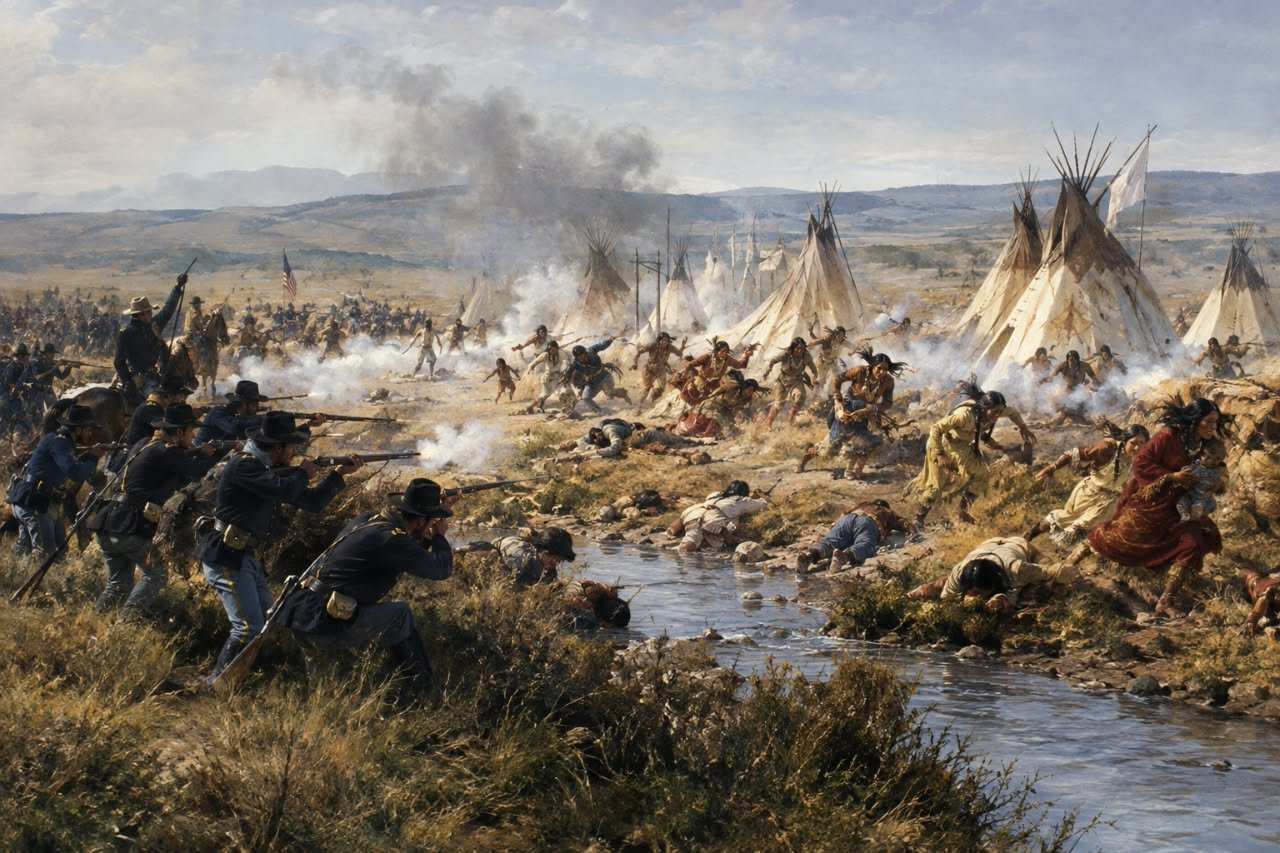
The Sand Creek Massacre occurred on November 29, 1864, when Colorado Territory militia under Colonel John M. Chivington attacked a camp of Cheyenne and Arapaho people along Sand Creek in southeastern Colorado. Hundreds of Native Americans were killed, including women, children, and elderly people.
The attack took place during a period of escalating conflict between Indigenous nations and white settlers in the American West. Although some Cheyenne and Arapaho leaders had pursued peace with U.S. authorities, the massacre demonstrated the deadly consequences of the territorial conflict and became one of the most notorious atrocities in the history of the American Indian Wars.
The Background to the Sand Creek Massacre
During the 1850s and early 1860s, increasing numbers of white settlers moved into the Colorado region, particularly following the discovery of gold in 1858. The expansion of settlements disrupted the traditional lands and hunting grounds of Indigenous peoples, including the Cheyenne and Arapaho.
Tensions increased as settlers, miners, and government officials competed for control of the region’s land and resources. Treaties intended to establish boundaries and regulate relations between Indigenous nations and the United States failed to prevent further encroachment.
The Treaty of Fort Laramie of 1851 had recognized extensive territories used by several Indigenous nations, including the Cheyenne and Arapaho. However, the discovery of gold and the growth of American settlements intensified pressure on those lands.
In 1861, the Treaty of Fort Wise significantly reduced the territory reserved for the Cheyenne and Arapaho who agreed to its terms. Not all Indigenous leaders accepted the treaty, and disagreements over land, authority, and relations with the United States contributed to divisions within the communities.
As violence spread across the Colorado region, attacks and reprisals involving Indigenous warriors, settlers, and military forces deepened hostilities.
The Cheyenne and Arapaho at Sand Creek
By the autumn of 1864, tensions had intensified across Colorado Territory. Territorial governor John Evans issued proclamations calling on Indigenous people considered peaceful to identify themselves and seek protection at designated military posts.
Black Kettle, a prominent Southern Cheyenne leader, sought peace with U.S. authorities. He and other leaders hoped that cooperation would protect their people from military attacks.
In the autumn of 1864, Black Kettle and his followers moved to a camp along Sand Creek in southeastern Colorado. The camp included Cheyenne people and members of the Arapaho community associated with Chief Niwot, also known as Left Hand.
The group was positioned near Fort Lyon, where military officials had been involved in discussions concerning the people’s status and the possibility of peace.
Black Kettle believed his people would be safe after receiving assurances that they would not be attacked if they remained peaceful. An American flag and a white flag were displayed at his camp, reflecting his efforts to demonstrate peaceful intentions.
However, the broader military situation remained hostile, and the camp’s presence did not prevent the approaching attack.
Colonel John Chivington and the Attack
John M. Chivington, a former Methodist minister and prominent Union military officer, commanded the Colorado Territory volunteer force that attacked the camp.
In November 1864, Chivington led approximately 675 troops toward Sand Creek. His force consisted primarily of members of the 3rd Colorado Cavalry, accompanied by soldiers from the 1st Colorado Cavalry.
In the early morning of November 29, the soldiers approached the Indigenous encampment while many of its inhabitants were still there.
Chivington ordered the attack despite the presence of women, children, and other noncombatants in the camp. The soldiers opened fire on the people gathered along Sand Creek.
Some Indigenous people attempted to escape, while others sought shelter in the creek bed or dugouts. Black Kettle reportedly tried to protect his people by raising an American flag and a white flag above his lodge.
The soldiers continued firing as people fled the encampment. The attack developed into a massacre in which hundreds of Cheyenne and Arapaho people were killed.
The Death Toll and the Victims
The precise number of people killed at Sand Creek remains uncertain. Historical estimates commonly place the death toll at approximately 150 to 230 Indigenous people, although accounts vary.
The victims included women, children, elderly people, and men. The presence of large numbers of noncombatants was one of the central issues raised during subsequent investigations into the attack.
Many survivors escaped from the camp and later reported what had happened. Their accounts described the killing of people who had not been participating in hostilities and the destruction of the encampment.
The massacre also left survivors without many of their possessions, shelter, and essential supplies as they fled the area.
Black Kettle survived the attack, although he was killed several years later during another U.S. military assault at the Battle of the Washita in 1868.
The Aftermath of the Massacre
Following the attack, Chivington and some of his supporters initially portrayed the operation as a military victory against hostile Indigenous forces. Some members of the public also received reports that presented the incident as a successful engagement.
However, accounts from survivors and soldiers who had participated in the attack challenged that description.
Several soldiers expressed outrage over the killing of women and children. Captain Silas Soule, who commanded a company of the 1st Colorado Cavalry, had refused to participate in the attack and subsequently provided testimony about what had occurred.
Soule’s account became an important source of evidence concerning the conduct of the troops. He described the killing of Indigenous people who were not engaged in fighting and challenged claims that the attack had been a legitimate battle.
In the months that followed, reports of the massacre reached military and government officials, prompting investigations into the conduct of Chivington and his men.
The Government Investigations
The Sand Creek Massacre became the subject of several official investigations in 1865.
A U.S. Army investigation examined the attack and the conduct of the troops. A congressional committee also investigated the massacre as part of a broader examination of relations between the United States and Indigenous peoples in the region.
The investigations heard testimony from military personnel and others familiar with the events. Evidence indicated that the camp contained substantial numbers of noncombatants and that the attack had involved the killing of people who posed no immediate threat to the soldiers.
The congressional investigation condemned the massacre and criticized Chivington’s actions. The findings challenged the military justification offered by Chivington and his supporters.
However, Chivington was no longer in active military service when the investigations concluded, and he was not court-martialed for the massacre.
The investigations exposed serious misconduct and contributed to growing criticism of the treatment of Indigenous peoples by U.S. military forces.
The Consequences for Cheyenne and Arapaho Communities
The Sand Creek Massacre intensified hostility between Indigenous nations and the United States. Many Cheyenne and Arapaho people who had sought peace lost confidence in the possibility of protection through negotiations with American authorities.
The attack contributed to further conflict across the Great Plains. Some Indigenous warriors joined campaigns against American settlements and military forces, while others continued to pursue negotiations under increasingly difficult circumstances.
The massacre also became an enduring source of grief for the descendants of those who were killed.
In the years that followed, the United States continued its westward expansion, while Indigenous nations faced further military campaigns, territorial losses, and restrictions on their traditional ways of life.
The massacre remained a significant event in the history of relations between Indigenous peoples and the federal government.
The Historical Legacy of the Sand Creek Massacre
The Sand Creek Massacre is remembered as one of the most notorious attacks against Indigenous people during the American Indian Wars.
Its historical significance lies not only in the number of people killed but also in the circumstances surrounding the attack. The presence of women and children, the peace efforts associated with Black Kettle, and the subsequent investigations made Sand Creek a major example of the violence experienced by Indigenous communities during American territorial expansion.
The massacre also demonstrated the difficulties faced by Indigenous leaders who attempted to negotiate with U.S. authorities while military conflict and settler expansion continued.
Today, the site is preserved as the Sand Creek Massacre National Historic Site in Colorado. Established in 2007, it commemorates the Cheyenne and Arapaho people who were killed and recognizes the historical significance of the event.
The massacre remains an important subject in the study of American history, particularly the history of Indigenous peoples, westward expansion, military violence, and the consequences of broken peace efforts.
On November 29, 1864, U.S. territorial troops under Colonel John M. Chivington attacked a Cheyenne and Arapaho encampment at Sand Creek in Colorado Territory, killing an estimated 150 to 230 people.
The massacre occurred despite peace efforts by Indigenous leaders, including Black Kettle, and resulted in the deaths of many women, children, and other noncombatants.
Subsequent military and congressional investigations condemned the attack and challenged the claims that it had been a legitimate military victory. Although Chivington faced public condemnation, he was never court-martialed for his role.
The Sand Creek Massacre remains a defining tragedy in the history of the American West and a lasting reminder of the devastating consequences of conflict between the United States and Indigenous nations.
The Historabase Editorial Team is dedicated to exploring and sharing the stories that have shaped Africa and the wider world. Our work covers African history, ancient civilizations, empires, historical figures, wars, cultures, political movements, and important events from the past.
We aim to present history in a clear, engaging, and accessible way, combining historical records with careful research to help readers better understand the people, events, and civilizations that shaped our world.