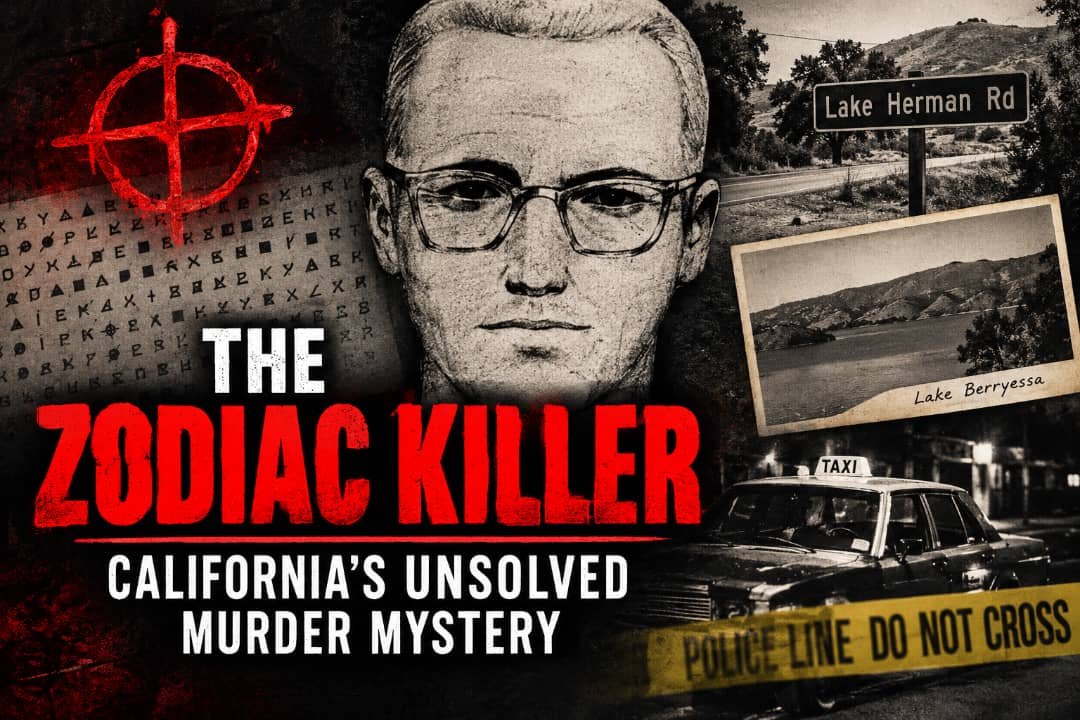
The Zodiac Killer was an unidentified serial killer who terrorized Northern California in the late 1960s, murdering people and sending cryptic letters to newspapers and law enforcement agencies. His crimes, threatening messages, and coded communications made him one of the most notorious unidentified murder suspects in American criminal history.
Despite decades of investigations, numerous suspects, and extensive attempts to decipher his messages, the killer’s identity has never been conclusively established.
The Beginning of the Zodiac Killer Murders
The attacks attributed to the Zodiac Killer began in Northern California in December 1968. On December 20, 1968, two teenagers, David Faraday, 17, and Betty Lou Jensen, 16, were shot and killed near Lake Herman Road, outside Benicia, California.
The couple had been parked along a secluded roadside when they were attacked. Investigators found their bodies near the vehicle, but the person responsible was not identified.
The killings remained unsolved for several months until another attack occurred in July 1969.
On July 4, 1969, Darlene Ferrin, 22, and Michael Mageau, 19, were sitting in a parked car at Blue Rock Springs Park in Vallejo, California, when a gunman approached and opened fire.
Ferrin died from her injuries, while Mageau survived despite being seriously wounded.
The following day, a man telephoned the Vallejo Police Department and claimed responsibility for the murders at Blue Rock Springs Park. He also claimed responsibility for the December 1968 killings of Faraday and Jensen.
The telephone call marked an important development in the investigation, as authorities began examining the possibility that the attacks were connected.
The Zodiac Letters and Cryptic Codes
In late July 1969, three newspapers in the San Francisco Bay Area received letters from someone claiming responsibility for the shootings. Each letter contained details about the crimes and included a portion of a coded message.
The writer demanded that the letters and codes be published in newspapers, threatening further killings if the demands were ignored.
The letters were sent to the San Francisco Chronicle, the San Francisco Examiner, and the Vallejo Times-Herald.
On August 1, 1969, the newspapers published the letters and their accompanying codes. The writer subsequently became known as the Zodiac Killer after using the name “Zodiac” in later communications.
The first major cipher, consisting of 408 symbols, was deciphered by Donald and Bettye Harden, a married couple from California, and submitted to the San Francisco Chronicle in August 1969.
The message contained disturbing statements about killing and the writer’s desire to gain attention. However, it did not reveal the killer’s identity.
A second major cipher, containing 340 characters, was sent to the San Francisco Chronicle in November 1969. It remained unsolved for more than 50 years before David Oranchak, Sam Blake, and Jarl Van Eycke deciphered it in 2020.
The decoded message did not identify the killer.
The letters frequently included threats, references to previous attacks, and claims about future murders. Some were signed with a distinctive crosshair-like symbol that became associated with the case.
These communications turned the investigation into a highly publicized mystery, drawing attention from across the United States.
The Lake Berryessa Attack
On September 27, 1969, another attack occurred at Lake Berryessa in Napa County, California.
Bryan Hartnell, 20, and Cecelia Shepard, 22, were relaxing near the lake when a man approached them wearing a dark hood with a white crosshair symbol on the front.
The attacker carried a gun and restrained the couple before stabbing them repeatedly.
Hartnell survived the attack, but Shepard died two days later from her injuries.
The assailant left a message on Hartnell’s car door, recording the dates of previous attacks and identifying himself with the Zodiac name and symbol.
After the attack, the killer telephoned the Napa County Sheriff’s Office and reported the incident.
Hartnell’s survival provided investigators with an eyewitness account of the attacker, although it did not lead to a confirmed identification.
The Murder of Paul Stine in San Francisco
On October 11, 1969, a taxi driver named Paul Stine, 29, was shot and killed while working in San Francisco.
Stine had picked up a passenger who directed him to the Presidio Heights neighborhood. The passenger shot him in the head while the taxi was stopped.
Police officers responding to the scene encountered a man in the area, but a communication error initially led them to believe they were searching for a Black suspect rather than a white man. This mistake may have contributed to the suspect’s escape.
Investigators later received a letter from the Zodiac Killer containing pieces of Stine’s bloodstained shirt. The evidence strengthened the connection between the letter writer and the murder.
The Stine killing was particularly significant because it occurred within a residential neighborhood of San Francisco rather than at an isolated location outside the city.
Following the murder, the killer continued sending communications to newspapers and law enforcement agencies.
Threats Against the Public and Police
As the investigation continued, the Zodiac Killer used letters to threaten further violence and challenge authorities.
In his communications, he claimed responsibility for additional murders and sometimes provided details intended to demonstrate his knowledge of the crimes.
He also threatened to target schoolchildren and public transportation, creating widespread concern among residents of Northern California.
The threats received considerable media attention, and police departments in several jurisdictions worked to investigate the crimes and evaluate possible connections between cases.
However, many of the killer’s claims could not be independently verified. Although he claimed responsibility for numerous killings, investigators officially associated him with five murders and two surviving victims from four confirmed attacks between December 1968 and October 1969.
The actual number of victims, if any beyond those confirmed, remains unknown.
The Investigation and Suspects
The Zodiac case involved several law enforcement agencies, including police departments in Vallejo and San Francisco, as well as authorities in Napa County.
Investigators examined physical evidence, handwriting, fingerprints, eyewitness accounts, and the letters sent to newspapers.
Despite these efforts, no suspect was conclusively identified.
Over the years, several individuals attracted investigative attention or were publicly proposed as possible suspects. One of the most widely discussed was Arthur Leigh Allen, a former schoolteacher who lived in the area.
Allen came under scrutiny during the investigation and was interviewed by authorities. Investigators searched his property, but he was never charged with the Zodiac murders. He died in 1992.
Other individuals have been suggested as suspects by investigators, journalists, independent researchers, and members of the public. However, none has been conclusively established as the Zodiac Killer.
The case has also generated competing theories about the meaning of the killer’s letters, the number of crimes attributable to him, and whether some communications were genuine.
The absence of a confirmed identity has allowed speculation to persist for decades.
The Disappearance of the Zodiac Letters
The Zodiac Killer’s communications became less frequent during the early 1970s. Although letters and postcards attributed to him continued to appear, the number of communications declined, and the original series of confirmed attacks did not resume in the same documented pattern.
In March 1971, the Los Angeles Times received a letter from someone claiming to be the Zodiac. The writer criticized the police investigation and referred to previous crimes.
Additional communications appeared in subsequent years, but questions arose about their authenticity and whether they came from the original killer.
One of the most notable later communications was a 1974 letter associated with the name “Zodiac,” although its authorship has also been debated.
The disappearance of confirmed communications left investigators without a reliable way to determine whether the killer had died, been imprisoned for another crime, moved away, or simply stopped contacting the media.
None of these possibilities has been conclusively established.
The Historabase Editorial Team is dedicated to exploring and sharing the stories that have shaped Africa and the wider world. Our work covers African history, ancient civilizations, empires, historical figures, wars, cultures, political movements, and important events from the past.
We aim to present history in a clear, engaging, and accessible way, combining historical records with careful research to help readers better understand the people, events, and civilizations that shaped our world.









One Comment