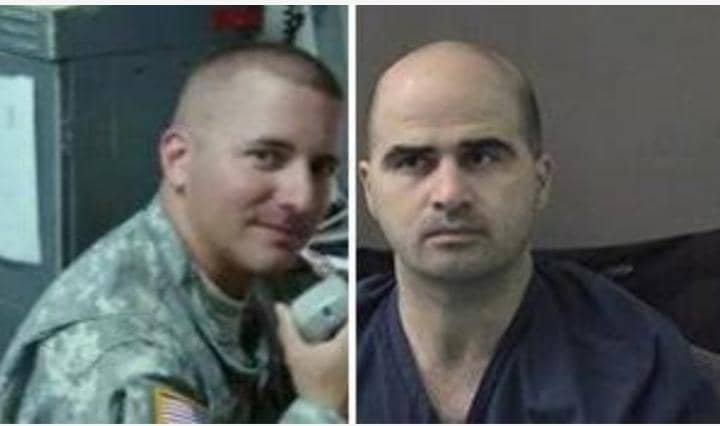
On November 5, 2009, a mass shooting at Fort Hood, a United States Army installation in Killeen, Texas, left 13 people dead and 32 others wounded. The gunman was Major Nidal Malik Hasan, an Army psychiatrist who opened fire inside the installation’s Soldier Readiness Processing Center.
The attack became one of the deadliest mass shootings at a U.S. military installation. It also prompted investigations into Hasan’s ideological beliefs, his communications with a radical cleric, and concerns about how the military had handled information about him before the shooting.
Hasan was subsequently convicted of 13 counts of premeditated murder and 32 counts of attempted murder by a military jury in August 2013. He was sentenced to death.
Who Was Nidal Malik Hasan?
Nidal Malik Hasan was a U.S. Army major and psychiatrist. Before the shooting, he had received medical training and served in military medical facilities, including Walter Reed Army Medical Center in Washington, D.C.
His professional responsibilities involved the mental health of military personnel. His background as an Army psychiatrist later became a significant aspect of public discussion about the attack.
Before November 2009, Hasan’s conduct and communications had attracted attention. His contacts with Anwar al-Awlaki, a radical cleric who later became a prominent al-Qaeda figure, subsequently became an important subject of the investigation into his motivations.
The November 5, 2009, Shooting
On November 5, 2009, Hasan opened fire at the Soldier Readiness Processing Center at Fort Hood, where military personnel underwent medical examinations and administrative procedures associated with their readiness for deployment.
Armed with two handguns, he shot military personnel and others inside the facility. Witnesses reported hearing him shout “Allahu Akbar” during the attack.
The shooting caused panic as people attempted to escape, find shelter, and assist the wounded.
Responding law enforcement officers confronted Hasan and shot him. He survived the encounter but sustained severe injuries that left him paralyzed from the waist down. He was taken into custody and subsequently faced military criminal proceedings.
By the time the shooting ended, 13 people had been killed and 32 others had been wounded.
The attack occurred inside the United States, at an Army installation, rather than during a military engagement overseas.
The 13 Victims of the Attack
The shooting claimed the lives of 13 people, including military personnel and a civilian employee.
The victims were members of the Fort Hood community whose deaths affected their families, colleagues, and fellow service members. The 32 wounded survivors also faced the consequences of the attack, including physical injuries that required medical treatment.
The deaths became a central part of the subsequent criminal proceedings against Hasan, who was charged with murdering the 13 victims and attempting to murder those who survived.
The incident also prompted renewed attention to security arrangements at military installations and the protection of personnel carrying out routine administrative duties.
Hasan’s Ideological Motivations and Contact With Anwar al-Awlaki
Investigators examined Hasan’s beliefs, communications, and statements to establish the circumstances surrounding the shooting.
One important aspect of the investigation was his contact with Anwar al-Awlaki, a U.S.-born radical cleric associated with al-Qaeda.
Hasan had communicated with al-Awlaki before the attack. These communications later attracted considerable attention because of al-Awlaki’s extremist ideology and his subsequent role in al-Qaeda.
Hasan’s opposition to U.S. military operations involving Muslim countries also formed part of the discussion surrounding his motivations.
The investigation raised questions about the relationship between ideological radicalization, potential warning signs, and the ability of authorities to identify threats before violence occurs.
However, evidence of communication or ideological influence does not, by itself, establish that another individual directly participated in planning or carrying out the shooting.
The Military Trial and Death Sentence
Hasan faced a military court-martial for the killings and attempted murders.
His trial began on August 6, 2013. He represented himself during the proceedings after choosing to act as his own attorney.
On August 23, 2013, the military jury found him guilty of 13 counts of premeditated murder and 32 counts of attempted murder.
The verdict corresponded to the 13 people killed and the 32 people wounded during the November 2009 attack.
On August 28, 2013, the jury sentenced Hasan to death.
The sentence marked the conclusion of the trial’s sentencing phase, but it did not mean that an execution would occur immediately. Military death sentences in the United States are subject to further legal review and procedures.
Hasan’s case subsequently became part of the broader history of capital punishment under the U.S. military justice system.
The Reported 2026 Execution Date
Claims have circulated that Hasan’s execution by firing squad has been scheduled for December 3, 2026.
However, that specific date and the reported execution method require confirmation from an authoritative source. The fact that Hasan received a death sentence in 2013 does not, by itself, establish that an execution date has been set.
Any report concerning a scheduled execution must be supported by an official announcement or relevant legal documentation confirming the status of his sentence and the execution arrangements.
Until such confirmation is available, the December 3, 2026, date should not be presented as an established fact.
The Historabase Editorial Team is dedicated to exploring and sharing the stories that have shaped Africa and the wider world. Our work covers African history, ancient civilizations, empires, historical figures, wars, cultures, political movements, and important events from the past.
We aim to present history in a clear, engaging, and accessible way, combining historical records with careful research to help readers better understand the people, events, and civilizations that shaped our world.