Few inventions have changed human history as profoundly as the printing press. Before its development in Europe during the 15th century, books were expensive, difficult to produce and largely accessible only to wealthy people, religious institutions and scholars. The invention of movable-type printing by Johannes Gutenberg transformed the way information was produced and shared, helping to reshape education, religion, politics and science.
For centuries, books in Europe were copied by hand, mainly by professional scribes working in monasteries and other religious institutions. Producing a single book could take months or even years. Because of the time and cost involved, books were rare and expensive.
Printing itself was not entirely new. China had developed woodblock printing centuries earlier, and Korea had experimented with movable metal type. However, Europe had not yet developed a system capable of producing books quickly and efficiently on a large scale.
This changed in the mid-15th century.
Johannes Gutenberg and His Breakthrough
Johannes Gutenberg was a German craftsman, inventor and goldsmith from Mainz. Around the 1440s and 1450s, he developed a practical printing system based on movable metal type.
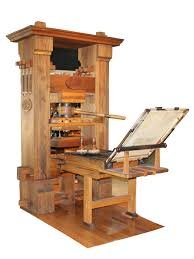
His achievement was not simply the invention of a machine. Gutenberg combined several technologies and techniques, including individually cast metal letters, oil-based ink and a modified screw press. Together, these innovations allowed printers to reproduce pages much faster and more consistently than hand copying.
The movable type could be rearranged and reused to print different pages, making the process more efficient and economical.
Gutenberg’s most famous achievement was the Gutenberg Bible, produced around 1455. Printed in Latin, it demonstrated the remarkable quality that could be achieved with the new technology.
The Rapid Spread of Printing
Gutenberg’s method quickly spread beyond Mainz. Printing workshops appeared in cities across Europe, including Venice, Paris, Rome and London.
As printing became more widespread, the number of books increased dramatically. Printers produced religious texts, classical works, educational materials, scientific writings, maps and political pamphlets.
The cost of books gradually fell, making written knowledge available to a much broader section of society.
The printing press therefore helped create a new culture of reading and learning. People who previously had limited access to books could increasingly obtain printed materials.
The Printing Press and the Reformation
One of the most significant consequences of the printing press was its effect on religion.
During the 16th century, Martin Luther and other reformers used printed pamphlets and translated religious texts to spread their ideas across Europe. Instead of remaining confined to universities or church institutions, controversial arguments could reach thousands of ordinary people.
The printing press did not cause the Protestant Reformation by itself, but it greatly accelerated the spread of Reformation ideas and allowed debates about religion to reach a much larger audience.
Transforming Science and Education
The printing revolution also transformed science. Scholars could publish their discoveries and communicate ideas more efficiently with other researchers.
Scientific works could be reproduced accurately and distributed across different countries. This helped create a wider community of scholars who could examine, criticize and build upon one another’s discoveries.
Education benefited as well. Universities and schools gained greater access to textbooks, dictionaries, classical literature and other learning materials. Over time, increased access to printed information contributed to rising literacy and the growth of educated populations.
A New Age of Information
The printing press also changed politics and society. Governments, political movements and ordinary citizens gained a powerful means of communicating ideas.
Newspapers, pamphlets and printed books eventually became important tools for political debate and public opinion. Ideas could travel beyond local communities and influence people thousands of kilometres away.
This represented a major shift in human communication. Knowledge was no longer dependent entirely on people physically passing information from one person to another.
Gutenberg’s Lasting Legacy
Johannes Gutenberg did not invent writing, paper or printing itself. His historic contribution was combining existing technologies into a highly effective system for mass-producing books with movable type.
His invention helped create the conditions for Europe’s intellectual and cultural transformation. The Renaissance, Reformation, Scientific Revolution and later spread of mass education were all influenced by the expanding availability of printed information.
The printing press also established an important principle that remains relevant today: whoever can control the production and distribution of information can profoundly influence society.
From the first printed Bibles to modern newspapers, textbooks and digital publishing, Gutenberg’s legacy continues to shape the way humanity shares knowledge.
The printing press was therefore far more than a machine for producing books. It was a revolution in communication, one that helped move the world from an age of limited information into an era of widespread knowledge.
The Historabase Editorial Team is dedicated to exploring and sharing the stories that have shaped Africa and the wider world. Our work covers African history, ancient civilizations, empires, historical figures, wars, cultures, political movements, and important events from the past.
We aim to present history in a clear, engaging, and accessible way, combining historical records with careful research to help readers better understand the people, events, and civilizations that shaped our world.