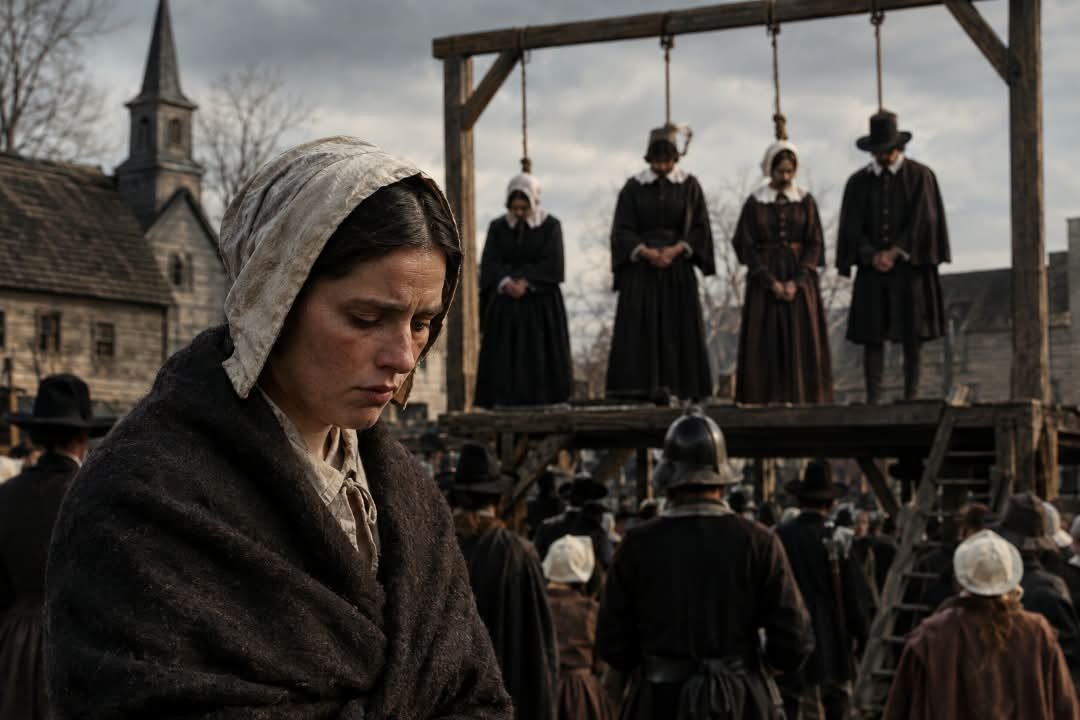
In 1692, a wave of accusations of witchcraft swept through colonial Massachusetts, leading to one of the most infamous episodes of mass hysteria in American history. Known as the Salem witch trials, the crisis resulted in the imprisonment of numerous people, the execution of 19 individuals by hanging, and the death of at least five others in custody.
The accusations began in a small community and eventually spread across Salem and neighbouring settlements. People who had lived ordinary lives suddenly found themselves accused of making pacts with the Devil, harming their neighbours through supernatural powers, or participating in witchcraft.
Among the victims were respected church members, elderly women, a former minister, and people whose only defence against the accusations was their own denial. Some maintained their innocence until their deaths, while others were condemned based on testimony that would later be widely discredited.
The Salem witch trials remain a significant historical example of how fear, religious beliefs, community conflicts, and failures of the judicial system can combine to produce devastating consequences.
1. Bridget Bishop: The First Person Executed
Bridget Bishop became the first person executed during the Salem witch trials when she was hanged on June 10, 1692.
Bishop was a resident of Salem who had previously faced accusations of witchcraft in 1680. Her reputation, personal conflicts, and unconventional behaviour contributed to suspicions surrounding her.
When the accusations intensified in 1692, Bishop was among the first people formally accused and brought before the court.
During her examination, several accusers claimed that she had afflicted them through supernatural means. Other testimony focused on alleged encounters with her spirit and claims that she had harmed people through witchcraft.
Bishop denied the accusations, but the court found her guilty.
On June 10, she was taken to Gallows Hill, the execution site in Salem, where she was hanged.
Her execution marked the beginning of a series of deaths that would continue throughout the summer and early autumn of 1692.
Bridget Bishop’s case became one of the most significant events of the trials because it demonstrated how quickly accusations could lead to a death sentence.
2. Rebecca Nurse: The Respected Church Member
Rebecca Nurse was one of the most well-known victims of the Salem witch trials.
Born in England around 1621, Nurse was an elderly woman who lived in Salem Village with her family. She was widely regarded as a respected member of her community and had strong connections to the local church.
Her age and reputation made her arrest particularly shocking to many people who knew her.
In March 1692, Nurse was accused of witchcraft after several young women claimed that she had afflicted them. She was arrested and examined before local authorities.
During her examination, Nurse firmly denied the accusations.
Despite testimony from people who supported her character, she was tried and found guilty in June 1692.
The jury initially returned a guilty verdict, but the court asked it to reconsider after questions arose about one of Nurse’s statements. The jury again found her guilty.
Nurse was hanged on July 19, 1692, alongside four other women: Sarah Good, Elizabeth Howe, Susannah Martin, and Sarah Wildes.
Her execution became one of the most troubling episodes of the trials because she had been a respected member of the community for decades.
In later years, Rebecca Nurse came to represent the injustice suffered by innocent people during the witchcraft panic.
3. Sarah Good: The Poor Woman Accused of Witchcraft
Sarah Good was another prominent victim of the Salem witch trials.
Good was a poor woman who struggled with financial difficulties and depended on assistance from others. Her circumstances and strained relationships with members of the community made her vulnerable when accusations of witchcraft began.
In February 1692, she was accused of afflicting young girls who claimed to experience fits and other disturbing symptoms.
Good denied practising witchcraft during her examination. However, the accusers continued to identify her as one of the people responsible for their suffering.
Her young daughter, Dorcas Good, was also accused and imprisoned.
Sarah Good was tried and convicted in June 1692. She was executed by hanging on July 19, 1692, alongside Rebecca Nurse and three other women.
Before her execution, the Reverend Nicholas Noyes reportedly urged her to confess. According to historical accounts, Good rejected the accusation and responded with words challenging his own judgment.
Her death demonstrated how people living in poverty could become targets of suspicion during periods of intense fear.
Sarah Good remains one of the most recognisable names associated with the Salem witch trials.
4. Giles Corey: The Man Crushed to Death
Giles Corey suffered one of the most unusual and brutal deaths associated with the Salem witch trials.
Corey was an elderly farmer living in Salem Farms. In April 1692, he was accused of witchcraft and arrested.
He initially denied the accusation but later refused to enter a plea when brought before the court.
Under English common law at the time, a person who refused to plead could be subjected to a punishment known as peine forte et dure. Heavy stones were placed on the accused to force a plea.
On September 17, 1692, Corey was subjected to this punishment.
As more weight was added, he endured extreme physical pressure. Historical accounts state that he repeatedly demanded additional weight rather than submit to the court.
Corey died on September 19, 1692, after being crushed beneath the stones.
Because he refused to enter a plea, he was never formally tried or convicted of witchcraft.
His death became one of the most memorable episodes of the trials, illustrating the extreme punishments that could result from the judicial practices of the period.
Corey’s refusal to cooperate with the court has often been interpreted as an attempt to prevent the confiscation of his property through a conviction.
Whatever his precise motivations, his death remains one of the most disturbing events in the history of the Salem witch trials.
5. John Proctor: The Man Who Challenged the Accusations
John Proctor was a farmer and tavern owner who became one of the most prominent male victims of the Salem witch trials.
Unlike many of the accused, Proctor openly criticised the accusations and questioned the reliability of the young women whose claims were driving the proceedings.
In April 1692, he was accused of witchcraft and arrested. His wife, Elizabeth Proctor, was also accused.
During the proceedings, Proctor maintained that the accusations were false. He reportedly criticised the accusers and expressed concern that innocent people were being condemned.
His outspoken opposition did not save him.
Proctor was tried, found guilty, and sentenced to death.
On August 19, 1692, he was hanged alongside George Burroughs, George Jacobs Sr., John Willard, and Martha Carrier.
His wife, Elizabeth, was also convicted, but her execution was postponed because she was pregnant. She survived the trials.
John Proctor later became one of the best-known figures associated with Salem, partly because his story was dramatised in Arthur Miller’s 1953 play The Crucible.
Although the play took considerable artistic liberties, Proctor’s historical case remains important because it demonstrates that people who challenged the accusations could themselves become targets.
6. George Burroughs: The Former Minister Executed as a Witch
George Burroughs was a former minister who had served in Salem Village and other communities in colonial Massachusetts.
His previous connection to Salem made him a familiar figure, but disputes and suspicions surrounding his ministry contributed to the accusations against him.
In 1692, Burroughs was accused of witchcraft and arrested.
The allegations against him included claims that he possessed extraordinary physical strength and had used supernatural powers to harm others. Accusers also claimed that he had appeared to them in spectral form.
Burroughs denied practising witchcraft.
At his trial, the accusations and testimony against him were accepted by the court, and he was convicted.
On August 19, 1692, he was hanged alongside four other accused people.
According to historical accounts, Burroughs recited the Lord’s Prayer shortly before his execution. His ability to do so reportedly unsettled some observers because it was widely believed that a witch could not recite the prayer correctly.
However, the execution proceeded.
Burroughs’ death became particularly controversial because he had previously served as a minister. His case illustrated how even religious standing did not guarantee protection against accusations during the panic.
7. Martha Carrier: The Woman Accused of Spreading Witchcraft
Martha Carrier was another victim whose case attracted considerable attention during the Salem witch trials.
Carrier lived in Andover, Massachusetts, and was accused in May 1692.
Several accusers claimed that she had afflicted them through witchcraft. Some testimony also alleged that she had spread the supposed practice among other people.
During her examination, Carrier denied the accusations.
Nevertheless, the proceedings against her continued, and she was tried and convicted.
Carrier was executed on August 19, 1692, alongside John Proctor, George Burroughs, George Jacobs Sr., and John Willard.
Her case demonstrated how the accusations had expanded beyond Salem Village into neighbouring communities.
Martha Carrier became one of the many people whose lives were destroyed by allegations that relied heavily on testimony about invisible supernatural attacks.
8. Martha Corey: The Church Member Accused of Witchcraft
Martha Corey was a member of the Salem Village community whose accusation shocked some of her neighbours.
She was a churchgoing woman and the wife of Giles Corey.
In March 1692, Martha was accused of witchcraft after young girls claimed that she had afflicted them.
During her examination, she denied the allegations. However, her responses and behaviour were interpreted by some observers as suspicious.
Her arrest attracted attention partly because she was considered a respected member of the community.
Giles Corey initially expressed support for his wife, but he was subsequently accused of witchcraft himself.
Martha was convicted and hanged on September 22, 1692, alongside seven other people: Mary Easty, Alice Parker, Ann Pudeator, Margaret Scott, Wilmot Redd, Samuel Wardwell, and Mary Parker.
Her execution occurred during the final group of hangings associated with the Salem witch trials.
The deaths of Martha and Giles Corey made their family one of the most enduring examples of the devastation caused by the accusations.
9. Mary Easty: The Woman Who Pleaded for Justice
Mary Easty was the sister of Rebecca Nurse and another victim of the Salem witch trials.
She lived in Topsfield, Massachusetts, and was accused of witchcraft in April 1692.
Although she was initially released from custody, she was arrested again after further accusations were made against her.
Easty denied the charges throughout the proceedings.
Before her execution, she reportedly submitted a petition asking the authorities to reconsider the accusations and protect other innocent people from suffering the same fate.
Her appeal was particularly significant because it focused not only on her own innocence but also on the danger facing others accused of witchcraft.
The authorities did not grant her request.
Mary Easty was hanged on September 22, 1692.
Her execution took place during the final group of hangings, which included seven other accused people.
Easty’s petition remains an important historical document associated with the trials because it demonstrates that some accused individuals attempted to challenge the proceedings through formal appeals.
10. Alice Parker, Ann Pudeator, Margaret Scott, and the Other Final Victims
The final executions of the Salem witch trials took place on September 22, 1692.
Eight people were hanged that day, making it the last mass execution associated with the crisis.
Among the victims were Alice Parker, Ann Pudeator, Margaret Scott, Wilmot Redd, Samuel Wardwell, and Mary Parker, alongside Martha Corey and Mary Easty.
Their backgrounds varied, but each had been caught in a judicial process that accepted accusations of witchcraft as evidence of serious wrongdoing.
Margaret Scott was an elderly widow from Rowley, Massachusetts. She was accused of witchcraft and convicted before being executed.
Ann Pudeator was a widow who worked as a nurse. She was accused in 1692 and subsequently condemned.
Wilmot Redd, also known as Wilmot Read, lived in Marblehead and was accused during the expanding panic.
Samuel Wardwell was a labourer and fortune-teller who was accused of witchcraft. He initially confessed under pressure but later withdrew his confession. He was nevertheless convicted and executed.
Alice Parker and Mary Parker were also among those condemned during the crisis.
Their executions marked the end of the series of hangings that had claimed the lives of 19 people.
Although their individual stories received less attention than those of Bridget Bishop, Rebecca Nurse, and John Proctor, their deaths formed part of the same tragedy.
The End of the Salem Witch Trials
By the autumn of 1692, doubts about the proceedings had begun to grow.
The use of spectral evidence, which involved claims that an accused person’s spirit had appeared to harm someone, became increasingly controversial.
Prominent religious figures, including Increase Mather, criticised the use of questionable evidence in witchcraft cases. Governor William Phips eventually intervened, restricting the court’s proceedings and bringing the executions to an end.
In January 1693, a new court began hearing witchcraft cases. It rejected much of the evidence that had previously been accepted, and most of the remaining accused people were acquitted.
Those still imprisoned were eventually released, although the financial and personal consequences of the accusations continued long after the trials ended.
In 1697, the Massachusetts General Court declared a day of fasting and repentance over the tragedy. In subsequent years, the authorities took further steps to acknowledge the injustice, and compensation was eventually paid to some of the victims’ families.
In 1711, Massachusetts passed legislation reversing the convictions of many of those accused and providing compensation to their heirs.
The Salem witch trials had exposed serious weaknesses in the colonial justice system, particularly the acceptance of unreliable testimony and the influence of fear on legal decisions.
Conclusion
The Salem witch trials of 1692 remain one of the most infamous episodes in early American history.
Nineteen people were executed by hanging, Giles Corey was pressed to death, and several others died in custody. Hundreds of people were accused, arrested, or drawn into the proceedings as the crisis spread across colonial Massachusetts.
The victims included elderly women, respected church members, farmers, a former minister, and people from different social backgrounds. Their experiences demonstrate how accusations of witchcraft could overwhelm evidence, damage communities, and lead to irreversible punishments.
Today, the Salem witch trials are remembered as a historical warning about the consequences of mass fear, unjust accusations, and legal systems that fail to protect the rights of the accused.
The Historabase Editorial Team is dedicated to exploring and sharing the stories that have shaped Africa and the wider world. Our work covers African history, ancient civilizations, empires, historical figures, wars, cultures, political movements, and important events from the past.
We aim to present history in a clear, engaging, and accessible way, combining historical records with careful research to help readers better understand the people, events, and civilizations that shaped our world.








One Comment