Babi Yar Massacre. On September 29 and 30, 1941, Nazi German forces and security personnel murdered 33,771 Jewish men, women, and children at Babi Yar, a ravine near Kyiv in present-day Ukraine. One of the largest mass shootings of the Holocaust, the massacre destroyed a substantial part of Kyiv’s Jewish community and became a defining example of the systematic murder of Jews in Nazi-occupied Eastern Europe.
The Babi Yar Massacre took place shortly after German forces captured Kyiv during Operation Barbarossa, the invasion of the Soviet Union that began on June 22, 1941. The massacre was part of a broader campaign of persecution and mass murder carried out by Nazi Germany and its collaborators.
The German Occupation of Kyiv
Before the Second World War, Kyiv was home to a substantial Jewish community with deep historical roots. When German forces occupied the city in September 1941, its Jewish residents came under the control of the Nazi occupation authorities.
The invasion of the Soviet Union was accompanied by widespread violence against Jewish communities. German mobile killing units known as Einsatzgruppen followed the advancing army, carrying out mass executions of Jews and other groups targeted by the Nazi regime.
In Kyiv, German security authorities soon began organizing measures against the Jewish population. The explosions that struck buildings in the city center in September provided the occupation authorities with a pretext for intensifying their persecution.
Soviet security agencies had planted explosives in buildings subsequently used by German forces. When the devices detonated, fires and destruction followed. German authorities responded with reprisals and blamed the city’s Jewish population collectively, despite the lack of evidence that Jews as a group were responsible.
On September 28, 1941, occupation authorities posted notices ordering Kyiv’s Jews to assemble the following morning. They were instructed to bring identification documents, money, valuables, and clothing. Those who failed to comply faced threats of severe punishment.
Many residents had little understanding of what awaited them.
September 29, 1941: The Deportation to Babi Yar
On the morning of September 29, thousands of Jewish residents gathered at the designated assembly point. They included children, elderly people, and entire families carrying their personal belongings.
German authorities directed them through the city toward Babi Yar, a large ravine on Kyiv’s outskirts.
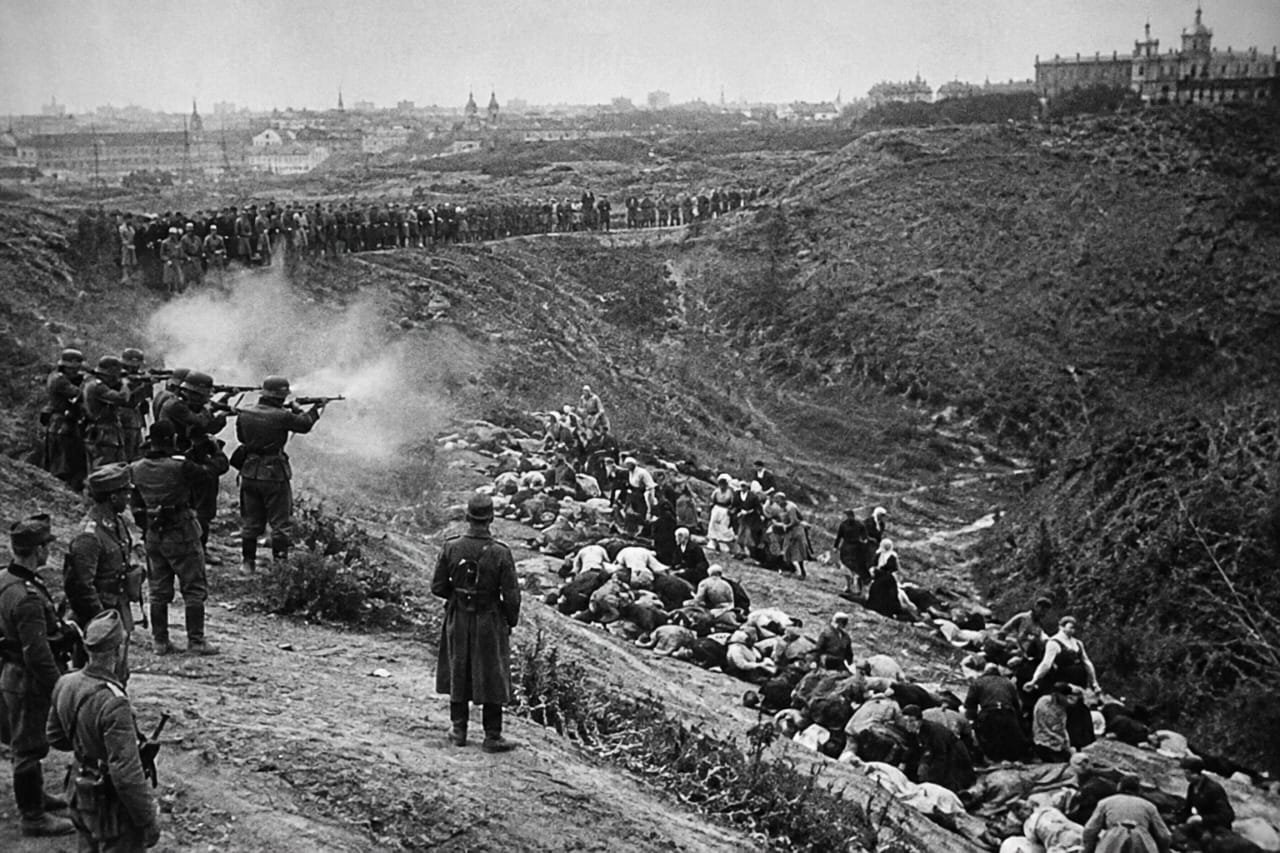
At the site, the victims were forced to surrender their possessions and remove their clothing. They were then taken in groups to the execution area and shot by German personnel. The killings continued as successive groups arrived.
According to a German security police report, 33,771 Jewish people were murdered at Babi Yar on September 29 and 30, 1941. The report documented the killings as part of the German authorities’ operational activities and remains an important piece of evidence of the massacre’s scale.
The victims were targeted because they were Jewish. The executions destroyed thousands of families and devastated a community that had been an integral part of Kyiv’s social and cultural life.
Unlike the mass murders carried out in gas chambers at extermination camps, the killings at Babi Yar were conducted by gunfire. Mass shootings were a central method of the Holocaust in occupied Soviet territories, particularly during the early stages of the German invasion.
Who Carried Out the Massacre?
The massacre was organized and carried out by German security forces and police personnel operating under Nazi occupation.
Sonderkommando 4a, a unit of Einsatzgruppe C, played a central role in the operation. Other German police formations and security personnel also participated.
The killings reflected the cooperation of different elements of the Nazi occupation apparatus. Mobile killing units, security police, and other German personnel worked together to carry out the mass execution.
Babi Yar was part of a wider pattern of mass shootings across occupied Eastern Europe, where German forces and their collaborators murdered Jewish communities near the towns and cities in which they had lived.
Although the murder of 33,771 Jews is the best-known event associated with Babi Yar, executions continued at the ravine throughout the German occupation.
Additional victims included Roma people, Soviet prisoners of war, communist officials, Ukrainian civilians, and others persecuted by the Nazi regime. Further Jewish victims were also murdered at the site.
The total number of people killed at Babi Yar during the occupation is commonly estimated at approximately 100,000, although historical estimates vary.
This broader figure includes victims from different groups and multiple executions. It should be distinguished from the documented number of Jewish people murdered during the two-day massacre in September 1941.
The Attempt to Conceal the Crimes
As Soviet forces advanced toward Kyiv in 1943, German authorities attempted to destroy evidence of their mass killings.
Prisoners were forced to exhume and burn bodies at Babi Yar in an effort to conceal the atrocities. Similar operations took place at other execution sites as the German military position deteriorated.
Despite these efforts, evidence survived through eyewitness testimony, German documentation, and subsequent investigations. Survivors and witnesses helped establish the circumstances of the massacre and the fate of those who had disappeared.
The surviving records became essential to the historical documentation of the Holocaust in Ukraine.
Soviet Rule and the Struggle to Remember
Soviet forces recaptured Kyiv in November 1943. However, the public commemoration of Babi Yar developed within the political constraints of the Soviet Union, where official accounts often emphasized the suffering of Soviet citizens collectively rather than the specifically Jewish character of the massacre.
For years, the absence of a memorial explicitly recognizing the Jewish victims remained a source of criticism.
In 1961, Soviet poet Yevgeny Yevtushenko published Babi Yar, a poem condemning antisemitism and criticizing the failure to adequately commemorate the victims. The work attracted international attention and was later incorporated into the first movement of Dmitri Shostakovich’s Symphony No. 13.
In 1976, Soviet authorities unveiled a monument at Babi Yar dedicated to Soviet citizens and prisoners of war murdered by the Nazis. However, the monument did not specifically identify the Jewish victims as the central victims of the September 1941 massacre.
Subsequent memorial efforts increasingly acknowledged the Jewish community’s destruction and the other groups murdered at the site.
The Significance of Babi Yar in Holocaust History
The massacre at Babi Yar illustrates the speed and scale with which Nazi persecution escalated into mass murder following the invasion of the Soviet Union.
It also demonstrates that the Holocaust was not confined to concentration and extermination camps. Across occupied Eastern Europe, German killing units and other Nazi organizations executed Jewish men, women, and children in ravines, forests, fields, and other locations, often close to their homes.
For many communities, these shootings represented the destruction of Jewish life within a matter of days.
Babi Yar remains one of the most significant documented sites of mass execution associated with the Holocaust. Its history is essential to understanding the methods used by Nazi Germany to murder Jewish communities throughout occupied Soviet territory.
Conclusion
On September 29 and 30, 1941, Nazi German forces and security personnel murdered 33,771 Jewish people at Babi Yar near Kyiv. The massacre devastated the city’s Jewish community and became one of the largest mass shootings of the Holocaust.
The executions were part of a broader campaign of genocide that continued across Nazi-occupied Eastern Europe. Additional killings at Babi Yar during the occupation brought the estimated total number of victims at the site to approximately 100,000.
Despite attempts to conceal the crimes and years of incomplete public commemoration, German records, eyewitness accounts, and historical investigations established the scale of the massacre.
Today, Babi Yar remains a major site of Holocaust remembrance, bearing witness to the destruction of Kyiv’s Jewish community and the consequences of Nazi Germany’s genocidal policies.
The Historabase Editorial Team is dedicated to exploring and sharing the stories that have shaped Africa and the wider world. Our work covers African history, ancient civilizations, empires, historical figures, wars, cultures, political movements, and important events from the past.
We aim to present history in a clear, engaging, and accessible way, combining historical records with careful research to help readers better understand the people, events, and civilizations that shaped our world.










One Comment