On September 21, 2013, what began as an ordinary Saturday at Nairobi’s upscale Westgate Shopping Mall turned into one of Kenya’s most devastating terrorist attacks.
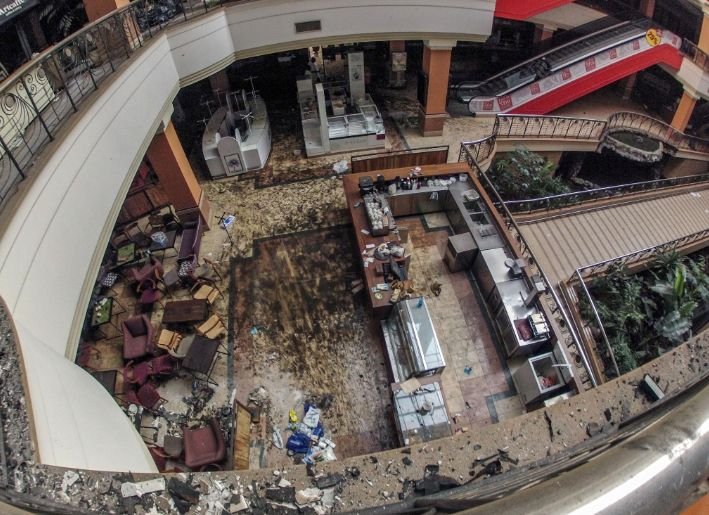
Armed attackers stormed the mall, opened fire on civilians and trapped hundreds of people inside. The siege continued for approximately four days before Kenyan security forces declared the building under control on September 24.
At least 67 people were killed and hundreds more were injured. The Somalia-based militant group al-Shabaab claimed responsibility, saying the attack was connected to Kenya’s military involvement in Somalia.
The attack shocked Kenya and drew international attention to the growing threat posed by al-Shabaab in East Africa.
The Attack Begins
Westgate was one of Nairobi’s most prominent shopping centres. On that Saturday, it was crowded with shoppers, families, employees and visitors.
At around midday, armed men arrived at the mall and began attacking people near the entrances. According to contemporary reporting, grenades were thrown and automatic weapons were fired as civilians tried to escape.
Witness accounts described people running through the complex while others hid inside shops and offices.
One eyewitness later told the BBC that people were hiding inside the mall and were unsure when police would be able to rescue them. Some people remained concealed for hours, afraid that moving would expose them to the attackers.
The attackers did not simply strike and leave. They occupied parts of the shopping centre, turning the incident into a prolonged hostage situation.
A Mall Becomes a Battlefield
As news of the attack spread, Kenyan police and military units moved toward Westgate.
The situation was complicated by the large number of civilians still inside the building. Security personnel had to distinguish between attackers and people attempting to escape while trying to clear different sections of the mall.
Survivors described scenes of confusion and terror.
Some people hid in stores, behind counters and in other concealed areas. Others attempted to escape through exits while security forces moved through the building.
The BBC documented eyewitness accounts of people sheltering inside shops and waiting for authorities to declare areas safe.
Meanwhile, emergency workers and ordinary Kenyans attempted to help those who had escaped or been wounded.
Who Was Behind the Attack?
The attack was claimed by al-Shabaab, an armed Islamist organisation based in Somalia.
The group said the Westgate operation was retaliation for Kenya’s military intervention in Somalia. Kenyan forces had entered Somalia in October 2011 as part of operations against al-Shabaab following growing security threats and kidnappings.
Human Rights Watch reported that al-Shabaab publicly claimed responsibility and described the attack as a response to Kenya’s military involvement in Somalia.
The U.S. State Department’s 2013 terrorism report similarly identified al-Shabaab as the group responsible for the attack and said the organisation linked the operation to Kenyan military involvement in Somalia.
The attack therefore represented more than an assault on a shopping centre. It was part of a broader conflict involving al-Shabaab, Somalia and Kenya’s regional military role.
The Siege Continues
For the people trapped inside Westgate, the attack became a battle for survival.
Some civilians remained hidden for many hours. Others were rescued as security forces gradually regained control of parts of the complex.
The siege lasted roughly four days.
A later investigation by The Guardian, based on interviews with survivors, relatives and security personnel, described an operation lasting approximately 80 hours. The investigation also reported serious problems during the security response, including confusion between different security units.
The prolonged operation raised questions about Kenya’s preparedness for a major terrorist attack in a crowded civilian location.
The Final Assault
By September 24, Kenyan authorities announced that security forces had regained control of the mall.
The end of the siege, however, revealed the scale of the tragedy.
At least 67 people had died, including Kenyan citizens and foreign nationals. Hundreds more were injured.
The U.S. State Department’s terrorism report recorded 65 civilians, six soldiers and police officers, and four attackers among those killed, while noting that hundreds were injured and 27 people were initially listed as missing.
Later sources commonly cite the overall death toll as 67 victims. Human Rights Watch and subsequent reports used that figure when discussing the attack.
The attackers were also reported killed during the security operation.
The Security Response Under Scrutiny
The conclusion of the siege did not end the controversy.
Questions emerged over how the attackers had managed to penetrate such a prominent shopping centre and how Kenyan security agencies handled the response.
Human Rights Watch later described the security response as problematic and reported allegations of confusion among different security agencies. Its 2015 World Report said authorities had failed to follow through adequately on promises to investigate security lapses and problems during the response.
The U.S. State Department also reported that President Uhuru Kenyatta announced plans for a commission of inquiry into the security lapses and how similar problems could be avoided in the future.
These questions became an important part of the history of Westgate because the tragedy exposed difficulties in coordinating a response to a complex urban terrorist attack.
The Historabase Editorial Team is dedicated to exploring and sharing the stories that have shaped Africa and the wider world. Our work covers African history, ancient civilizations, empires, historical figures, wars, cultures, political movements, and important events from the past.
We aim to present history in a clear, engaging, and accessible way, combining historical records with careful research to help readers better understand the people, events, and civilizations that shaped our world.