To modern people, the idea of washing clothes with urine sounds bizarre, even disgusting. Yet in ancient Rome, urine was a valuable household and commercial product.
Roman laundries, known as fullonicae, used urine as part of the process of cleaning wool and other fabrics. Far from being a strange ritual, the practice was based on simple chemistry: stale urine contains ammonia, a substance that can help break down grease and dirt.
The story of Roman laundry reveals something fascinating about ancient life, the Romans had practical solutions to everyday problems long before modern detergents existed.
Why Was Urine Useful for Washing Clothes?
Fresh urine contains very little ammonia. However, when urine sits for some time, bacteria break down the urea in it and produce ammonia.
Ammonia is an effective cleaning agent because it is alkaline and can help loosen oils, grease and dirt from fabric.
This made aged urine particularly useful for washing woolen clothing, which could become heavily soiled through daily use.
The Romans did not necessarily think of the substance in the way modern people do. It was simply another useful material that could be collected and put to work.
How Roman Laundries Worked
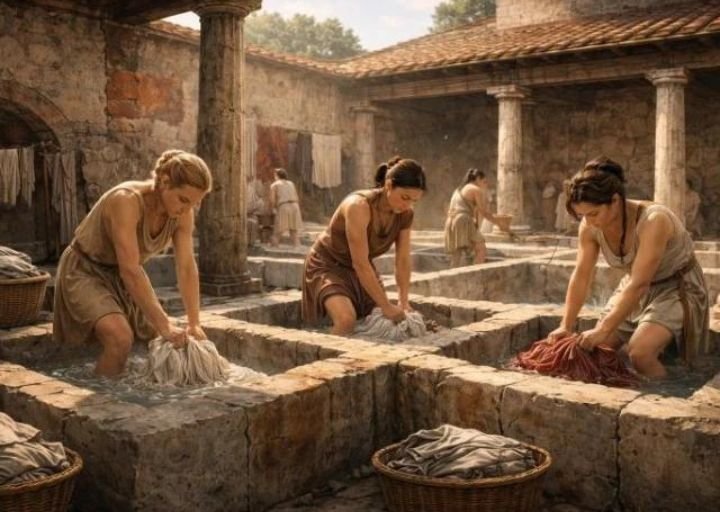
Professional Roman laundries were called fullonicae. These businesses cleaned and finished textiles for customers.
Workers would place dirty garments into large washing basins or tubs. A liquid containing urine was added, and the clothes were agitated by workers who sometimes stood in the mixture and repeatedly moved the garments around.
The movement helped the cleaning solution penetrate the fabric and remove dirt and grease.
After washing, the garments were rinsed with water. Depending on the type of fabric and the desired finish, the clothes could undergo additional treatments before being dried and returned to their owners.
Some laundries were large commercial operations, particularly in busy Roman towns.
Where Did the Romans Get So Much Urine?
This raises another interesting question: if laundries needed large quantities of urine, where did it come from?
The Romans developed a practical collection system.
Urinals and containers were placed in public areas and at certain businesses so that urine could be collected rather than simply discarded.
The collected urine could then be sold or delivered to laundries and other users.
One of the best-known historical references comes from Emperor Vespasian, who reportedly introduced a tax associated with the collection and sale of urine.
According to the Roman historian Suetonius, Vespasian’s son Titus criticized him for taxing urine. Vespasian is traditionally said to have responded with the famous phrase, “Money does not stink.”
The Latin expression pecunia non olet became associated with the story.
Whether every detail of the famous anecdote happened exactly as later writers described it is uncertain, but the story reflects a genuine Roman practice: waste products could have economic value.
Urine Wasn’t Just Used for Laundry
Roman society found several uses for urine.
Because of its ammonia content, aged urine could be useful in cleaning and processing materials. It was also associated with certain stages of textile production and leather processing.
The Romans also understood that urine could have practical value in other areas of daily life.
This reflects a broader feature of ancient Roman society: recycling was often driven by necessity and economics. Materials that modern societies might classify as waste could be collected and reused.
Why Wool Required Special Treatment
Wool was one of the most important textiles in the Roman world.
Roman clothing frequently used wool because it was warm, durable and widely available. But wool naturally contains oils, including lanolin, which can make the fibers greasy.
Dirt could also become trapped in the fibers.
Cleaning wool therefore required more than simply soaking it in water.
An alkaline cleaning substance could help remove oils and other contaminants. The ammonia produced by decomposed urine provided a cheap and accessible solution.
The process was not equivalent to modern laundry detergent, but it served a similar basic purpose.
Was Roman Laundry Actually Hygienic?
It is easy to imagine Roman laundries as extremely dirty places. They certainly would not have smelled pleasant.
However, using urine in laundry does not mean Romans simply washed clothes in raw human waste and stopped there.
The cleaning process involved washing, mechanical agitation and rinsing. Water was essential to the final process.
Ancient Roman cities also invested heavily in water infrastructure, including aqueducts, fountains and drainage systems. Access to water made large-scale textile cleaning possible.
The finished garments could therefore be considerably cleaner than the initial washing mixture might suggest.
The Fullers Who Ran the Laundries
The people who worked in Roman laundries were known as fullones, or fullers.
Their job involved much more than simply washing clothes.
Fullers cleaned, treated, thickened and sometimes repaired textiles. They could also improve the appearance and texture of garments.
The work was physically demanding.
Workers had to handle heavy, wet fabrics and cleaning solutions throughout the day. The process required repeated movement, rinsing and drying.
Fulling was therefore an important part of Rome’s textile economy.
What Archaeology Tells Us
Archaeological discoveries have helped historians understand how Roman laundries operated.
Excavations at Pompeii and other Roman settlements have revealed structures associated with textile processing, including large basins and working areas.
Pompeii is particularly valuable because the eruption of Mount Vesuvius in AD 79 preserved much of the city’s architecture and everyday environment.
The remains provide evidence of commercial activities that would otherwise be difficult to reconstruct.
Roman laundry facilities were often positioned in places where they could access water and serve nearby communities.
The Famous “Urine Tax”
The story of Vespasian’s urine tax is one of the most memorable anecdotes from Roman history.
Vespasian ruled as emperor from AD 69 to 79. His government needed money to rebuild Rome and stabilize the empire after a period of political conflict.
The urine-related tax became famous because of its unusual subject.
According to the traditional story, Titus objected to the smell associated with the money raised from the tax. Vespasian supposedly held the collected money under his son’s nose and asked whether it smelled.
When Titus answered that it did not, Vespasian reportedly replied that it came from urine.
This produced the famous saying pecunia non olet, “money does not stink.”
The story has survived for nearly two thousand years because it combines Roman politics, economics and an unusually memorable subject.
What This Tells Us About Ancient Rome
The use of urine in Roman laundry may seem like a bizarre historical curiosity, but it actually reveals something important about Roman society.
The Romans were highly practical when dealing with resources.
They built aqueducts to transport water over long distances, developed sophisticated sewage systems and created extensive commercial networks.
They also understood that many materials could be reused.
Urine was not valuable because Romans had some unusual fascination with it. It was valuable because its chemical properties made it useful—and because there was an economic incentive to collect it.
In a world without modern detergents, industrial chemicals or washing machines, people had to make use of whatever effective resources were available.
A Strange Practice With a Scientific Explanation
Ancient Romans obviously did not understand the chemistry of ammonia in the same way modern scientists do. They did not know about bacteria converting urea into ammonia at the molecular level.
But they could observe the results.
They knew that certain substances helped clean and process fabrics, and generations of practical experience allowed these techniques to become part of Roman industry.
Today, the idea of urine being used to wash clothes seems shocking. Yet when viewed in its historical context, it was a practical technology.
The Romans were not simply being strange—they were solving a very ordinary problem with the resources available to them.
The Historabase Editorial Team is dedicated to exploring and sharing the stories that have shaped Africa and the wider world. Our work covers African history, ancient civilizations, empires, historical figures, wars, cultures, political movements, and important events from the past.
We aim to present history in a clear, engaging, and accessible way, combining historical records with careful research to help readers better understand the people, events, and civilizations that shaped our world.