Few cities in ancient history have captured the human imagination like Babylon. Located in ancient Mesopotamia, near present-day Hillah in Iraq, Babylon grew from a relatively modest settlement into one of the most influential cities of the ancient world.
For centuries, Babylon was associated with powerful kings, monumental architecture, advanced scholarship and religious traditions. Its name appears in ancient texts, including the Bible, while Greek and Roman writers described its enormous walls and remarkable buildings.
But how did Babylon become so powerful, and why did one of the greatest cities of antiquity eventually decline?
The Origins of Ancient Babylon
Babylon was established in Mesopotamia, the fertile region between the Tigris and Euphrates rivers. This area is often described as one of the world’s earliest centres of urban civilisation.
Although Babylon existed before its greatest period of power, it became historically important during the early second millennium BCE. Its transformation was closely connected with Hammurabi, one of the most famous rulers of ancient Mesopotamia.
Hammurabi became king of Babylon around 1792 BCE. During his reign, Babylon expanded its political influence through military campaigns, diplomacy and administration.
By the end of his rule, Babylon had become the centre of a powerful kingdom.
Hammurabi and the Rise of Babylon
Hammurabi is remembered not only for expanding Babylon but also for his famous collection of laws.
The Code of Hammurabi is one of the best-known surviving legal texts from the ancient world. Written in Akkadian using cuneiform script, it contains laws dealing with property, trade, marriage, wages, crimes and social responsibilities.
The code is particularly important because it provides historians with evidence about the organisation of Babylonian society.
However, Babylon’s power did not remain permanent. After Hammurabi’s death, the kingdom weakened, and Babylon eventually lost much of its political influence.
The city would later experience an even greater transformation under a ruler who turned it into an imperial capital.
Babylon Under Nebuchadnezzar II
Babylon reached its most famous period during the Neo-Babylonian Empire, particularly under King Nebuchadnezzar II, who ruled from approximately 605 to 562 BCE.
Nebuchadnezzar II expanded Babylonian territory and transformed Babylon into a spectacular imperial capital.
During his reign, major construction projects changed the appearance of the city. Temples, walls, gates and palaces were built or restored, making Babylon one of the most impressive urban centres of the ancient Near East.
The city became a centre of religion, administration, commerce and learning.
The Ishtar Gate
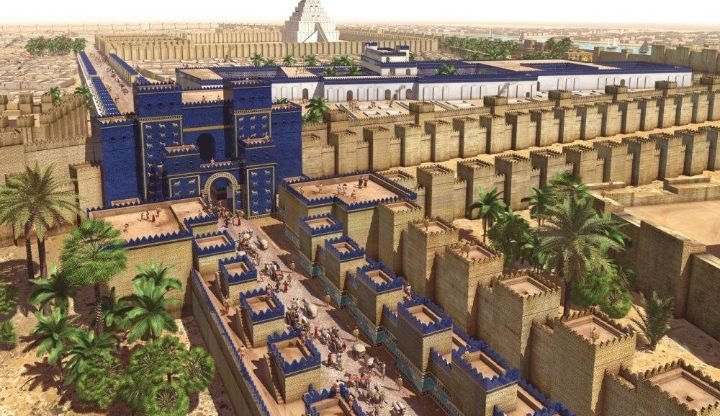
One of Babylon’s most famous monuments was the Ishtar Gate.
Built during the reign of Nebuchadnezzar II, the gate formed part of the city’s monumental entrance system. It was decorated with images of animals associated with Babylonian religious traditions, including lions, bulls and dragons.
The gate was constructed using glazed bricks, giving it a striking appearance.
Today, a reconstructed section of the Ishtar Gate can be seen at the Pergamon Museum in Berlin, although archaeological remains at Babylon itself provide important evidence of the original structure.
The Legendary Hanging Gardens
Babylon is also traditionally associated with the Hanging Gardens of Babylon, one of the Seven Wonders of the Ancient World.
According to ancient accounts, the gardens consisted of impressive terraces filled with vegetation and supplied with water. They were supposedly created for a royal figure who missed the mountainous landscape of her homeland.
However, historians still debate whether the Hanging Gardens actually existed in Babylon.
No definitive archaeological evidence has confirmed their location in the city. Some researchers have suggested that descriptions traditionally attributed to Babylon may instead have referred to gardens at Nineveh.
The mystery surrounding the gardens has only strengthened Babylon’s legendary reputation.
Babylon as a Centre of Knowledge
Babylon was more than a city of enormous buildings. It was also an important centre of scholarship.
Babylonian scholars studied astronomy, mathematics, medicine, religion and literature. They carefully recorded observations of the sky and developed sophisticated mathematical methods.
Babylonian mathematical texts demonstrate knowledge of advanced calculations and numerical systems. Their astronomical observations also contributed to later scientific traditions in the ancient Near East.
The city therefore played an important role in the development and preservation of knowledge long before the rise of modern science.
The Fall of Babylon
Babylon’s political dominance eventually came to an end.
In 539 BCE, the Persian king Cyrus the Great conquered Babylon and incorporated it into the expanding Achaemenid Persian Empire.
The conquest was significant because Babylon was one of the most important cities in the region. Yet the city was not immediately destroyed. It continued to function as an important administrative and cultural centre under Persian rule.
Babylon later came under the control of Alexander the Great after his conquest of the Persian Empire.
Alexander reportedly planned to make Babylon one of the major centres of his empire. However, he died in the city in 323 BCE at the age of 32.
His death marked another turning point in Babylon’s history.
Why Did Babylon Decline?
Babylon did not disappear overnight. Its decline occurred gradually over centuries.
Political changes, shifting imperial centres, warfare and changes in regional trade all contributed to the city’s decreasing importance.
After the Hellenistic period, other cities became more influential. Babylon’s population and political significance declined, while parts of the ancient city were abandoned.
By the time later travellers and historians encountered the remains, much of the once-great metropolis had fallen into ruins.
Babylon’s Legacy
Although Babylon eventually declined, its influence survived.
The city’s name became associated with wealth, power, monumental architecture and human ambition. Ancient writers helped spread stories about its extraordinary buildings, while religious texts gave Babylon an enduring place in cultural history.
Archaeological excavations have also revealed important evidence about Babylonian architecture, writing, religion and daily life.
Today, the ruins of Babylon stand as a reminder of the complexity of ancient Mesopotamian civilisation.
A City That Changed History
The story of Babylon is ultimately a story of transformation.
It rose from an ancient Mesopotamian settlement to become the capital of a powerful empire. Under Hammurabi, it became a major political centre. Under Nebuchadnezzar II, it was transformed into a monumental imperial capital.
Yet even one of the greatest cities of the ancient world could not escape the forces of political change and time.
Babylon’s walls eventually crumbled, its palaces disappeared and its population declined. But its legacy survived through archaeology, literature, religion and the historical record.
The Historabase Editorial Team is dedicated to exploring and sharing the stories that have shaped Africa and the wider world. Our work covers African history, ancient civilizations, empires, historical figures, wars, cultures, political movements, and important events from the past.
We aim to present history in a clear, engaging, and accessible way, combining historical records with careful research to help readers better understand the people, events, and civilizations that shaped our world.