The ancient Maya civilization is one of the most remarkable cultures in the history of the Americas. Long before European contact, Maya cities rose across parts of present-day Mexico, Guatemala, Belize, Honduras and El Salvador.
They built enormous temples, developed sophisticated calendars, recorded history in hieroglyphic writing and made important advances in mathematics and astronomy. Yet many of their greatest cities were eventually abandoned, leaving behind magnificent ruins hidden beneath forests.
This has led to a popular question: What happened to the Maya civilization?
The answer is more complicated than a single collapse. The Maya did not simply disappear. Instead, many major cities declined at different times because of a combination of environmental, political and social pressures.
Who Were the Ancient Maya?
The Maya were not a single empire ruled by one king. They were a collection of independent city-states and political kingdoms that shared related languages, religious traditions and cultural practices.
Maya civilization developed over thousands of years. Its history is commonly divided into the Preclassic, Classic and Postclassic periods.
The Classic Period, roughly from 250 to 900 CE, was particularly important. During this period, powerful cities such as Tikal, Calakmul, Palenque and Copán became centres of political power, trade and culture.
The Rise of the Great Maya Cities
Maya cities were impressive urban centres.
Large pyramids and temples dominated their ceremonial areas, while palaces, plazas and residential neighbourhoods surrounded them. Monumental architecture demonstrated the power of Maya rulers and their ability to organise large populations.
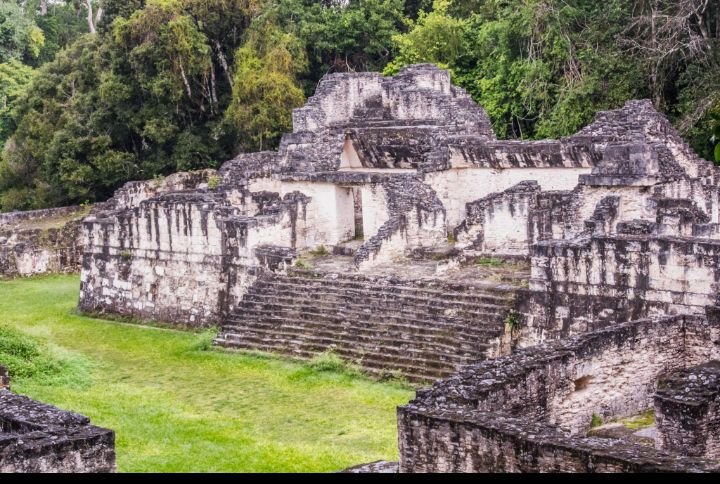
Tikal, located in present-day Guatemala, became one of the most powerful Maya cities. Its towering temples still rise above the surrounding rainforest.
Other major centres competed with Tikal for influence. Calakmul, for example, developed into a powerful rival and controlled an extensive network of political alliances.
The Maya world was therefore shaped by both cooperation and intense competition.
Maya Achievements
The Maya made remarkable achievements in several fields.
They developed a complex writing system capable of recording names, dates, political events and religious information. Maya inscriptions found on monuments provide historians with valuable information about their rulers and wars.
Their mathematicians also used a sophisticated numerical system that included the concept of zero.
Maya astronomers carefully observed celestial movements and developed detailed calendars. Their knowledge of astronomy was closely connected to religion and political life.
These achievements demonstrate that the Maya were not simply a mysterious ancient people. They were a highly organised civilisation with advanced intellectual and cultural traditions.
Why Were Maya Cities Abandoned?
Around the eighth and ninth centuries CE, many major Maya cities in the southern lowlands began experiencing serious political and social disruption.
Monument construction declined in several centres. Royal dynasties lost power, warfare increased and some urban populations decreased dramatically.
For many years, historians searched for one explanation.
Was it war? Drought? Overpopulation? Environmental destruction?
Modern research suggests that several factors probably interacted with one another.
Climate Change and Severe Drought
One of the strongest explanations involves prolonged periods of drought.
Maya communities depended heavily on rainfall, particularly in areas where rivers and other permanent water sources were limited. During severe droughts, reservoirs and agricultural systems could come under enormous pressure.
Scientific studies of lake sediments, caves and other environmental records indicate that parts of the Maya region experienced periods of significant drought during the period when many southern cities declined.
Drought alone, however, probably does not explain the entire collapse.
Different cities experienced different conditions, and some Maya communities continued to thrive long after major southern centres declined.
Warfare and Political Conflict
Warfare was another important factor.
Maya kingdoms frequently competed for territory, trade routes and political influence. In some periods, conflicts between powerful city-states intensified.
When warfare disrupted agriculture, trade and political alliances, the consequences could be severe.
The collapse of one ruling dynasty could also weaken an entire city. As political authority declined, populations may have moved elsewhere.
Environmental Pressure
The growth of large urban populations placed pressure on natural resources.
Agriculture required forests to be cleared, while cities needed enormous quantities of wood and other resources for construction and fuel.
Researchers continue to investigate how deforestation, soil exhaustion and changing environmental conditions affected Maya communities.
It is unlikely that environmental damage alone destroyed Maya civilisation, but it may have made some communities more vulnerable during periods of drought and political instability.
The Maya Did Not Disappear
One of the biggest misconceptions about Maya history is that the Maya civilization completely vanished.
The Maya people never disappeared.
Millions of Maya people live across Central America today, particularly in Guatemala, Mexico and Belize. They continue to speak Maya languages and maintain distinctive cultural traditions.
What declined was the political system and urban culture associated with many of the great Classic Period city-states.
This distinction is essential when discussing the so-called “lost Maya civilization.”
The Mystery of the Abandoned Cities
When European explorers and later archaeologists encountered Maya ruins hidden beneath dense vegetation, the abandoned cities appeared almost like lost worlds.
Temples were covered by trees and vines. Roads disappeared beneath the forest. Buildings that had once been surrounded by thousands of people stood largely silent.
However, the cities were not necessarily abandoned all at once.
Some settlements declined while others continued to grow. Northern cities such as Chichén Itzá became important after the decline of several southern centres.
Later Maya societies also developed powerful cities and political networks.
The Maya world therefore underwent a major transformation rather than a single civilisation-wide disappearance.
What Happened to Tikal?
Tikal provides one of the clearest examples of the Classic Maya decline.
The city reached its height between roughly the sixth and eighth centuries CE. Its rulers controlled extensive territories and participated in complex political relationships.
But by the ninth century, monumental construction had largely stopped and the city gradually lost its population.
Tikal eventually became surrounded by rainforest, where it remained for centuries before modern archaeological exploration revealed the scale of its remains.
Today, Tikal is one of the most important archaeological sites associated with Maya civilisation.
The Rediscovery of the Maya World
European knowledge of Maya civilisation developed slowly.
Explorers, scholars and archaeologists documented Maya ruins from the nineteenth century onward. Archaeological research later revealed thousands of inscriptions, buildings and artefacts.
The decipherment of Maya hieroglyphic writing transformed our understanding of the civilisation.
Researchers can now reconstruct the names of rulers, political conflicts, alliances and important historical events that were previously hidden in stone inscriptions.
Modern technologies such as satellite imagery and LiDAR have also revealed extensive Maya settlements beneath dense vegetation, showing that ancient Maya landscapes were far more heavily developed than once believed.
A Civilisation That Adapted
The decline of the Classic Maya cities was not the end of Maya history.
Maya communities adapted to changing political and environmental conditions. New centres became important, populations moved and different political systems emerged.
When Spanish forces arrived in the sixteenth century, they encountered several independent Maya states. Some Maya kingdoms resisted Spanish conquest for generations.
The last independent Maya kingdom, the Itza state centred around the Lake Petén region, was conquered by the Spanish in 1697.
The True Story of the Maya Collapse
The story of the Maya is not simply one of a mysterious civilisation that disappeared into the jungle.
It is a story of growth, innovation, political competition, environmental challenges, adaptation and transformation.
Climate stress may have contributed to agricultural difficulties. Warfare weakened political systems. Environmental pressure affected resources. Together, these challenges may have pushed some cities beyond their ability to cope.
But the Maya themselves survived.
Their descendants continue to live in the same broader region where their ancestors built some of the most extraordinary cities in the ancient Americas.
Conclusion
The ancient Maya created one of the most sophisticated civilisations in pre-Columbian history. Their cities, temples, writing system, mathematics and astronomical knowledge continue to fascinate historians and archaeologists.
Many of their greatest cities were eventually abandoned, but the people who built them did not vanish.
The “lost city” of the Maya is therefore not a story about an entire people disappearing. It is a story about powerful cities rising, struggling and transforming over centuries.
The Historabase Editorial Team is dedicated to exploring and sharing the stories that have shaped Africa and the wider world. Our work covers African history, ancient civilizations, empires, historical figures, wars, cultures, political movements, and important events from the past.
We aim to present history in a clear, engaging, and accessible way, combining historical records with careful research to help readers better understand the people, events, and civilizations that shaped our world.