In June 1812, Napoleon Bonaparte launched one of the largest military campaigns Europe had ever seen. At the height of his power, the French emperor led a huge multinational army into the Russian Empire, expecting a quick victory that would force Tsar Alexander I to accept his terms.
Instead, the campaign became one of the greatest military disasters in European history.
Napoleon entered Russia with hundreds of thousands of soldiers. By the time the surviving forces struggled back across the border months later, his army had been devastated by battle, disease, hunger, exhaustion, desertion and the brutal Russian winter.
The invasion did not immediately destroy Napoleon’s empire, but it severely weakened French military power and encouraged his enemies to challenge him. Within two years, Napoleon was fighting for the survival of his empire.
So, why did Napoleon invade Russia, and how did the campaign go so disastrously wrong?
Why Did Napoleon Invade Russia?
The roots of the invasion lay in Napoleon’s struggle against Britain.
After years of war with France, Britain remained Napoleon’s most persistent enemy. Napoleon therefore attempted to weaken the British economy through the Continental System, a blockade designed to prevent European countries from trading with Britain.
Russia initially cooperated with Napoleon after the Treaty of Tilsit in 1807, but the relationship gradually deteriorated.
The Russian economy suffered from restrictions on trade with Britain, while Russian leaders were increasingly unhappy with French influence in Europe.
Tsar Alexander I also disliked Napoleon’s growing power and expansion.
By 1812, the alliance had effectively collapsed.
Napoleon decided that military pressure would force Russia back into cooperation.
His plan was based on a familiar strategy: defeat the enemy’s main army quickly, occupy important territory and force its government to negotiate.
But Russia would not give Napoleon the quick battle he wanted.
The Grande Armée Marches Into Russia
In June 1812, Napoleon crossed the Neman River with the Grande Armée.
The force was enormous. Estimates vary, but roughly 450,000 to 600,000 troops entered Russia during the opening phase, making it one of the largest armies assembled in Europe at that time.
The army was not made up entirely of French soldiers.
It included troops from many parts of Napoleon’s empire and allied states, including Poland, Italy, Germany and other European territories.
Napoleon expected his opponents to confront him in a decisive battle.
Instead, Russian commanders repeatedly withdrew.
Russia Refuses to Fight Napoleon on His Terms
Russian forces used a strategy that frustrated Napoleon.
Rather than allowing themselves to be surrounded and destroyed, they retreated deeper into Russian territory.
As they withdrew, Russian forces and authorities used a policy that later became known as scorched earth.
Food supplies, crops and other resources that could be useful to the invading army were destroyed or removed.
This created a serious problem for Napoleon.
The farther his army travelled into Russia, the more difficult it became to supply hundreds of thousands of soldiers.
Napoleon’s army depended heavily on supply lines stretching across enormous distances.
Russia’s vast geography made those supply lines increasingly difficult to protect.
The French army was also losing men before many major battles took place.
Disease, exhaustion, hunger, accidents and desertion steadily reduced its strength.
The Battle of Borodino
Eventually, the Russians decided to make a major stand.
On September 7, 1812, the armies fought the Battle of Borodino, one of the bloodiest single days of the entire Napoleonic Wars.
Napoleon’s forces eventually forced the Russians to withdraw, but the victory came at an enormous cost.
Tens of thousands of soldiers were killed or wounded.
The battle did not destroy the Russian army.
That was crucial.
Napoleon had hoped that a decisive victory would force Tsar Alexander to negotiate peace.
Instead, the Russian army retreated.
The French had won the battlefield, but Napoleon had not achieved the strategic victory he needed.
Napoleon Enters Moscow
After Borodino, Russian forces abandoned Moscow.
Napoleon entered the city in September 1812 expecting that its occupation would force Alexander I to surrender or negotiate.
But Moscow was largely deserted.
Soon after Napoleon’s arrival, fires broke out across the city.
Historians continue to debate the precise causes and organization of the fires, but the destruction deprived Napoleon’s army of many of the resources it needed.
Most importantly, Tsar Alexander refused to negotiate.
Napoleon waited for a response that never came.
His army was now deep inside Russia, far from its supply bases and facing the approach of winter.
The emperor finally realized that he could not remain in Moscow.
He ordered a retreat.
The Terrible Retreat
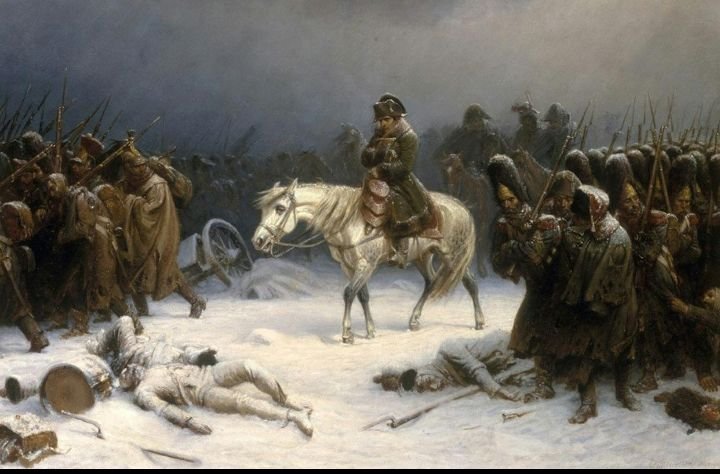
The retreat from Moscow became the most infamous part of the campaign.
Napoleon initially attempted to take a different route through richer territory, but Russian forces blocked his advance.
The French were forced to retreat along the devastated route they had previously travelled.
Winter arrived.
Temperatures dropped dramatically, while soldiers struggled to find food, shelter and warm clothing.
Horses died in enormous numbers, making it difficult to transport artillery and supplies.
The roads became crowded with exhausted soldiers, wounded men, civilians and abandoned equipment.
Russian forces continued attacking the retreating army.
Cossack units were particularly effective at harassing French forces and disrupting their movements.
The French army was no longer the powerful force that had entered Russia months earlier.
It was becoming a desperate collection of survivors.
The Crossing of the Berezina
One of the most dramatic moments came at the Berezina River in November 1812.
The retreating French army faced a dangerous river crossing while Russian forces attempted to trap it.
French engineers constructed temporary bridges, allowing large numbers of soldiers and civilians to escape.
The crossing was costly, however.
Thousands of people were killed, wounded, captured or drowned during the chaos.
Napoleon’s forces managed to avoid complete destruction, but the army was now a shadow of its former strength.
The emperor eventually left the surviving troops and returned to Paris.
He needed to raise another army.
What Destroyed Napoleon’s Army?
The popular image of Napoleon’s defeat often focuses entirely on the Russian winter.
The cold was certainly devastating, but the disaster was caused by several factors.
1. The Enormous Distance
Russia was vast.
Napoleon’s army travelled hundreds of kilometres away from its bases, making supply increasingly difficult.
2. Russian Strategy
Russian forces repeatedly avoided giving Napoleon the decisive victory he wanted.
Their retreat forced the French deeper into hostile territory.
3. Scorched Earth
The destruction or removal of supplies made it difficult for the French to feed themselves and their animals.
4. Disease and Exhaustion
Large numbers of soldiers became sick or physically exhausted before the final retreat.
5. Battle Casualties
Major battles such as Borodino inflicted enormous losses without destroying the Russian army.
6. Winter
The severe Russian winter compounded every existing problem.
Cold killed weakened soldiers and animals, while snow and ice made movement extremely difficult.
The disaster was therefore not caused by winter alone. Winter became catastrophic because Napoleon’s army was already severely weakened and undersupplied.
How Many Soldiers Survived?
The exact figures remain debated because the Grande Armée included soldiers from many countries and because records were incomplete.
However, the scale of the losses was extraordinary.
Napoleon had entered Russia with several hundred thousand troops. Only a small fraction of the original invasion force remained effective by the time the retreat ended.
Many soldiers were killed in battle, while others died from disease, starvation and exposure. Tens of thousands were also captured or deserted.
The campaign effectively destroyed Napoleon’s main army.
The Consequences for Napoleon
The disaster transformed the political situation in Europe.
Napoleon still possessed enormous military skill and political influence, but his enemies now recognized that he could be defeated.
Prussia and Austria eventually joined Russia and other powers against him.
Napoleon managed to raise another large army in 1813 and won several battles, but his position was increasingly difficult.
The War of the Sixth Coalition eventually brought the Allied armies into France.
In 1814, Napoleon was forced to abdicate and was exiled to the island of Elba.
Although he returned to power in 1815, his final defeat came at the Battle of Waterloo.
The Russian campaign had therefore played a major role in setting the chain of events that ultimately ended Napoleon’s reign.
The Legacy of the Russian Campaign
Napoleon’s invasion of Russia became a classic example of the dangers of overextending a military force.
The campaign demonstrated that a powerful army could be defeated without being destroyed in one decisive battle.
Russia’s vast territory, strategic retreat, destruction of supplies and willingness to absorb enormous losses gradually weakened the French army.
The campaign also became one of the defining moments of Napoleon’s career.
Before 1812, Napoleon appeared almost unbeatable.
After 1812, his enemies became increasingly confident that his empire could be defeated.
Conclusion
Napoleon’s invasion of Russia began as an attempt to force Tsar Alexander I back into cooperation with France. Instead, it became a catastrophic military campaign that destroyed much of the Grande Armée.
The Russians avoided the decisive battle Napoleon wanted, retreated deep into their territory and denied the French access to essential supplies. The Battle of Borodino produced enormous casualties without ending Russian resistance, while Moscow offered Napoleon no political victory.
When the French retreat began, disease, hunger, exhaustion, Russian attacks and the brutal winter turned the campaign into a disaster.
The invasion did not destroy Napoleon immediately, but it destroyed the army that had made his European dominance possible.
The Historabase Editorial Team is dedicated to exploring and sharing the stories that have shaped Africa and the wider world. Our work covers African history, ancient civilizations, empires, historical figures, wars, cultures, political movements, and important events from the past.
We aim to present history in a clear, engaging, and accessible way, combining historical records with careful research to help readers better understand the people, events, and civilizations that shaped our world.