The Battle of Zama, fought in 202 BC, was one of the most important battles of the ancient world. It brought the Second Punic War between Rome and Carthage to a decisive conclusion and ended the extraordinary military career of Hannibal Barca, one of history’s most famous commanders.
For more than a decade, Hannibal had threatened the Roman Republic. He had crossed the Alps with an army that included war elephants, defeated Roman armies in several spectacular battles, and brought Rome closer to disaster than perhaps any foreign commander before him.
Yet at Zama, the Romans turned the tables.
Led by Scipio Africanus, the Roman army defeated Hannibal’s forces and forced Carthage to accept harsh peace terms. The battle demonstrated how Rome had learned from its earlier defeats and adapted its military strategy to counter one of the greatest commanders of the ancient world.
To understand Zama, it is necessary to understand the conflict that came before it.
The Second Punic War began in 218 BC after years of growing tensions between Rome and Carthage.
Carthage was a powerful North African city-state with territories and commercial interests across the western Mediterranean. Rome, meanwhile, was rapidly expanding its influence throughout Italy and beyond.
The immediate trigger for the war was the Carthaginian attack on Saguntum, a city in Iberia that had strong connections with Rome.
Hannibal, the son of the Carthaginian general Hamilcar Barca, became the leading commander of Carthage’s war effort.
Rather than waiting for Rome to attack Carthage directly, Hannibal decided to take the war into Italy.
His strategy shocked the Romans.
Hannibal Crosses the Alps
In 218 BC, Hannibal marched his army from Iberia across the Pyrenees and into Gaul.
He then attempted one of the most famous military journeys in history: crossing the Alps with his army.
The journey was extremely difficult.
Hannibal lost soldiers, supplies, and animals along the way, but he eventually emerged in northern Italy.
The Romans were caught off guard.
Hannibal’s army was smaller than the Roman forces available in Italy, but his troops were experienced and battle-hardened.
His tactical abilities soon became clear.
Hannibal’s Greatest Victories
Hannibal won several major victories against Rome during the early years of the war.
At the Battle of Trebia in 218 BC, he defeated a Roman army through careful planning and the use of an ambush.
In 217 BC, Hannibal achieved another major victory at the Battle of Lake Trasimene.
But his greatest triumph came in 216 BC at Cannae.
There, Hannibal’s army surrounded and destroyed a much larger Roman force.
The Battle of Cannae became one of the classic examples of military encirclement.
Rome suffered enormous casualties.
For a time, it appeared possible that Hannibal might force the Roman Republic to collapse.
But Rome refused to surrender.
Rome Changes Its Strategy
Instead of constantly seeking a decisive battle with Hannibal, Rome gradually changed its approach.
Roman leaders understood that Hannibal was extremely difficult to defeat directly.
The Romans began avoiding unnecessary confrontations while attacking Carthaginian allies and territories elsewhere.
This strategy is associated particularly with Quintus Fabius Maximus, whose cautious approach earned him the nickname Cunctator, meaning “the Delayer.”
The strategy was frustrating, but it gave Rome time to rebuild its armies.
Rome also benefited from its enormous manpower reserves.
Even after suffering devastating losses, the Republic could continue raising new armies.
Roman soldiers also used noise and weapons to frighten or redirect the animals.
Some elephants were driven back toward their own lines.
This prevented Hannibal from using his elephants as effectively as he might have hoped.
The Cavalry Battle
The cavalry fighting was equally important.
Scipio’s Numidian allies played a major role in the battle.
Roman and Numidian cavalry attacked Hannibal’s mounted forces.
The Carthaginian cavalry was eventually driven from the battlefield.
Rather than immediately returning to the main battle, the Roman and Numidian horsemen pursued the retreating Carthaginian cavalry.
This temporarily removed both sides’ cavalry from the central battlefield.
But Scipio had an important advantage: his cavalry would eventually return.
The Infantry Clash
With the elephants largely neutralized and the cavalry temporarily absent, the main infantry forces engaged.
Hannibal’s army was organized in multiple lines.
His first line consisted largely of less experienced troops, while more experienced soldiers were positioned farther back.
The arrangement was designed to wear down the Roman army before Hannibal’s veteran troops delivered the decisive blow.
The fighting became intense.
The Roman legions pushed forward, but Hannibal’s veterans provided extremely strong resistance.
The outcome remained uncertain.
Hannibal’s Veterans Enter the Battle
Hannibal eventually committed his experienced Italian veterans.
These troops had fought alongside him for years and were among the most capable soldiers in the Carthaginian army.
They had survived battles such as Trebia, Trasimene, and Cannae.
Their arrival threatened to turn the battle in Carthage’s favor.
Scipio’s soldiers were already exhausted from fighting through the earlier Carthaginian lines.
But the Roman commander still had one major advantage.
His cavalry was returning.
The Decisive Cavalry Charge
Masinissa’s Numidian cavalry and the Roman cavalry eventually came back from pursuing the Carthaginian horsemen.
They attacked Hannibal’s army from the rear.
This was devastating.
Hannibal’s infantry was now caught between the Roman legions in front and cavalry attacking from behind.
The battle turned into a massive encirclement.
The tactic that Hannibal had used so effectively against Rome at Cannae was now being used against him.
The Carthaginian army collapsed.
Hannibal was defeated.
Why Did Hannibal Lose at Zama?
Several factors explain the Roman victory.
Scipio Studied Hannibal
Scipio understood that Hannibal’s previous victories had often depended on controlling the battlefield and exploiting Roman weaknesses.
At Zama, Scipio deliberately designed his army to counter Hannibal’s tactics.
The Elephants Were Neutralized
The Roman formations created openings through which the elephants could pass.
This prevented them from causing the destruction Hannibal needed.
Roman Infantry Was Strong
Rome’s heavily trained infantry was able to withstand repeated attacks and maintain pressure throughout the battle.
Numidian Cavalry Was Crucial
Masinissa’s cavalry gave Scipio an important advantage in mobility.
The cavalry’s return at the decisive moment helped destroy Hannibal’s army.
Carthage Lacked the Same Strategic Position
Hannibal was no longer fighting in Italy with the same advantages he had enjoyed earlier in the war.
The conflict had shifted to Africa, where Scipio controlled the initiative.
Hannibal’s Defeat
After the battle, Hannibal escaped with a relatively small group of survivors.
The defeat effectively ended Carthage’s ability to continue the war.
Carthage was forced to negotiate peace with Rome.
The resulting treaty imposed severe restrictions.
Carthage had to surrender its warships, pay a large indemnity, and give up most of its overseas territories.
Most importantly, Carthage was prohibited from conducting war without Roman approval.
The once-powerful Mediterranean rival had been reduced to a much weaker state.
Scipio Becomes “Africanus”
Scipio’s victory made him one of the most celebrated Roman commanders of his generation.
He received the honorary name Africanus, reflecting his success in Africa.
The victory also strengthened Rome’s position as the dominant power in the western Mediterranean.
Hannibal remained a respected military commander, but his dream of defeating Rome had failed.
Was Zama the End of Hannibal?
Although Zama ended Hannibal’s military campaign against Rome, it did not end his political career.
Hannibal later became involved in Carthaginian politics and attempted to reform the city’s government and finances.
Eventually, political pressure forced him into exile.
He later served foreign rulers and continued to be regarded as a valuable military adviser.
Rome remained concerned about him for years.
Hannibal eventually died in exile, traditionally believed to have taken poison to avoid capture by the Romans.
Why Is the Battle of Zama Important?
The Battle of Zama was more than a single military defeat.
It marked the end of Carthage’s attempt to challenge Rome for dominance in the western Mediterranean.
The battle also demonstrated Rome’s ability to learn from catastrophic defeats.
At Cannae, Hannibal had used superior tactics to destroy a much larger Roman army.
At Zama, Scipio successfully prevented Hannibal from repeating those tactics.
The battle therefore represents a remarkable example of military adaptation.
Rome did not defeat Hannibal simply through greater numbers.
It studied its enemy, changed its strategy, developed alliances, and created a battlefield plan specifically designed to counter Hannibal’s strengths.
Hannibal and Scipio: Two Great Commanders
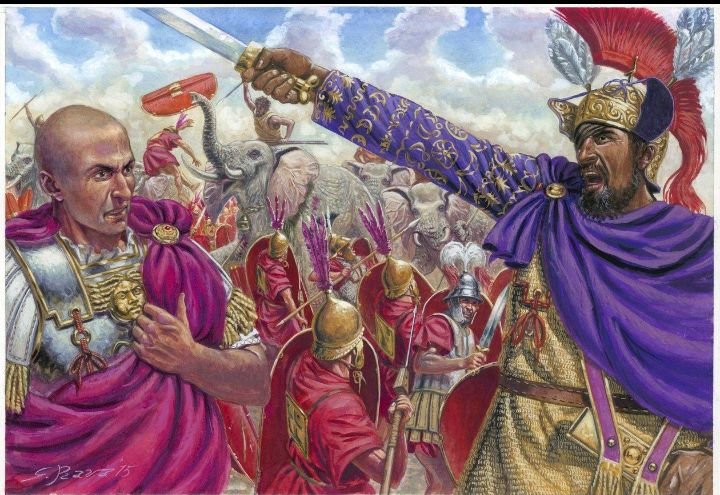
The Battle of Zama is often remembered as a clash between two extraordinary military minds.
Hannibal Barca had spent years demonstrating his ability to defeat larger Roman armies through deception, maneuver, and tactical innovation.
Scipio Africanus represented a new generation of Roman commanders who had learned from those defeats.
Their encounter at Zama was therefore more than a battle between armies.
It was a confrontation between two military traditions and two commanders who understood the strengths and weaknesses of their opponents.
Scipio emerged victorious.
The Long-Term Consequences
Zama transformed the balance of power in the Mediterranean.
Carthage was no longer Rome’s equal.
Rome’s victory opened the way for further Roman expansion.
In the following decades, Rome became increasingly involved in conflicts across the Mediterranean.
Eventually, Carthage would be destroyed completely during the Third Punic War in 146 BC.
The Battle of Zama therefore represents an important milestone in Rome’s rise toward Mediterranean dominance.
Conclusion
The Battle of Zama in 202 BC brought the Second Punic War to a dramatic conclusion.
For years, Hannibal had terrified Rome with a series of extraordinary victories. He had crossed the Alps, defeated Roman armies at Trebia, Lake Trasimene, and Cannae, and demonstrated military skills that made him one of antiquity’s most respected commanders.
But Rome refused to surrender.
Scipio Africanus developed a strategy that brought the war to Africa, forced Hannibal to return from Italy, neutralized his war elephants, relied on powerful Numidian cavalry, and ultimately surrounded the Carthaginian army.
Zama was Hannibal’s great defeat, and Rome’s decisive victory.
The battle demonstrated that even the greatest military commander can be defeated when an opponent learns from previous mistakes and adapts.
The Historabase Editorial Team is dedicated to exploring and sharing the stories that have shaped Africa and the wider world. Our work covers African history, ancient civilizations, empires, historical figures, wars, cultures, political movements, and important events from the past.
We aim to present history in a clear, engaging, and accessible way, combining historical records with careful research to help readers better understand the people, events, and civilizations that shaped our world.






One Comment