Nigeria’s independence on October 1, 1960, was one of the most important moments in the history of modern Africa. After decades of British colonial rule, Nigeria became an independent nation and began governing itself as a sovereign state.
The journey to independence was not sudden. It was the result of decades of political activism, constitutional reforms, nationalist movements, negotiations, and growing demands for self-government. Nigerian leaders and ordinary citizens increasingly challenged colonial rule and demanded greater control over the country’s political future.
But how exactly did Nigeria gain independence, and who were the people responsible for the country’s transition to self-government?
Nigeria Under British Colonial Rule
Modern Nigeria was formally created as a unified British colony in 1914, when the British administration amalgamated the Northern and Southern Protectorates with the Lagos Colony.
British colonial rule introduced a centralized administrative system, but Nigeria remained governed by British authorities. Nigerians had limited participation in important political decisions, while traditional rulers were often incorporated into the colonial system through indirect rule.
The colonial period also encouraged the development of schools, newspapers, political organizations, and an educated Nigerian class. These developments eventually helped create a generation of Nigerians who began demanding political rights and independence.
The Rise of Nigerian Nationalism
During the early and mid-20th century, Nigerian nationalism became increasingly organized.
Newspapers played an important role in criticizing colonial policies and encouraging political awareness. Figures such as Herbert Macaulay, often regarded as one of the pioneers of Nigerian nationalism, helped mobilize Nigerians against aspects of British colonial administration.
Political organizations also emerged. The Nigerian National Democratic Party (NNDP) was established in 1923, while later organizations developed into powerful regional and national political movements.
After the Second World War, demands for self-government became much stronger.
Nigerian nationalists increasingly argued that Nigerians should control their own political institutions rather than remain under British authority.
The Constitution of 1946
One important step toward independence was the introduction of the Richards Constitution in 1946.
The constitution created a central legislative body and recognized the importance of Nigeria’s different regions. However, many Nigerian nationalists criticized it because they believed Nigerians had not been sufficiently consulted during its development.
Despite its limitations, the constitution contributed to the growth of political participation and helped establish a framework for further constitutional negotiations.
The political system continued to evolve through subsequent constitutional reforms.
The Macpherson Constitution of 1951
The Macpherson Constitution of 1951 represented another major step.
Unlike earlier constitutional arrangements, the Macpherson Constitution involved greater consultation with Nigerians. It expanded the role of regional governments and increased Nigerian participation in the legislative process.
However, Nigeria’s regional differences became increasingly important.
The country was broadly divided into three major political regions:
Northern Region
Western Region
Eastern Region
Political parties often had strong regional bases, although some leaders attempted to develop broader national support.
These regional political differences would influence Nigerian politics both before and after independence.
The Major Political Leaders
Several Nigerian leaders became central figures in the independence movement.
Nnamdi Azikiwe
Nnamdi Azikiwe, popularly known as “Zik,” was one of Nigeria’s most prominent nationalist leaders. Through journalism and politics, he advocated greater self-government and Nigerian independence.
He became a major figure in the National Council of Nigeria and the Cameroons (NCNC).
Azikiwe later became Nigeria’s first Governor-General after independence and subsequently the country’s first President under the republican system.
Obafemi Awolowo
Obafemi Awolowo became the leading political figure of the Western Region.
He founded the Action Group in 1951 and advocated political and economic development, education, and regional advancement.
Awolowo was also an important advocate of Nigerian self-government and played a major role in the constitutional politics that preceded independence.
Ahmadu Bello
Ahmadu Bello, the Sardauna of Sokoto, became the most influential political leader in Northern Nigeria.
He led the Northern People’s Congress (NPC) and focused heavily on the political interests and development of the Northern Region.
Although the major political leaders sometimes disagreed over the pace and structure of independence, they all became important figures in the political transition that eventually produced an independent Nigeria.
The 1954 Constitution and Federalism
The Lyttleton Constitution of 1954 was another crucial stage in Nigeria’s journey toward independence.
It established a more clearly defined federal system, giving considerable powers to Nigeria’s regions while maintaining a federal government at the center.
Federalism was considered important because Nigeria contained numerous ethnic groups, languages, cultures, and political traditions.
However, regional political competition remained intense.
The constitutional developments of the 1950s gradually prepared Nigerian politicians and civil servants for greater responsibility in governing the country.
The Western Region Crisis and Political Tensions
The road to independence was not completely peaceful.
Political disagreements and regional competition created serious tensions. The Western Region crisis of 1962–1965, for example, would occur after independence, but tensions between political groups were already visible during the final years of colonial rule.
Despite these disagreements, Nigerian political leaders continued negotiating with the British government over the country’s constitutional future.
By the late 1950s, independence was becoming increasingly realistic.
The 1957 Constitutional Conference
A major turning point came with the 1957 Constitutional Conference in London.
Nigerian political representatives met with British officials to discuss the country’s political future.
During these negotiations, Nigerian leaders pushed for greater self-government and eventually full independence.
The Eastern and Western Regions moved toward greater internal self-government in 1957, while the Northern Region followed in 1959.
This gradual process allowed Nigerian politicians and administrators to gain more experience in running government institutions before full independence.
The 1959 Federal Election
Nigeria held a federal election in December 1959, less than a year before independence.
No single political party won enough seats to govern alone. The Northern People’s Congress became the largest party, while the NCNC and Action Group also won significant representation.
This resulted in a political alliance between the NPC and NCNC.
Abubakar Tafawa Balewa, a prominent leader of the NPC, became the country’s first Prime Minister.
The formation of a Nigerian-led federal government was an important indication that political power was rapidly moving away from British colonial officials.
The Final Negotiations for Independence
By 1960, the main constitutional issues surrounding independence had largely been settled.
Nigeria would become an independent federal state within the Commonwealth.
The British monarch would remain Nigeria’s head of state, represented in Nigeria by a Governor-General, while the Nigerian government would exercise domestic political authority.
The final arrangements were approved through the Nigeria Independence Act 1960, passed by the British Parliament.
The date chosen for independence was October 1, 1960.
October 1, 1960: Nigeria Becomes Independent
At midnight on September 30, Nigeria’s colonial era came to an end.
On October 1, 1960, Nigeria officially became an independent country.
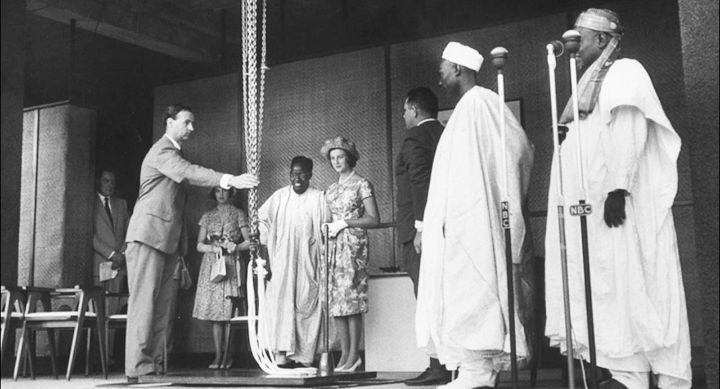
A historic ceremony took place in Lagos, where the Nigerian flag was raised and the Union Jack was lowered.
Princess Alexandra, representing Queen Elizabeth II, attended the independence celebrations.
Abubakar Tafawa Balewa became Nigeria’s first Prime Minister, while Nnamdi Azikiwe became Governor-General.
In his famous independence speech, Balewa emphasized the significance of the moment while recognizing the enormous challenges facing the new nation.
Nigeria’s independence was celebrated across the country and attracted international attention.
Why Nigeria’s Independence Was Significant
Nigeria’s independence was important not only to Nigerians but also to Africa and the wider world.
At independence, Nigeria was one of Africa’s most populous countries and possessed significant economic and human resources.
Its independence demonstrated that colonial territories could transition to self-government through political negotiations and constitutional development.
Nigeria also became an important voice in African and international affairs.
However, independence did not immediately solve the country’s political, economic, and social challenges.
Nigeria inherited a colonial administrative structure, regional political divisions, economic inequalities, and significant differences between its many communities.
The new government therefore faced the difficult task of building a unified nation from a territory containing hundreds of ethnic groups and numerous languages and cultures.
Nigeria After Independence
The first years of independence were filled with both optimism and political challenges.
Nigeria initially operated as a parliamentary federal system, with significant powers held by the regions.
The government focused on developing infrastructure, education, agriculture, industry, and public institutions.
However, political competition and regional tensions gradually intensified. These problems contributed to a series of political crises that eventually culminated in the military coup of January 1966.
The events that followed would dramatically change Nigeria’s political history.
Nevertheless, the achievement of independence in 1960 remained a defining moment.
Conclusion
Nigeria’s independence was the result of a long political journey rather than a single event. From the emergence of Nigerian nationalism to constitutional reforms and negotiations between Nigerian leaders and British authorities, the country gradually moved toward self-government.
Figures such as Nnamdi Azikiwe, Obafemi Awolowo, Ahmadu Bello, Abubakar Tafawa Balewa, and Herbert Macaulay played important roles in Nigeria’s political development.
On October 1, 1960, the process reached its historic conclusion when Nigeria became an independent nation.
The independence celebration marked the end of British colonial rule and the beginning of a new chapter in Nigerian history. Although the new country inherited considerable challenges, 1960 gave Nigerians the opportunity to determine their own political future and establish their place in the international community.
Today, October 1 remains Nigeria’s Independence Day, commemorating the moment when the country emerged from colonial rule and began its journey as a sovereign nation.
The Historabase Editorial Team is dedicated to exploring and sharing the stories that have shaped Africa and the wider world. Our work covers African history, ancient civilizations, empires, historical figures, wars, cultures, political movements, and important events from the past.
We aim to present history in a clear, engaging, and accessible way, combining historical records with careful research to help readers better understand the people, events, and civilizations that shaped our world.






One Comment