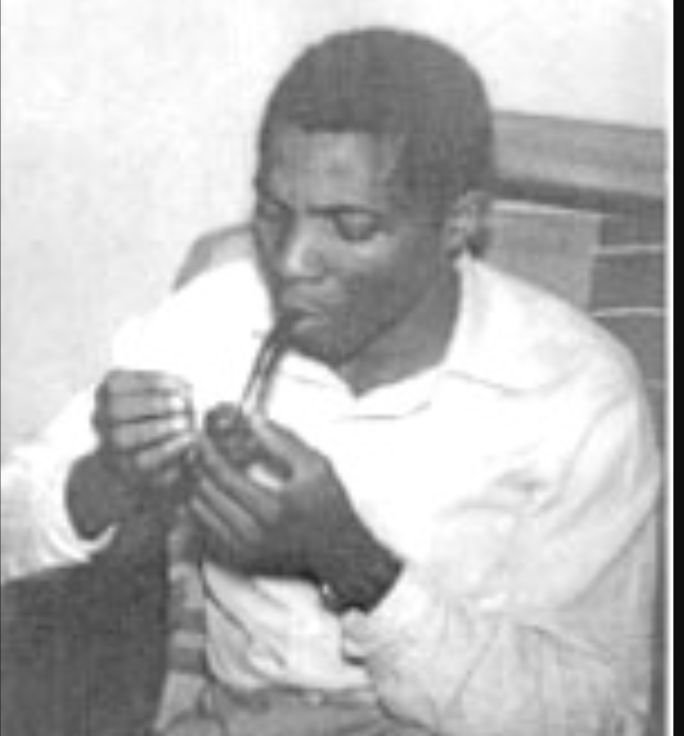
Christopher Okigbo was one of Africa’s most influential poets of the 20th century. Born in 1932 in Ojoto, southeastern Nigeria, he produced a relatively small body of poetry before his death in 1967. Yet his work earned him a lasting place in African literature.
Okigbo’s life was cut short during the Nigerian Civil War, when he joined the forces of the breakaway Republic of Biafra. He was killed in September 1967 while fighting near Nsukka.
His story is remarkable because it connects two worlds that are often treated separately: literature and war. Okigbo was not simply a poet who happened to live during a conflict. He became an active participant in one of the most devastating episodes in Nigerian history.
Early Life and Education
Christopher Ifekandu Okigbo was born on 16 August 1932 in Ojoto, in what was then the Eastern Region of Nigeria.
He grew up during the final decades of British colonial rule. His father was a teacher, and Okigbo’s upbringing exposed him to both traditional Igbo culture and Western education.
He attended Government College, Umuahia, one of the most respected secondary schools in colonial Nigeria. The school produced several notable Nigerian intellectuals and writers.
Okigbo later attended the University College, Ibadan, where he studied Classics. His education introduced him to Greek and Roman literature, mythology, and Western literary traditions.
At the same time, his cultural background strongly influenced his imagination.
This combination would eventually become one of the defining characteristics of his poetry.
A Poet With a Unique Style
Okigbo’s poetry was different from much of the writing emerging from Africa during the period.
Rather than simply writing political poems about colonialism, he explored mythology, spirituality, memory, nature, identity, and personal experience.
His poems often contained complex symbolism and references to both African traditions and classical literature.
One of his best-known works, “Heavensgate,” demonstrates this approach. The poem contains spiritual imagery and references to the river goddess associated with Igbo tradition.
Another important work was “Limits,” published in 1964.
Okigbo’s poetry was not always easy to understand. His writing was highly symbolic and sometimes deliberately mysterious. This complexity helped establish his reputation as an innovative modernist poet.
Okigbo and Nigerian Literature
During the 1950s and 1960s, Nigeria was experiencing an extraordinary cultural transformation.
The country was approaching independence, and a generation of writers was beginning to establish a distinctive African literary tradition.
Okigbo became associated with some of the most important literary figures of the period, including Chinua Achebe and Wole Soyinka.
He worked as a librarian and later became involved in publishing and literary activities.
He also helped establish Mbari, an important cultural organization in Ibadan that provided a space for writers, artists, musicians, and intellectuals.
Through these activities, Okigbo became part of the intellectual movement that helped shape modern Nigerian literature.
Nigeria Descends Into Crisis
Nigeria gained independence from Britain in 1960, but the new country struggled with political instability.
Ethnic and regional tensions became increasingly serious.
In January 1966, a group of military officers carried out a coup that resulted in the deaths of several prominent political leaders and senior military officers.
A counter-coup followed in July 1966.
Violence against Igbo people living in northern Nigeria forced hundreds of thousands of people to flee toward the Eastern Region.
The political crisis eventually developed into the Nigerian Civil War.
Biafra Declares Independence
On 30 May 1967, Lieutenant Colonel Chukwuemeka Odumegwu Ojukwu declared the independence of the Eastern Region as the Republic of Biafra.
The Nigerian federal government rejected the declaration, and fighting began.
For Okigbo, the crisis was not simply an abstract political dispute.
Like many people from the Eastern Region, he had witnessed the fear and displacement created by the political violence.
He eventually decided to support Biafra.
From Poet to Soldier
Okigbo could have remained a writer and intellectual during the conflict.
Instead, he chose to join Biafra’s military forces.
His decision demonstrated how deeply the crisis affected him.
For Okigbo, the survival of his homeland and community had become more important than the safety of his own life.
He reportedly rejected opportunities that might have allowed him to leave the conflict zone.
His decision also reflected the attitude of many young men who believed that they had a responsibility to defend Biafra.
Okigbo became involved with Biafran forces as the war expanded across southeastern Nigeria.
The Battle for Nsukka
One of the early and important areas of fighting was Nsukka, a university town in southeastern Nigeria.
Federal troops advanced into the region during the opening months of the war.
The fighting around Nsukka was intense, and Biafran forces attempted to stop the federal advance.
It was during this period that Okigbo was killed.
The Death of Christopher Okigbo
Christopher Okigbo died in September 1967, reportedly while fighting near Nsukka.
He was only 35 years old.
His death shocked Nigeria’s literary community.
A promising writer who had already gained international recognition had been lost at a time when his literary career was still developing.
Okigbo’s body was reportedly never recovered.
His death transformed him from an influential poet into a powerful symbol of the human cost of the Nigerian Civil War.
The Poet’s Unfinished Legacy
One of the most tragic aspects of Okigbo’s death is that his literary career was still developing.
He had published only a limited amount of poetry, but his work had already attracted significant attention.
His death meant that readers would never know what additional poems he might have produced.
His final writings also gained new significance because they were created during a period of growing political tension.
His poem “Path of Thunder,” written shortly before his death, is particularly important when examining his response to the crisis.
The work contains dark and prophetic imagery and has often been read in the context of the approaching conflict.
Why Okigbo’s Poetry Remains Important
Okigbo’s importance extends beyond the circumstances of his death.
His poetry challenged the idea that African writers needed to imitate European literary traditions or produce straightforward political literature.
He developed a highly personal style that combined African spirituality, classical mythology, modernist techniques, and sophisticated imagery.
His poems also demonstrated that African literature could be intellectually complex while remaining deeply connected to local culture.
For this reason, Okigbo is widely regarded as one of the pioneers of modern African poetry.
Okigbo and the Memory of Biafra
More than five decades after his death, Christopher Okigbo remains closely associated with the Biafran experience.
His story illustrates the way the Nigerian Civil War affected not only soldiers and politicians but also writers, artists, students, families, and ordinary civilians.
He was a poet who believed strongly enough in the cause he supported to take up arms.
That decision remains controversial because it raises questions about the relationship between intellectuals and political conflict.
Was Okigbo primarily a poet who became a soldier, or was he a patriot defending the people and homeland he believed were threatened?
Different readers have reached different conclusions.
A Life Cut Short
Christopher Okigbo’s life lasted only 35 years, but his influence has survived for generations.
His poetry continues to be studied in universities and literary circles across Africa and beyond.
His death during the Nigerian Civil War has also made him one of the most recognizable literary figures associated with the Biafran conflict.
Unlike politicians whose careers can be measured through policies and military leaders whose legacies are tied to battles, Okigbo left behind something different: poetry.
His words survived the war that claimed his life.
Conclusion
Christopher Okigbo’s story is one of the most poignant chapters in Nigerian literary history.
He was a gifted poet, intellectual, librarian, and cultural figure whose career was developing rapidly when Nigeria descended into civil war.
Rather than escape the conflict, Okigbo joined Biafran forces and died fighting near Nsukka in September 1967.
The Historabase Editorial Team is dedicated to exploring and sharing the stories that have shaped Africa and the wider world. Our work covers African history, ancient civilizations, empires, historical figures, wars, cultures, political movements, and important events from the past.
We aim to present history in a clear, engaging, and accessible way, combining historical records with careful research to help readers better understand the people, events, and civilizations that shaped our world.