Masturbation is often discussed as a modern subject, but the practice itself is far older than modern medicine, psychology, or even recorded history. Across different civilizations, people developed very different ideas about self-pleasure. Some cultures connected it with creation and fertility, others treated it humorously, while later religious and medical traditions sometimes condemned it as immoral or harmful.
Because evidence from the ancient world is incomplete, historians must be careful not to assume that modern attitudes existed in the past. Archaeological discoveries, mythology, literature, artwork and medical writings provide clues, but they do not tell us exactly how every ancient person understood masturbation.
Here is what history can actually tell us.
Masturbation Before Written History
It is impossible to identify precisely when humans first began masturbating. The behavior cannot be dated in the same way as a building, weapon or written document because prehistoric people left very few direct records about private sexual behavior.
Some prehistoric artwork and archaeological objects have been interpreted as having sexual significance, but interpreting these objects is difficult. A sexually suggestive object does not necessarily prove how its creator or owner understood masturbation.
What historians can say with greater confidence is that human sexual behavior existed long before written civilization. Once writing appeared, however, references and representations provide clearer evidence of how particular societies thought about sexuality.
Ancient Mesopotamia and the Power of Creation
Some of the oldest written civilizations emerged in Mesopotamia, where the Sumerians and later cultures developed sophisticated religious traditions.
Mesopotamian mythology sometimes connected sexual activity with fertility and creation. In some myths, gods are described using sexual acts as part of the process of creating life or producing abundance.
One famous example involves the Sumerian god Enki. In versions of the mythology, his sexual activity is associated with the creation of rivers and fertility.
However, it would be misleading to conclude that Mesopotamians therefore viewed ordinary masturbation as a religious obligation or universally celebrated it. Ancient myths generally concern gods and supernatural events, not straightforward descriptions of everyday sexual behavior.
Still, these stories demonstrate an important point: sexuality could be connected with creative and cosmic power rather than simply being regarded as a private act.
Ancient Egypt and the Creation of the World
Ancient Egyptian mythology provides another fascinating example.
The Egyptian creator god Atum appears in some creation traditions as producing the first divine generation through an act associated with his own sexual power. Ancient Egyptian texts contain several versions and interpretations of the creation story.
This has led to the popular claim that ancient Egyptians regarded masturbation as sacred.
The reality is more complicated.
The mythology is primarily about divine creation, not instructions for human sexual behavior. Egyptians could associate sexual fluids and reproductive power with fertility, life and creation, but that does not mean ordinary masturbation was universally considered a religious ritual.
Nevertheless, the symbolism is significant. In Egyptian thought, sexual power could be connected with one of the most fundamental concepts imaginable: the creation of life itself.
Masturbation in Ancient Greece
Ancient Greek society provides considerably more evidence about sexuality through literature, art and philosophy.
Greek writers occasionally referred to masturbation, and the subject could appear in humorous or satirical contexts. Ancient Greek comedy was particularly willing to make jokes about bodily functions and sexual behavior.
The Greek philosopher Diogenes of Sinope, for example, became associated with the idea that he publicly demonstrated his disregard for social conventions by masturbating in public.
Whether every detail of the story is historically accurate is uncertain. Much of what is known about Diogenes comes from later writers, and some stories about him were deliberately designed to illustrate his unconventional philosophy.
Nevertheless, the story reflects something important about Greek society: masturbation could be used as a subject for comedy, philosophy and social commentary.
Greek attitudes toward sexuality were also highly diverse. There was no single Greek opinion that applied to every city, period or social class.
What Did Ancient Romans Think?
Roman attitudes toward sexuality were similarly complicated.
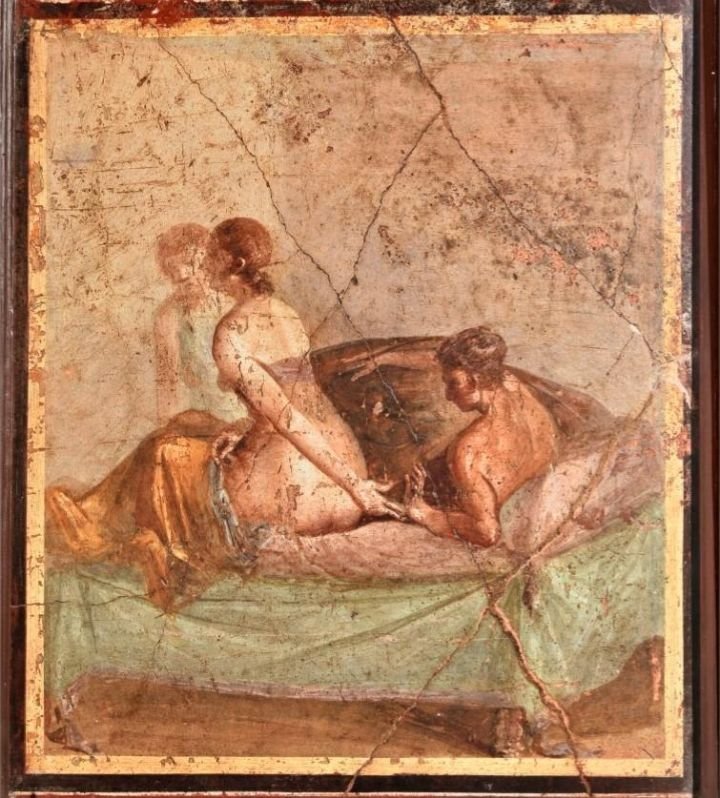
Roman literature contains references to masturbation, sexual pleasure and prostitution. Sexual behavior was often discussed openly in certain forms of poetry, comedy and satire.
However, Roman society was strongly concerned with status, masculinity, self-control and social hierarchy.
An act that was considered acceptable for one person might be viewed differently depending on the individual’s social position, gender or circumstances.
Roman sexual morality therefore cannot be reduced to the modern idea that something was simply “allowed” or “forbidden.”
Instead, questions of who was involved, their social status, and whether the behavior was considered excessive or shameful often mattered greatly.
Ancient India and the Kama Sutra
Ancient India produced some of the world’s best-known writings about sexuality.
The Kama Sutra, traditionally associated with Vātsyāyana and generally dated to the early centuries of the Common Era, is often described today as an ancient sex manual.
That description is incomplete.
The work is much broader, dealing with relationships, courtship, marriage, social behavior, pleasure and erotic life. It also contains discussions of sexual practices.
The existence of such literature demonstrates that some ancient Indian intellectual traditions treated sexual pleasure as an important subject worthy of discussion.
However, it would be inaccurate to assume that the Kama Sutra represented the beliefs of everyone in ancient India. Indian society contained many religious, philosophical and cultural traditions, with different attitudes toward sexuality.
Masturbation and Ancient Medicine
Ancient medical writers also discussed sexual fluids and reproductive health.
Greek physician Hippocrates and later medical traditions developed theories about the body that were very different from modern biology. Ancient physicians sometimes believed that sexual fluids contained important physical qualities and that excessive sexual activity could affect the body.
These ideas eventually contributed to centuries of debate about sexual activity and health.
Importantly, ancient medicine did not have a modern understanding of hormones, reproduction, psychology or sexual health. Therefore, claims that ancient doctors “proved” masturbation was healthy or unhealthy should be treated cautiously.
They were working within completely different medical systems.
The Rise of Religious Restrictions
Attitudes toward masturbation became particularly complicated as major religious traditions developed and expanded.
In Jewish, Christian and Islamic societies, sexual behavior became closely connected to questions of morality, marriage, self-control and religious law.
A common misconception is that the biblical story of Onan directly describes masturbation. It does not. The story concerns Onan’s refusal to fulfill a particular reproductive obligation, and the interpretation of the passage has changed over time.
The association between Onan and masturbation became much stronger in later Christian interpretations.
During the medieval and early modern periods in Europe, religious writers increasingly discussed masturbation within broader debates about sexual morality. Sexual activity outside approved relationships could be treated as sinful, and self-control was frequently emphasized.
The Medicalization of Masturbation
By the 18th and 19th centuries, masturbation became the subject of intense medical concern in parts of Europe and North America.
Some physicians claimed that masturbation caused physical and psychological illnesses. These theories were based on medical ideas that modern science does not support.
One influential example was the 18th-century physician Samuel-Auguste Tissot, whose writings helped popularize fears that masturbation could damage health.
The result was a strange historical reversal.
In some ancient cultures, sexual pleasure could be associated with fertility, humor, pleasure or mythology. Centuries later, certain European medical and religious authorities increasingly portrayed masturbation as a dangerous habit.
Many of those medical claims were eventually rejected.
The 20th Century Changes the Conversation
During the 20th century, scientific research gradually changed Western attitudes.
Researchers began studying human sexuality more systematically. Alfred Kinsey’s research in the United States during the mid-20th century documented masturbation as a common human sexual behavior.
Later researchers, including William Masters and Virginia Johnson, contributed to the scientific study of human sexual responses.
These developments helped move masturbation away from purely religious and moral debate and toward the fields of sexuality, psychology and medicine.
Modern medical understanding does not support the old idea that ordinary masturbation causes the wide range of diseases once attributed to it.
What Can History Really Tell Us?
The history of masturbation reveals something larger than the history of one sexual behavior.
It shows that attitudes toward sexuality have never been completely universal.
Ancient civilizations interpreted sexual behavior through their own ideas about:
religion
fertility
masculinity and femininity
social status
reproduction
morality
medicine
pleasure
The same behavior could be interpreted very differently depending on the culture and historical period.
Most importantly, historians should avoid projecting modern attitudes backward. An Egyptian creation myth is not necessarily evidence of everyday Egyptian behavior. A Greek joke does not represent every Greek citizen. A Roman poem does not establish a universal Roman attitude.
Conclusion
Masturbation did not begin in the modern world. Human sexual behavior existed long before written history, but our understanding of it comes mainly from the surviving evidence of particular cultures.
Ancient Mesopotamian and Egyptian traditions sometimes connected sexual power with creation and fertility. Greek and Roman writers occasionally treated masturbation as a subject of humor, social commentary or everyday sexuality. Ancient Indian literature explored sexual pleasure in considerably greater detail.
Later religious and medical traditions often placed greater emphasis on sexual restraint, while some 18th- and 19th-century physicians promoted medical theories about masturbation that are no longer accepted.
The history of masturbation is therefore not a simple story of humanity gradually “discovering” sexuality. It is a story about how different societies repeatedly reinterpreted the same human behavior through their own religious beliefs, medical theories, cultural values and ideas about the body.
The Historabase Editorial Team is dedicated to exploring and sharing the stories that have shaped Africa and the wider world. Our work covers African history, ancient civilizations, empires, historical figures, wars, cultures, political movements, and important events from the past.
We aim to present history in a clear, engaging, and accessible way, combining historical records with careful research to help readers better understand the people, events, and civilizations that shaped our world.








One Comment