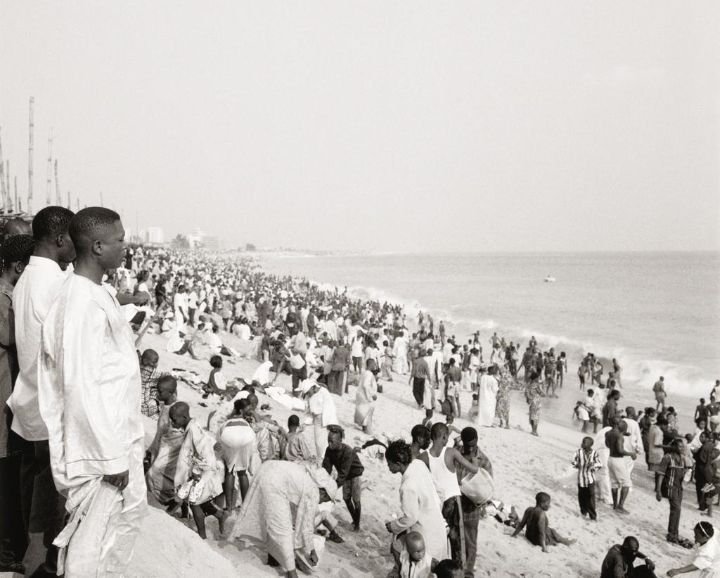
On a Saturday in 1971, thousands of people gathered at Bar Beach in Lagos to witness an event that would become one of the most controversial chapters in Nigeria’s history.
Three condemned men were brought before a firing squad.
They were Babatunde Folorunsho, Joseph Ilobo and Sub-Lieutenant Williams Alders Oyazimo.
Their execution marked the beginning of a new and disturbing era of public executions in Nigeria, particularly the military government’s campaign against armed robbery.
But who were the men?
What had they been convicted of?
And why did the government decide that their deaths should take place publicly?
Nigeria Before the Bar Beach Executions
Capital punishment was not new to Nigeria in 1971.
Executions had already been carried out under colonial rule. Academic research into British colonial Africa records executions in Nigeria, including the hanging of three men in Enugu in 1918. Colonial governments used capital punishment as part of their system of criminal justice and, at times, as a demonstration of state authority.
This means that describing the 1971 event as simply “the first execution in Nigeria” would be historically inaccurate.
What made 1971 different was that it introduced the era of public executions of armed-robbery convicts at Lagos’s Bar Beach, a spectacle that would later become infamous in Nigerian history.
The Rise of Armed Robbery
Nigeria was experiencing significant political and economic changes following the civil war.
The military government became increasingly concerned about armed robbery, which was regarded as a serious threat to public safety.
In response, the government introduced tougher measures.
Armed robbery became punishable by death under the military government’s Robbery and Firearms legislation.
The policy was intended not only to punish convicted robbers but also to deter others from committing similar crimes.
The government believed that making executions public would send a powerful warning to the wider population.
That decision produced one of the most controversial spectacles in Nigerian history.
The Three Men
The first widely documented public execution at Bar Beach involved Babatunde Folorunsho, Joseph Ilobo and Williams Alders Oyazimo.
They had been convicted in connection with an armed-robbery case involving Alhaja Taibatu Opene.
According to a later account published by Gavel, the robbery involved the theft of a record player and loudspeaker from Opene.
Oyazimo’s case was particularly controversial.
He was a former naval officer and maintained that he was innocent.
Rather than quietly accepting his fate, he continued to proclaim his innocence as he faced execution.
A contemporary recollection published decades later by Catholic priest Anthony Akinwale described Oyazimo speaking to Father Pedro Martins, who had been present to minister to the condemned men.
Oyazimo reportedly insisted that he was innocent and spoke about what he believed would happen to his family after his death.
His final protest became part of the lasting memory of the Bar Beach executions.
The Day of the Execution
The executions took place at Bar Beach in Lagos in 1971.
Sources differ slightly on the exact date, with accounts citing April 24 and April 26, while other recollections describe the first Lagos public execution as occurring later in July. Because of those discrepancies, the safest historical description is simply that the first Bar Beach public execution took place in 1971.
What is not disputed is the significance of the event.
The condemned men were taken to the execution site and placed before a firing squad.
Large crowds gathered to watch.
The event was not treated as a private prison procedure. It was deliberately visible.
The authorities wanted Nigerians to see the consequences of armed robbery.
But instead of producing a quiet lesson about crime and punishment, the execution became a spectacle.
The Bar Beach “Show”
The phrase “Bar Beach Show” eventually became associated with public executions at the location.
The executions attracted enormous crowds.
People came to watch condemned criminals face the firing squad, turning the deaths into public spectacles.
Academic research on Nigeria’s political culture describes how the executions at Bar Beach were carried out before large crowds and, in some cases, television cameras. The location eventually became associated with a form of political theatre surrounding state violence and punishment.
The public nature of the executions was deliberate.
The military authorities wanted the punishment to be seen.
The message was straightforward:
Commit armed robbery, and you could lose your life.
But the executions also generated questions about whether public killing actually reduced crime.
Did It Stop Armed Robbery?
It did not.
Despite the executions, armed robbery continued to be a major problem in Nigeria.
The number of public executions increased dramatically during subsequent military regimes.
A study published in the Journal of Security Management, Policy & Administration notes that by 1976, more than 400 armed robbers had reportedly been publicly executed by firing squad. It also records a dramatic increase during the 1980s, including hundreds of executions in 1984.
The authorities continued to believe that severe punishment could deter criminals.
But the persistence of armed robbery suggested that executions alone could not solve the underlying causes of violent crime.
The Controversy Over Oyazimo
Among the three men executed in the first Bar Beach event, Oyazimo’s story has remained particularly striking because of his insistence that he was innocent.
According to Akinwale’s later recollection, Oyazimo maintained that his dealings with Taibatu Opene were not robbery but arose from a business dispute.
He also questioned whether his military position had been used against him.
Those claims cannot by themselves establish his innocence. He was convicted by the tribunal responsible for the case.
But his protest illustrates one of the greatest dangers surrounding capital punishment:
an executed person cannot later be released if evidence emerges that the conviction was wrong.
Once the sentence is carried out, there is no possibility of correcting the punishment itself.
Public Executions Become a National Phenomenon
After the first Bar Beach executions, public executions became increasingly common.
Bar Beach became synonymous with the practice.
During subsequent military governments, convicted armed robbers were executed at various locations across the country.
The executions sometimes attracted thousands of spectators.
The spectacle became so familiar that Nigerians began referring to public executions at Bar Beach simply as the “Bar Beach Show.”
The term itself revealed something disturbing about the practice.
A government punishment designed to demonstrate the seriousness of crime had become a public spectacle watched by crowds.
The Era of the Firing Squad
The firing squad became one of the most recognisable methods of execution during Nigeria’s military era.
The practice was especially associated with armed-robbery convictions.
Public executions reached particularly high levels during the military regimes of the 1980s and 1990s.
They became part of the government’s wider campaign to demonstrate that it was willing to use extreme punishment against criminals.
But human-rights advocates increasingly challenged the practice.
They argued that public executions violated human dignity and that capital punishment created the possibility of irreversible miscarriages of justice.
Nigeria’s Other Famous Executions
The history of Nigerian executions did not end with armed robbers.
Perhaps the most internationally controversial executions occurred in 1995, when writer and environmental activist Ken Saro-Wiwa and eight other Ogoni activists were executed after a special tribunal convicted them in connection with the deaths of four Ogoni leaders.
Amnesty International described the trial as unfair and condemned the executions.
The case triggered international outrage and damaged Nigeria’s relationship with the international community.
It demonstrated that execution in Nigeria was not only used in ordinary criminal cases but could also become deeply connected to political power.
The End of the Bar Beach Era
Over time, public executions at Bar Beach disappeared.
The practice became increasingly criticised, while Nigeria’s use of the death penalty continued to attract national and international debate.
Nigeria still retains the death penalty in law.
However, actual executions became increasingly rare.
Amnesty International’s records show that the last executions documented by the organisation occurred in 2016, when three men in Edo State were executed, while Nigeria had also carried out executions in 2013.
The history of capital punishment in Nigeria therefore stretches from colonial rule through military governments and into the democratic era.
What Did the First Three Men Do?
The three men at the centre of the first Bar Beach public execution were convicted of armed robbery.
Their case involved the robbery of Alhaja Taibatu Opene, with the stolen property reportedly including a record player and loudspeaker.
But the historical significance of their story goes beyond the crime itself.
Their deaths marked the beginning of a period in which the Nigerian state deliberately used public execution as a tool of deterrence.
The government wanted Nigerians to see the consequences of armed robbery.
Instead, Bar Beach became a symbol of the country’s complicated relationship with crime, punishment, military rule and human rights.
The Historabase Editorial Team is dedicated to exploring and sharing the stories that have shaped Africa and the wider world. Our work covers African history, ancient civilizations, empires, historical figures, wars, cultures, political movements, and important events from the past.
We aim to present history in a clear, engaging, and accessible way, combining historical records with careful research to help readers better understand the people, events, and civilizations that shaped our world.