On April 15, 2013, thousands of runners and spectators gathered in Boston, Massachusetts, for the annual Boston Marathon. What began as one of the city’s biggest sporting celebrations ended in tragedy when two bombs exploded near the race’s finish line.
The attack killed three people, injured more than 500 others and triggered a massive investigation and manhunt. Within days, authorities identified two brothers, Tamerlan and Dzhokhar Tsarnaev, as the suspects.
The bombing became one of the most significant terrorist attacks in the United States since September 11, 2001.
A Day of Celebration Turns Into Tragedy
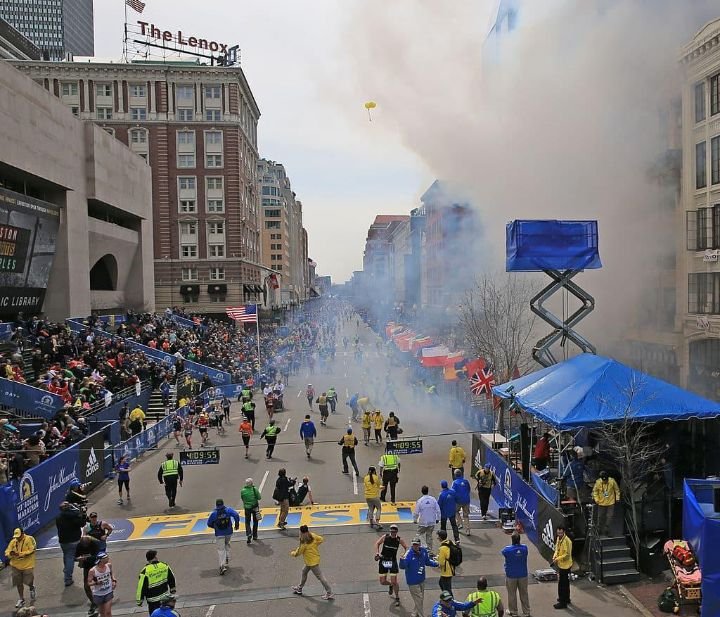
The 117th Boston Marathon was taking place on April 15, 2013. The marathon traditionally attracts runners from around the world, while large crowds gather along the route to watch the race.
At approximately 2:49 p.m., two improvised explosive devices detonated near the finish line on Boylston Street, only seconds apart.
The explosions caused chaos among runners, spectators and emergency personnel. Three people were killed: 8-year-old Martin Richard, 29-year-old Krystle Campbell and 23-year-old Lingzi Lu.
More than 500 people were physically injured. According to the FBI, 17 victims suffered amputations as a result of the attack.
The attack immediately transformed the normally celebratory atmosphere around the marathon into a major crime scene.
Investigators from the FBI, Boston Police Department, Massachusetts State Police and Bureau of Alcohol, Tobacco, Firearms and Explosives began collecting evidence and interviewing witnesses.
The Investigation Begins
One of the biggest challenges was determining who had planted the explosives.
Boston was filled with surveillance cameras, smartphones and spectators who had taken photographs and videos during the marathon. Investigators appealed to the public for photographs and recordings that could help identify suspicious individuals.
The response was enormous.
According to the FBI, investigators eventually collected more than 33 terabytes of digital information, including photographs and video submitted by members of the public. Evidence teams processed thousands of pieces of physical evidence from the bombing scene.
Three days after the bombing, on April 18, the FBI released photographs and video showing two men believed to be involved in the attack.
The suspects were later identified as brothers Tamerlan Tsarnaev and Dzhokhar Tsarnaev.
The Manhunt
The identification of the brothers quickly led to another violent confrontation.
On the night of April 18, the Tsarnaev brothers went to the Massachusetts Institute of Technology (MIT) campus. There, they encountered MIT Police Officer Sean Collier.
Collier was shot and killed.
The brothers then carjacked a vehicle and forced its driver to take them away from the area. The driver eventually escaped, and the brothers continued toward Watertown, Massachusetts.
Police soon confronted them.
A violent firefight followed in Watertown, during which additional explosive devices were used. Several police officers were injured.
Tamerlan Tsarnaev was seriously wounded during the confrontation. According to the FBI, Dzhokhar then drove the vehicle toward officers while attempting to escape and ran over his brother as he fled.
Tamerlan died from his injuries.
Dzhokhar escaped the immediate confrontation and became the subject of an intense manhunt.
The Search for Dzhokhar Tsarnaev
Authorities searched Watertown and surrounding areas while residents were instructed to remain indoors.
The search eventually focused on a residential neighborhood where a homeowner discovered that someone was hiding inside a boat stored in his backyard.
Police surrounded the boat and discovered Dzhokhar Tsarnaev hiding underneath its cover.
He was taken into custody on April 19, 2013.
The five-day sequence of bombing, investigation and manhunt had come to an end.
Who Were the Tsarnaev Brothers?
Tamerlan and Dzhokhar Tsarnaev were brothers who had lived in the United States.
Dzhokhar, who was 19 when the bombing occurred, was a U.S. citizen and was living in Cambridge, Massachusetts.
Federal investigators concluded that the brothers had planned the attack themselves. The FBI described them as self-radicalized.
The investigation also examined people who had interacted with the brothers before and after the bombing. Several individuals were subsequently prosecuted for actions connected to the investigation, including efforts to conceal or destroy evidence.
The Federal Case
After his arrest, Dzhokhar Tsarnaev was charged in federal court.
A federal grand jury eventually returned a 30-count indictment against him. The charges included using a weapon of mass destruction resulting in death, bombing a place of public use, malicious destruction of property resulting in death, and the murder of MIT Police Officer Sean Collier.
The case went to trial in 2015.
Prosecutors presented extensive physical, forensic and digital evidence. More than 100 witnesses testified, while investigators presented more than 1,000 exhibits.
Among those who testified were survivors, family members of victims, law enforcement officers and forensic experts.
In April 2015, a federal jury found Dzhokhar Tsarnaev guilty on all 30 counts.
The jury subsequently recommended the death penalty for the charges eligible for capital punishment. In June 2015, he was formally sentenced to death.
The Human Cost
The Boston Marathon bombing was not simply a case involving two explosions. Hundreds of people were affected physically and emotionally.
Three people died at the marathon.
MIT Police Officer Sean Collier was killed three days later during the confrontation with the suspects.
More than 500 people suffered physical injuries, with some losing limbs and others sustaining severe wounds.
Families were also left dealing with the loss of loved ones and the long-term consequences of the attack.
In the years that followed, Boston continued to remember those who were killed and injured.
At the 10th anniversary in 2023, the FBI noted that 17 victims had suffered amputations and emphasized the continuing importance of remembering the victims and survivors.
How the Bombers Were Identified
One of the most important aspects of the investigation was the role of ordinary members of the public.
People attending the marathon had taken photographs and videos throughout the day. Some of those images captured the suspects.
After authorities released photographs of the two men, information from the public helped investigators identify them.
The FBI later described the investigation as one of its largest terrorism cases since 9/11. Investigators processed thousands of pieces of evidence and worked with numerous law-enforcement agencies.
The case demonstrated how surveillance footage, forensic evidence, witness accounts and public assistance could be combined during a major criminal investigation.
The Historabase Editorial Team is dedicated to exploring and sharing the stories that have shaped Africa and the wider world. Our work covers African history, ancient civilizations, empires, historical figures, wars, cultures, political movements, and important events from the past.
We aim to present history in a clear, engaging, and accessible way, combining historical records with careful research to help readers better understand the people, events, and civilizations that shaped our world.