The Tulsa Race Massacre of 1921 was one of the deadliest episodes of racial violence in United States history. Between May 31 and June 1, 1921, a white mob attacked the predominantly Black Greenwood district of Tulsa, Oklahoma, destroying homes, businesses, churches, and other community institutions. The violence killed an undetermined number of Black residents, left thousands homeless, and devastated one of the most prosperous African American communities in the country.
Greenwood was widely known as Black Wall Street because of its thriving Black-owned businesses and the economic independence of its residents. The massacre destroyed much of that prosperity and exposed the racial inequality and violence that shaped American life in the early twentieth century.
The Rise of Greenwood
Greenwood developed in the early twentieth century as a center of Black business and community life in Tulsa. At a time when racial segregation restricted African Americans’ access to many establishments and economic opportunities, Greenwood supported a substantial network of Black-owned businesses.
The district contained grocery stores, restaurants, hotels, barbershops, medical offices, law firms, churches, and other enterprises. Black professionals, entrepreneurs, and workers contributed to its growth, while residents established schools and community organizations that served the neighborhood.
Oklahoma had become a state in 1907, but racial segregation and discrimination remained widespread. Black residents faced restrictions in education, housing, employment, and public facilities. Despite these obstacles, Greenwood developed a strong commercial district and a substantial degree of economic independence.
Its success made the neighborhood an important symbol of African American achievement. However, prosperity did not protect its residents from the racial hostility and violence that affected Black communities throughout the United States.
The Incident That Preceded the Massacre
The immediate events began on May 30, 1921, when Dick Rowland, a 19-year-old Black shoeshiner, entered an elevator operated by Sarah Page, a young white woman, in the Drexel Building in downtown Tulsa.
The precise circumstances of the encounter remain uncertain. Reports suggested that Rowland and Page had some kind of physical contact, possibly after he stumbled or the elevator malfunctioned. The details were never conclusively established.
The following day, a local newspaper published a report about the incident that contributed to public alarm. Rowland was arrested and held at the Tulsa County Courthouse.
Rumors spread rapidly through Tulsa’s white community, and some residents demanded that Rowland be lynched. The threat of mob violence became increasingly serious as crowds gathered near the courthouse.
On the evening of May 31, Black residents, including some First World War veterans, went to the courthouse after learning that Rowland might be in danger. They intended to help prevent a possible lynching.
A confrontation developed between Black men and white residents outside the courthouse. A gun was reportedly discharged during the confrontation, triggering an exchange of gunfire. The incident escalated into widespread violence.
During the night of May 31 and into June 1, white mobs moved into the Greenwood district and attacked its residents.
Armed attackers shot Black residents, looted businesses, and set fire to buildings. Violence spread throughout the neighborhood as homes and commercial properties were burned.
The destruction intensified on the morning of June 1. Mobs attacked residential streets and business districts, leaving large sections of Greenwood in flames. Some attackers used private aircraft during the violence, and eyewitness accounts described objects being dropped from the air. The precise extent and nature of these aerial attacks remain subjects of historical investigation.
The scale of the destruction overwhelmed the community. Firefighters faced dangerous conditions, and efforts to protect buildings and residents were severely obstructed by the violence.
Black residents attempted to defend their homes and families, but they were heavily outnumbered. Some fled Tulsa, while others sought shelter wherever they could find it.
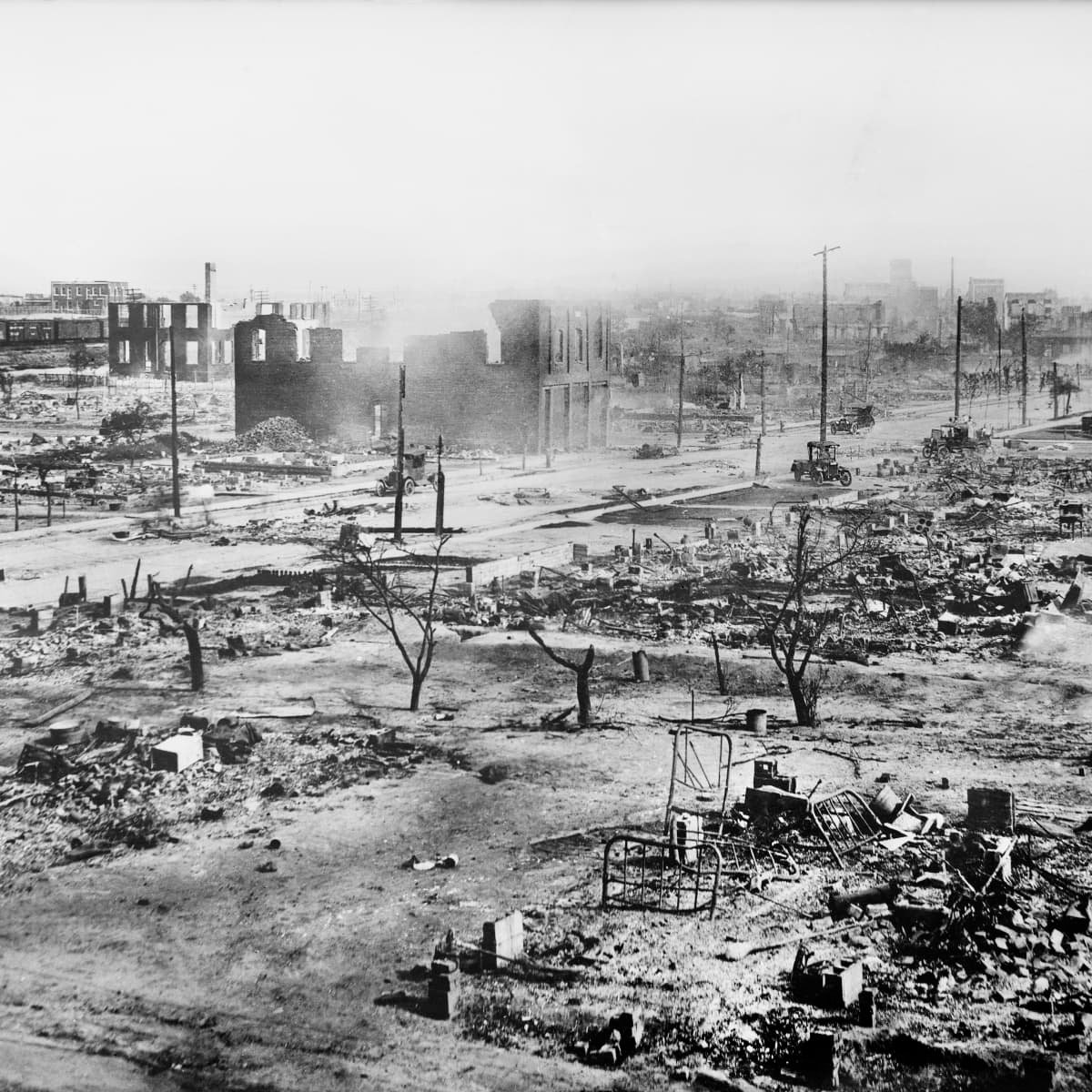
By the time the violence subsided on June 1, much of Greenwood had been destroyed.
The Role of Law Enforcement and Public Officials
The response of Tulsa’s authorities became a central issue in investigations of the massacre.
Rather than consistently protecting Black residents from the attacking mobs, some members of law enforcement and other local authorities participated in the violence or assisted in the detention of Black residents. The Oklahoma National Guard was deployed, and Black Tulsans were detained in large numbers.
Thousands of Black residents were held in temporary detention facilities, including the Convention Hall and the Tulsa Fairgrounds. Many were not released until white employers or other individuals vouched for them.
The treatment of Black residents during the crisis reflected the racial inequalities of the period. Many victims had lost their homes and possessions, yet they were also subjected to restrictions on their movement and faced obstacles to recovering their property.
The massacre demonstrated the failure of local institutions to protect Greenwood’s residents and the devastating consequences of racial hostility supported or tolerated by people in positions of authority.
Deaths and Destruction
The exact death toll remains disputed because contemporary records were incomplete and the investigation of the massacre was inadequate.
Early official figures recorded 36 deaths. Later estimates commonly placed the number of people killed at approximately 100 to 300, with Black residents accounting for the overwhelming majority of the victims. The precise number has never been conclusively established.
The physical destruction was extensive. Approximately 35 blocks of the Greenwood district were affected, and more than 1,000 homes were destroyed or damaged. Black-owned businesses, churches, schools, and other community buildings were also lost.
Thousands of residents were left homeless. Many lost savings, personal possessions, business inventories, and property accumulated over years of work.
The financial losses were substantial, but the full economic damage was difficult to calculate. Insurance claims frequently encountered resistance, and policies often excluded losses caused by riots or similar disturbances. As a result, many survivors received little or no compensation for what they had lost.
The Aftermath and Reconstruction
Following the massacre, Greenwood’s residents faced the enormous task of rebuilding their community.
Despite the devastation, Black Tulsans began reconstructing homes and businesses. Community members, business owners, religious leaders, and other supporters contributed to recovery efforts.
However, rebuilding was made more difficult by limited financial resources, discrimination, and disputes over proposed changes to the district. Some local authorities sought to impose new restrictions on construction in the affected area, further complicating recovery.
Many survivors struggled to regain their former economic position. Businesses that had taken years to establish were gone, and families who had lost their homes faced prolonged hardship.
Although Greenwood eventually recovered part of its commercial activity, the massacre caused lasting damage to the community’s wealth and development. The loss of property, businesses, and accumulated assets affected generations of residents.
The destruction also disrupted family networks and weakened institutions that had supported the Black community in Tulsa.
The massacre produced few meaningful legal consequences for those responsible for the destruction.
Despite the scale of the violence, no one was successfully prosecuted for the killings and widespread destruction associated with the massacre. Many survivors found it difficult to obtain legal remedies for their losses.
The events also received limited attention in official public accounts for decades. The lack of comprehensive investigations, the loss or absence of records, and the reluctance of some authorities to confront the violence contributed to the long period of public silence.
For many years, the massacre was discussed primarily within the Black community and by survivors and their descendants. Its limited treatment in mainstream historical accounts meant that generations of Americans knew little about what had happened in Tulsa.
The Rediscovery of the Massacre
Interest in the Tulsa Race Massacre increased significantly during the late twentieth century.
In 1997, Oklahoma established the Oklahoma Commission to Study the Tulsa Race Riot of 1921. The commission investigated the events, examined historical records, and collected testimony concerning the violence and its aftermath.
Its final report, published in 2001, documented the destruction of Greenwood and recommended measures including reparations for survivors and their descendants.
The report helped bring renewed national attention to the massacre and strengthened public discussion about responsibility, historical memory, and compensation for victims.
In subsequent years, researchers continued investigating the death toll and the possibility of mass graves. In 2020, Tulsa began a renewed search for potential burial sites associated with the massacre. Excavations in 2020 and 2021 uncovered human remains at Oaklawn Cemetery, prompting further forensic and historical investigations. The discoveries reinforced efforts to identify victims and clarify the circumstances surrounding their deaths.
The centennial anniversary in 2021 brought additional national attention to the massacre, including commemorations, educational programs, and renewed discussions about racial injustice and the lasting effects of historical violence.
The Tulsa Race Massacre and Its Historical Significance
The Tulsa Race Massacre remains a significant event in the history of racial violence in the United States.
It demonstrated how racial hostility, sensational reporting, mob violence, and the failure of public institutions to protect citizens could combine to destroy an established community. Greenwood’s residents had built businesses, homes, and institutions despite segregation, yet their achievements offered little protection when violence erupted.
The massacre also exposed the difficulty Black Americans faced in obtaining justice and compensation after racial attacks. The absence of successful prosecutions and the limited recovery of property losses contributed to the long-term consequences for survivors and their descendants.
The destruction of Greenwood became an important part of broader discussions about the history of racial discrimination, the loss of Black wealth, and the responsibilities of public institutions.
Although the massacre was long neglected in national historical accounts, continued research, survivor testimony, and public commemorations have helped establish its place in American history.
Conclusion
The Tulsa Race Massacre of 1921 destroyed much of Greenwood, one of the most prominent Black commercial districts in the United States. The attacks killed an undetermined number of Black residents, displaced thousands, and devastated a community built through years of enterprise and collective effort.
The failure to deliver meaningful justice or compensation left lasting consequences for survivors and their descendants. Decades of limited public recognition further delayed a comprehensive understanding of the tragedy.
The Historabase Editorial Team is dedicated to exploring and sharing the stories that have shaped Africa and the wider world. Our work covers African history, ancient civilizations, empires, historical figures, wars, cultures, political movements, and important events from the past.
We aim to present history in a clear, engaging, and accessible way, combining historical records with careful research to help readers better understand the people, events, and civilizations that shaped our world.