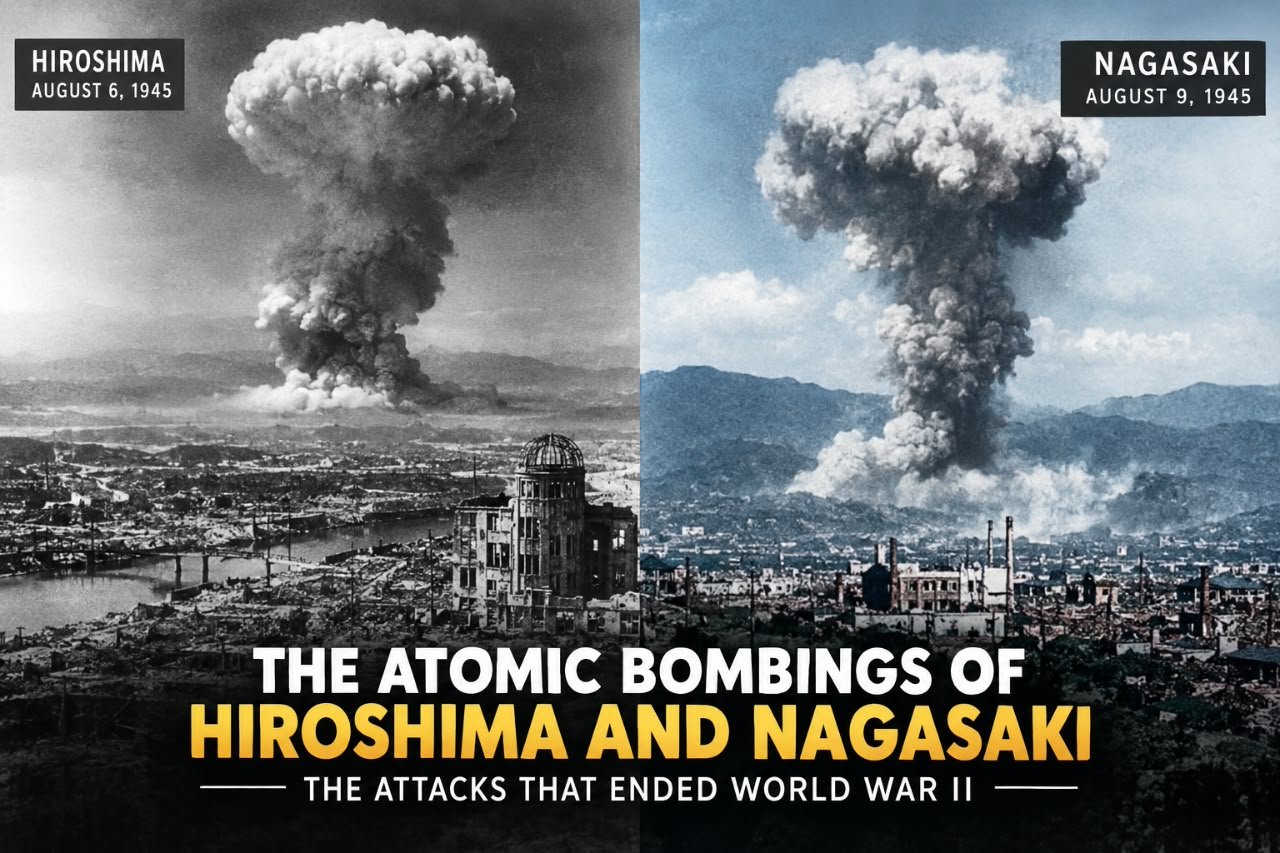
The Atomic Bombings of Hiroshima and Nagasaki. In August 1945, the United States dropped two atomic bombs on the Japanese cities of Hiroshima and Nagasaki during the final stages of World War II. The attacks killed tens of thousands of people immediately, destroyed large sections of both cities, and exposed survivors to severe radiation injuries.
Hiroshima was bombed on August 6, 1945, using a uranium-based atomic bomb called Little Boy. Three days later, on August 9, the United States dropped a plutonium-based bomb known as Fat Man on Nagasaki.
The bombings remain the only wartime uses of nuclear weapons against cities. They played a central role in Japan’s surrender and the conclusion of World War II.
Japan and the Final Stages of World War II
By the summer of 1945, Japan was fighting against the United States and its allies in the Pacific. Germany had surrendered in May, ending the war in Europe, but Japan continued to resist Allied forces.
American forces had captured strategic islands across the Pacific and carried out extensive conventional bombing raids against Japanese cities. The Battle of Okinawa, fought from April to June 1945, resulted in enormous military and civilian casualties.
The Japanese government had not accepted the Allied demand for unconditional surrender. On July 26, 1945, the United States, Britain, and China issued the Potsdam Declaration, calling on Japan to surrender and warning of devastating consequences if it refused.
Meanwhile, the United States had developed atomic weapons through the Manhattan Project, a wartime research program involving American and international scientists. The first successful test of an atomic bomb took place on July 16, 1945, at the Trinity test site in New Mexico.
Following the successful test, American leaders proceeded with plans to use atomic weapons against Japan.
The Atomic Bombing of Hiroshima — August 6, 1945
At approximately 8:15 a.m. on August 6, 1945, the American B-29 bomber Enola Gay, piloted by Colonel Paul W. Tibbets Jr., dropped the atomic bomb Little Boy over Hiroshima.
The bomb exploded approximately 600 meters above the city. Its explosive yield was estimated at about 15 kilotons of TNT.
Hiroshima had been an important military and industrial center. It contained military headquarters, supply facilities, and industrial establishments, alongside a large civilian population.
The explosion generated an intense flash, extreme heat, and a powerful blast wave. Buildings across the city were destroyed or severely damaged, while fires spread through residential and commercial districts.
People near the explosion suffered fatal burns, traumatic injuries, and exposure to intense radiation. Many buildings constructed from wood collapsed or caught fire, and emergency services struggled to respond to the scale of destruction.
The city’s hospitals and medical facilities were overwhelmed. Numerous doctors, nurses, and other medical personnel were killed or injured, leaving survivors with limited access to treatment.
The exact number of people killed in Hiroshima remains uncertain because records were destroyed, people disappeared, and many survivors died from injuries and radiation-related illnesses in the months and years that followed.
Estimates commonly place the death toll at approximately 70,000 to 80,000 by the end of 1945, although some estimates are higher. The city’s population before the bombing was approximately 350,000.
Survivors, later known as hibakusha, experienced burns, injuries, radiation sickness, and increased risks of certain cancers. Some also faced social discrimination because of fears and misunderstandings surrounding radiation exposure.
The bombing devastated Hiroshima’s infrastructure and left much of the city in ruins.
The Atomic Bombing of Nagasaki — August 9, 1945
Three days after Hiroshima, the United States carried out a second atomic bombing against Japan.
The original target for the August 9 mission was Kokura, which contained a major Japanese arsenal. However, cloud cover and smoke obstructed visibility over the city. The American bomber crew therefore proceeded to its secondary target, Nagasaki.
At approximately 11:02 a.m., the B-29 bomber Bockscar, commanded by Major Charles W. Sweeney, dropped the plutonium-based atomic bomb Fat Man over Nagasaki.
The bomb exploded above the city with an estimated yield of approximately 21 kilotons of TNT.
Nagasaki was an important industrial and port city, with shipbuilding facilities, factories, and other military-related industries. Its landscape of hills and valleys influenced the distribution of the blast and the areas most severely damaged.
The explosion destroyed buildings, damaged industrial facilities, and killed or injured thousands of people. Residential neighborhoods near the detonation were devastated, while fires and collapsing structures caused further casualties.
The city’s medical infrastructure suffered severe damage, making it difficult to treat the wounded. Survivors experienced burns, traumatic injuries, and radiation exposure.
Estimates indicate that approximately 40,000 people died in Nagasaki by the end of 1945. Some historical estimates place the number higher. The city’s population before the bombing was approximately 240,000.
As in Hiroshima, the death toll continued to rise after the initial explosion because of burns, injuries, infections, and radiation-related illnesses.
The bombing destroyed a substantial part of Nagasaki’s industrial and residential areas, although the surrounding hills limited the blast’s impact in some districts.
Survivors faced long-term medical consequences, including an increased risk of leukemia and other cancers. The effects of radiation exposure remained a major concern for decades.
Why the United States Used Atomic Bombs
The decision to use atomic weapons emerged from the final stages of the Pacific War and American efforts to secure Japan’s surrender.
President Harry S. Truman authorized the use of the weapons. American officials argued that the bombings could force Japan to surrender and avoid a prolonged invasion of the Japanese home islands, which they expected could result in substantial military and civilian casualties.
The United States had been preparing for a possible invasion, known as Operation Downfall. The invasion was never carried out.
The decision to use the bombs remains a subject of historical debate. Historians have examined military planning, estimates of invasion casualties, Japan’s willingness to surrender, the potential effects of the Soviet Union’s entry into the war, and the possibility of alternatives to atomic bombing.
Some historians emphasize the bombings’ role in accelerating Japan’s surrender. Others argue that Japan’s military position was already deteriorating and that Soviet intervention was a major factor in the decision to surrender.
The historical record contains differing interpretations of the relative importance of these factors.
The Soviet Union Declares War on Japan
On August 8, 1945, the Soviet Union declared war on Japan. Soviet forces began an offensive against Japanese positions in Manchuria during the early hours of August 9.
The Soviet offensive rapidly weakened Japan’s position in northeast Asia. Japanese leaders now faced the prospect of continued war against the United States and its allies, as well as a new conflict with the Soviet Union.
The timing of the Soviet declaration and invasion, together with the atomic bombings, became central to historical discussions about why Japan decided to surrender.
Historians continue to debate the relative weight of the atomic attacks and Soviet intervention in the Japanese government’s final decision.
Japan Announces Its Surrender
Following the bombings and the Soviet Union’s entry into the war, the Japanese government moved toward surrender.
On August 10, 1945, Japan communicated its willingness to accept the Potsdam Declaration, subject to a condition concerning the position of the emperor. The Allied response did not guarantee that the emperor would retain sovereign authority, but it allowed that his position would be subject to the authority of the Allied occupation.
On August 14, Emperor Hirohito informed the Japanese government of his decision to accept surrender terms. The following day, August 15, he announced Japan’s surrender in a radio broadcast to the Japanese public.
The formal surrender ceremony took place on September 2, 1945, aboard the American battleship USS Missouri in Tokyo Bay.
Japan’s surrender marked the end of World War II.
The Human Cost of the Bombings
The atomic bombings caused mass civilian casualties and long-lasting medical and social consequences.
People who survived the initial explosions suffered extensive burns, injuries from collapsing buildings, and exposure to ionizing radiation. Many developed acute radiation sickness, which could cause nausea, vomiting, bleeding, hair loss, and damage to the body’s blood-forming organs.
Some survivors died within days or weeks. Others developed cancers, including leukemia, in subsequent years.
The bombings also affected pregnant women and their children. Studies of survivors contributed to scientific understanding of the long-term effects of radiation exposure.
The destruction of homes, hospitals, schools, and workplaces displaced survivors and disrupted daily life. Many people lost relatives and remained uncertain about the fate of family members.
Survivors encountered psychological trauma, financial hardship, and discrimination. Some faced prejudice over concerns that radiation exposure could affect marriage prospects or be passed to future generations.
The Japanese government and medical researchers subsequently developed programs to study and support atomic bomb survivors.
Reconstruction of Hiroshima and Nagasaki
After the war, Hiroshima and Nagasaki began rebuilding their damaged infrastructure and communities.
Hiroshima’s reconstruction included the restoration of housing, transportation, public services, and industrial activity. In 1949, the Japanese government enacted the Hiroshima Peace Memorial City Construction Law, supporting the city’s reconstruction and its development as a center for peace.
The Hiroshima Peace Memorial Park was established near the area devastated by the explosion. The Atomic Bomb Dome, the remains of a building close to the hypocenter, became one of the city’s most recognized historical landmarks.
Nagasaki also rebuilt its residential districts, industrial facilities, and public infrastructure. The Nagasaki Peace Park and the Nagasaki Atomic Bomb Museum were later established to commemorate the victims and document the bombing.
Both cities became international centers for remembrance, historical education, and nuclear disarmament advocacy.
The Legacy of the Atomic Bombings
The bombings of Hiroshima and Nagasaki introduced the world to the destructive power of nuclear weapons in warfare.
The attacks influenced international debates about military strategy, civilian protection, nuclear deterrence, and the possibility of future nuclear conflict.
In 1946, the United Nations established the United Nations Atomic Energy Commission to address issues associated with atomic energy and international security.
During the following decades, nuclear weapons became central to the Cold War rivalry between the United States and the Soviet Union. The development of increasingly powerful weapons intensified international concerns about the consequences of nuclear warfare.
Japan adopted a strongly anti-nuclear position in public life, shaped in part by the experiences of Hiroshima and Nagasaki. The survivors’ accounts became important sources for historical research and international campaigns against nuclear weapons.
In 2016, Barack Obama became the first sitting U.S. president to visit Hiroshima. He paid tribute to the victims and called for continued efforts toward a world without nuclear weapons. His visit did not include a formal apology for the bombing.
The two cities continue to commemorate the attacks each August, preserving records, survivor testimonies, and memorial sites for future generations.
Conclusion
The atomic bombings of Hiroshima on August 6, 1945, and Nagasaki on August 9, 1945, were decisive events in the final days of World War II. The attacks caused enormous civilian casualties, destroyed major urban areas, and introduced long-term health consequences associated with radiation exposure.
Japan announced its surrender on August 15, 1945, and formally surrendered on September 2, bringing World War II to an end.
The bombings remain significant in military history, the study of modern Japan, and international discussions about nuclear weapons. Hiroshima and Nagasaki continue to serve as reminders of the human consequences of nuclear warfare.
The Historabase Editorial Team is dedicated to exploring and sharing the stories that have shaped Africa and the wider world. Our work covers African history, ancient civilizations, empires, historical figures, wars, cultures, political movements, and important events from the past.
We aim to present history in a clear, engaging, and accessible way, combining historical records with careful research to help readers better understand the people, events, and civilizations that shaped our world.