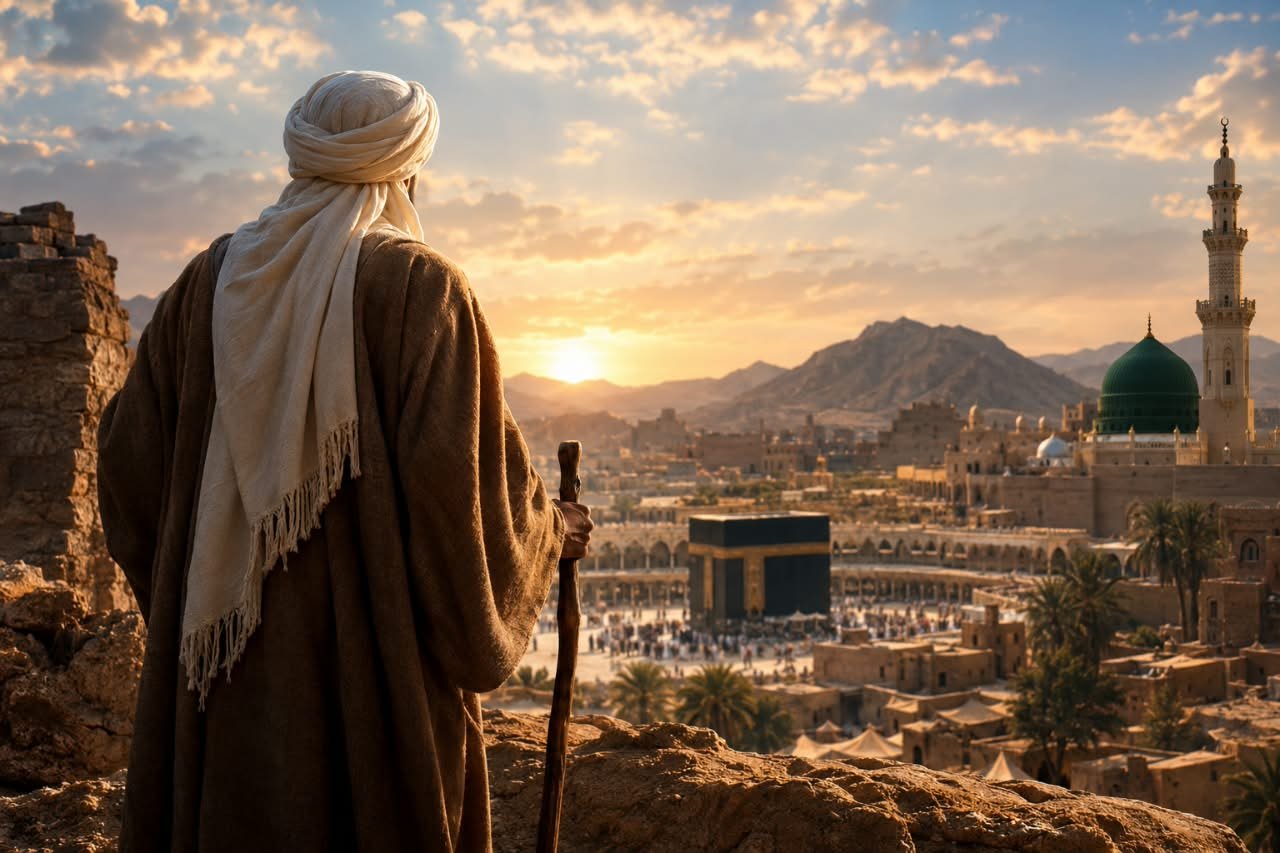
Prophet Muhammad, known as Muhammad ibn Abdullah, was the founder of Islam and the central religious figure of the Muslim faith. He was born in Mecca, in the Arabian Peninsula, around 570 CE and died in Medina in 632 CE. Muslims believe he was the final prophet sent by Allah, or God, to guide humanity.
His life marked a major transformation in the religious, political, and social history of Arabia.
Early Life and Family Background
Muhammad was born into the Banu Hashim clan of the Quraysh tribe, an influential group in Mecca. His father, Abdullah ibn Abd al-Muttalib, died before his birth, according to traditional Islamic accounts. His mother, Aminah bint Wahb, belonged to the Banu Zuhrah clan.
When Muhammad was approximately six years old, his mother died. His grandfather, Abd al-Muttalib, subsequently took responsibility for him. Following his grandfather’s death, Muhammad was placed under the protection of his paternal uncle, Abu Talib.
Muhammad’s paternal ancestry is traditionally traced through Abdullah, Abd al-Muttalib, Hashim, Abd Manaf, Qusayy, and other ancestors to Adnan. Muslim genealogical traditions connect Adnan’s descendants to Ishmael, the son of Abraham, although the links beyond Adnan cannot be independently established with certainty.
Childhood and Early Career
Muhammad grew up in Mecca, a commercial and religious centre in western Arabia. Traditional Islamic biographies report that he worked in trade and developed a reputation for honesty, earning the title Al-Amin, meaning “the trustworthy.”
Around 595 CE, according to the conventional chronology, he married Khadijah bint Khuwaylid, a merchant who had employed him. Their marriage lasted until her death, traditionally dated to approximately 619 CE.
Muhammad and Khadijah had four daughters—Zaynab, Ruqayyah, Umm Kulthum, and Fatimah—and two sons, Al-Qasim and Abdullah, according to traditional Islamic sources. Both sons died during childhood.
Muhammad later had another son, Ibrahim, with Maria al-Qibtiyya, according to Islamic tradition. Ibrahim also died in infancy.
Around 610 CE, when Muhammad was approximately 40 years old, he began receiving revelations according to Islamic belief. Muslim tradition identifies the angel Gabriel as the messenger who delivered the revelations, beginning with verses associated with Surah Al-Alaq in the Quran.
Muhammad began preaching the worship of one God and called on people to abandon the worship of multiple deities. His message emphasized prayer, charity, moral responsibility, accountability after death, and care for vulnerable members of society.
His preaching challenged established religious practices in Mecca. According to early Islamic accounts, he and his followers faced opposition from sections of the Quraysh community.
Muhammad’s revelations continued over approximately 23 years and became the Quran, the sacred scripture of Islam.
Migration to Medina
In 622 CE, Muhammad and his followers migrated from Mecca to Yathrib, subsequently known as Medina. This migration, called the Hijrah, marks the beginning of the Islamic calendar.
In Medina, Muhammad established a Muslim community and assumed religious, political, and judicial leadership. His community entered agreements with groups in the city and became involved in conflicts with opponents from Mecca.
Major military engagements during this period included the Battle of Badr in 624 CE, the Battle of Uhud in 625 CE, and the Battle of the Trench in 627 CE.
These conflicts contributed to the political and military development of the early Muslim community.
Muhammad’s Beliefs and Teachings
Muhammad preached strict monotheism, teaching that Allah was the one God and that human beings were accountable for their actions.
Islam recognizes several figures also found in Jewish and Christian traditions, including Adam, Noah, Abraham, Moses, David, Solomon, and Jesus. Muslims regard Jesus as the Messiah and a prophet of God but do not consider him divine or the Son of God in the Christian theological sense.
Muslims believe Muhammad was the final prophet in a line of prophets that included Abraham, Moses, and Jesus. The Quran and the Sunnah—the reported teachings and practices of Muhammad—became central sources of Islamic religious guidance.
Muhammad’s Marriages and Family
Following Khadijah’s death, Muhammad entered additional marriages. Traditional Islamic biographies commonly identify 11 women as his wives, although counts vary according to how particular accounts classify marriages.
His wives included Sawdah bint Zam’ah, Aisha bint Abi Bakr, Hafsah bint Umar, Umm Salamah, Zaynab bint Jahsh, Juwayriyah bint al-Harith, Umm Habibah, Safiyyah bint Huyayy, Maymunah bint al-Harith, and Zaynab bint Khuzaymah, in addition to Khadijah.
Aisha was the daughter of Abu Bakr, who later became the first caliph. Some widely cited Sunni hadith reports state that Aisha was six when her marriage contract was concluded and nine when the marriage was consummated. Other writers have proposed older ages based on chronological comparisons with different historical reports. Her precise age remains debated.
Muhammad’s daughter Fatimah married Ali ibn Abi Talib, his cousin. Their sons Hasan and Husayn became prominent figures in Islamic history. Many families and religious lineages claim descent from Muhammad through Fatimah and Ali.
The Conquest of Mecca
In 630 CE, Muhammad and his followers entered Mecca, which came under Muslim control following the breakdown of a treaty with the Quraysh, according to traditional Islamic accounts.
Islamic sources describe Muhammad granting amnesty to many former opponents. The Kaaba, a sanctuary already central to Meccan religious life, was cleansed of idols and became the principal sanctuary of Islamic worship.
The event strengthened Muhammad’s position in Arabia. By the time of his death, much of the Arabian Peninsula had come under Muslim political influence, although the degree of control varied between regions.
Muhammad’s Death
Muhammad died in Medina in 632 CE. Traditional Islamic accounts place his age at 63 lunar years, equivalent to approximately 61–62 solar years.
He was buried in the chamber associated with his wife Aisha. The site later became incorporated into the Prophet’s Mosque in Medina.
His death left the Muslim community facing the question of political and religious leadership.
Abu Bakr became the first caliph. However, disagreement over succession developed into a lasting division within Islam.
Sunni Muslims recognize Abu Bakr as the rightful first caliph, followed by Umar ibn al-Khattab, Uthman ibn Affan, and Ali ibn Abi Talib. Shia Muslims maintain that Ali was the rightful successor designated by Muhammad. This disagreement contributed to the historical development of Sunni and Shia Islam.
The Compilation of the Quran
According to Islamic tradition, Muhammad recited revelations that his followers memorized and, in some cases, recorded in writing. After his death, these revelations were collected, and the Quranic text was standardized during the early caliphate, particularly under Uthman ibn Affan.
Muslims regard the Quran as the word of God revealed to Muhammad rather than a book authored by him. Historians examine early Quranic manuscripts, textual traditions, and Islamic accounts to study the scripture’s transmission and preservation.
Historical Legacy
Muhammad’s teachings and leadership transformed Arabia and established the foundations of Islam. Within decades of his death, Muslim rule expanded beyond the Arabian Peninsula, and Islam developed into a major religious and political force.
His family also remained important in Islamic history. Fatimah, Ali, Hasan, and Husayn occupy prominent positions in Muslim religious traditions, particularly in discussions of succession and the authority of Muhammad’s descendants.
Muhammad remains the central prophet of Islam, and his reported words and actions continue to influence Muslim religious practice, law, ethics, and community life.
The Historabase Editorial Team is dedicated to exploring and sharing the stories that have shaped Africa and the wider world. Our work covers African history, ancient civilizations, empires, historical figures, wars, cultures, political movements, and important events from the past.
We aim to present history in a clear, engaging, and accessible way, combining historical records with careful research to help readers better understand the people, events, and civilizations that shaped our world.