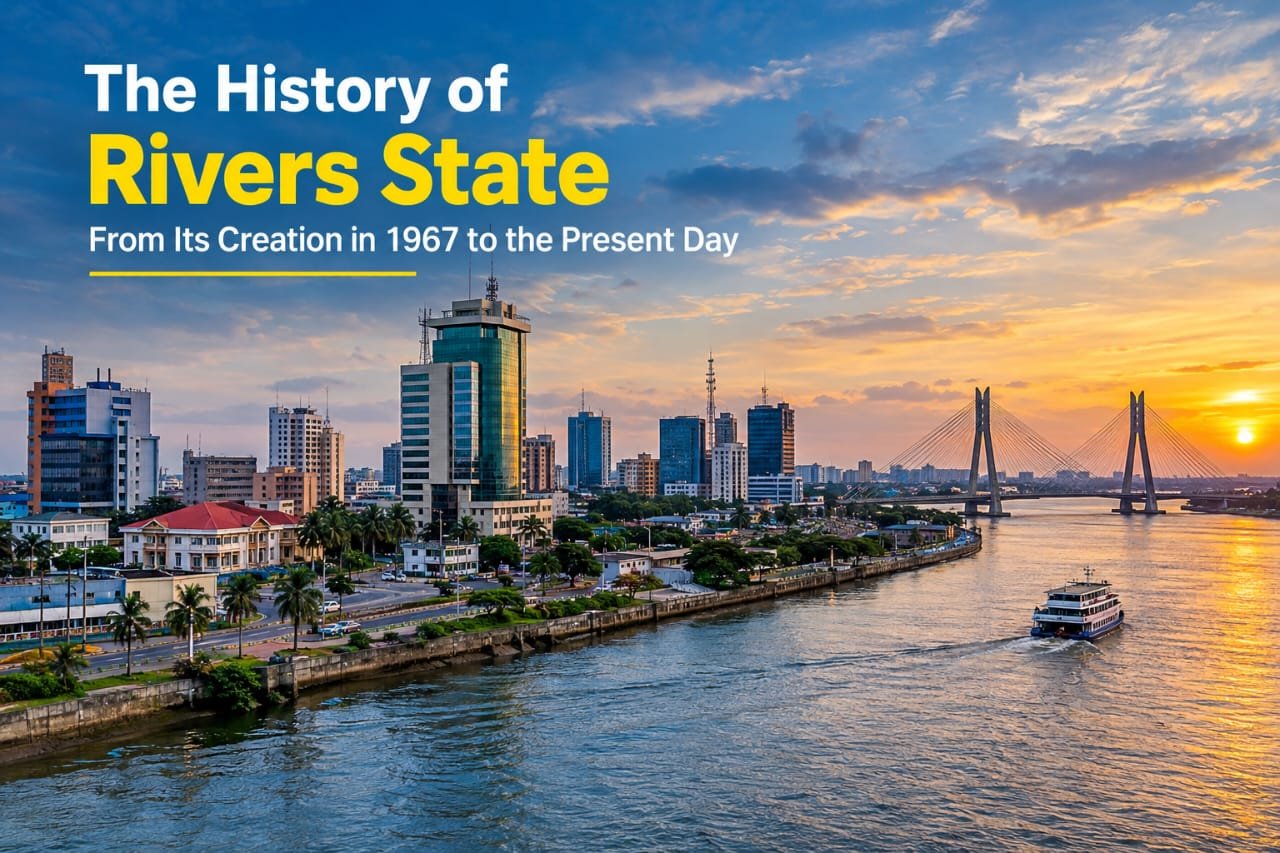
Rivers State is one of Nigeria’s most historically significant states, known for its rich cultural heritage, strategic coastal location, and enormous contribution to the country’s petroleum industry. Located in the southern Niger Delta, the state is home to diverse ethnic communities, important waterways, thriving commercial centres, and a history shaped by traditional kingdoms, European trade, colonial rule, and the discovery of crude oil.
Since its creation on May 27, 1967, Rivers State has experienced remarkable political, economic, and social transformations. Its capital, Port Harcourt, has grown into one of Nigeria’s major industrial and commercial cities, while the state’s oil and gas resources have made it central to the country’s economy.
However, the history of Rivers State extends far beyond petroleum. It is a story of ancient communities, powerful traditional institutions, resistance to colonial domination, struggles over resource control, and the continuing efforts of its people to achieve sustainable development.
Before the Creation of Rivers State
Long before Rivers State became a political entity, the region was inhabited by numerous communities with established systems of government, trade, agriculture, fishing, and cultural traditions.
The area lies within the Niger Delta, one of Africa’s largest river delta systems. Its network of rivers, creeks, mangrove forests, and coastal waterways shaped the lifestyles and economic activities of its inhabitants.
Several ethnic groups have historically occupied the region, including the Ikwerre, Ijaw, Ogoni, Kalabari, Okrika, Etche, Ndoni, and Ogba, among others. These communities developed distinct languages, customs, political structures, and relationships with neighbouring societies.
Traditional rulers, councils of elders, chiefs, and community institutions played important roles in governance, dispute resolution, trade, and the preservation of cultural identity.
Fishing, farming, salt production, canoe transportation, and local commerce supported many communities. Palm produce also became an important trading commodity, particularly as European commercial activities expanded along the West African coast.
The region’s waterways connected inland communities to the Atlantic Ocean, making it an important centre of commerce long before modern Nigeria emerged.
The Rise of Coastal Trading States
Before colonial rule became firmly established, several communities in the region developed influential trading networks.
The Kalabari, Bonny, and Okrika communities became particularly prominent in coastal commerce. Their geographical positions allowed them to participate in regional and international trade.
The Kingdom of Bonny, for example, became an important trading power in the eastern Niger Delta. Its merchants participated in commercial networks that connected inland producers with European traders.
During the era of the Atlantic slave trade, several coastal trading states became involved in the trade, although the experiences and roles of different communities varied.
Following the decline of the transatlantic slave trade, palm oil and palm kernel exports became increasingly important during the nineteenth century. European demand for these products contributed to the expansion of commercial activities along the Niger Delta.
These trading relationships brought wealth and influence to some local authorities and merchant families. However, they also created competition over trade routes, commercial privileges, and political authority.
The legacy of these coastal trading states remains an important part of Rivers State’s historical identity.
British Colonial Rule and the Establishment of Port Harcourt
British influence expanded across the Niger Delta during the nineteenth century. Commercial competition, missionary activity, and the growing ambitions of the British Empire gradually transformed the region’s political and economic structures.
By the early twentieth century, British colonial administration had established greater control over the area.
One of the most important developments occurred in 1912, when construction began on a railway connecting the coalfields around Enugu with the coast.
The British colonial government selected a location near the Bonny River as the railway’s coastal terminus. This decision led to the establishment of Port Harcourt, officially founded in 1913 and named after Lewis Harcourt, the British Secretary of State for the Colonies at the time.
The railway was designed to facilitate the transportation of coal and other goods to the coast for export.
Port Harcourt subsequently developed into an important port and industrial centre. Its harbour, railway connections, and commercial opportunities attracted workers, merchants, and migrants from different parts of Nigeria.
As the city expanded, it became increasingly important to the economic development of the surrounding region.
The Creation of Rivers State in 1967
The formal creation of Rivers State was a defining moment in the region’s history.
On May 27, 1967, the Federal Military Government under General Yakubu Gowon created Rivers State through the administrative restructuring of Nigeria.
The decision came during a period of intense political tension following the country’s first military coup in 1966, the counter-coup that followed, and the growing crisis between the federal government and the Eastern Region.
Rivers State was created alongside other states as part of a broader reorganization of Nigeria’s federal structure. The creation of the state separated the predominantly riverine and minority communities of the former Eastern Region from the wider regional administration.
Port Harcourt became the state capital.
For many communities, state creation represented an opportunity for greater political representation and administrative attention. It also established a new political framework for managing the region’s resources and development priorities.
However, the creation of Rivers State coincided with the outbreak of the Nigerian Civil War in July 1967.
The conflict brought considerable hardship to the region, particularly because of its strategic location, oil installations, and importance to Nigeria’s emerging petroleum industry.
Following the end of the war in January 1970, Rivers State entered a new period of reconstruction and administrative development.
The Discovery of Oil and the Transformation of the Economy
One of the most significant events in the modern history of Rivers State was the discovery and development of commercial petroleum resources.
Oil exploration in Nigeria began during the colonial period, and a major breakthrough occurred in 1956 when Shell discovered oil in commercial quantities at Oloibiri, in present-day Bayelsa State. At that time, Oloibiri was within the area that later became part of Rivers State before Bayelsa was created in 1996.
Commercial oil exports began in 1958, marking the emergence of petroleum as an increasingly important national resource.
Rivers State subsequently became a major centre of oil and gas exploration, production, transportation, and processing.
Port Harcourt developed further as an industrial hub, supported by petroleum-related businesses, government institutions, and the establishment of the Port Harcourt refinery, which began operations in 1965, before Rivers State itself was created.
The petroleum industry generated employment, attracted investment, and contributed significantly to government revenue.
However, oil wealth also introduced major challenges. Environmental pollution, oil spills, gas flaring, land disputes, and disagreements over resource ownership became recurring concerns in communities across the Niger Delta.
Many residents argued that the economic benefits of petroleum production were not adequately reflected in local infrastructure, employment opportunities, and environmental protection.
These issues would become central to the political history of Rivers State.
Rivers State During the Military Era
Between the late 1960s and 1999, Nigeria experienced extended periods of military government, interrupted by brief civilian administrations.
During these decades, Rivers State underwent significant administrative and economic changes. Port Harcourt continued to expand, while oil production increased the state’s importance to the national economy.
However, the state’s political development was also affected by centralized military rule and disputes over petroleum revenue allocation.
The Niger Delta increasingly became a focal point for debates about environmental justice, local participation in resource management, and the responsibilities of oil companies and government authorities.
Community organizations, activists, and political groups demanded greater attention to the needs of oil-producing areas.
These demands contributed to a wider national discussion about federalism, resource control, and the distribution of oil revenue.
The period also witnessed population growth and rapid urbanization, particularly in Port Harcourt and its surrounding communities.
The Creation of Bayelsa State in 1996
Another important milestone occurred on October 1, 1996, when the federal government under General Sani Abacha created Bayelsa State from part of the territory previously administered as Rivers State.
The new state was carved out of Rivers State to address demands for greater administrative representation among communities in the western Niger Delta.
The creation of Bayelsa reduced the geographical size of Rivers State but established a separate political structure for many Ijaw communities.
It also changed the administrative boundaries of the Niger Delta and the organization of oil-producing areas.
Despite the separation, Rivers and Bayelsa have continued to share important historical, cultural, economic, and environmental connections.
The Return to Democratic Government in 1999
Nigeria returned to civilian democratic government on May 29, 1999, beginning the Fourth Republic.
For Rivers State, the transition marked a new phase in political administration, public investment, and electoral competition.
Peter Odili became governor in 1999 and served until 2007. He was succeeded by Chibuike Rotimi Amaechi, who governed from 2007 to 2015.
Nyesom Wike served as governor from 2015 to 2023, followed by Siminalayi Fubara, who assumed office on May 29, 2023.
These administrations pursued different development priorities involving roads, schools, healthcare, public institutions, urban renewal, and other infrastructure.
However, the state’s political history has also been marked by intense competition between political factions, disputes over governance, and disagreements involving the state government and federal institutions.
Such conflicts have frequently attracted national attention because of Rivers State’s economic importance and strategic political position.
Rivers State in the Present Day
Today, Rivers State remains one of Nigeria’s most economically significant states.
Port Harcourt is a major centre for the petroleum industry, maritime commerce, manufacturing, education, healthcare, and transportation.
The state’s oil and gas sector continues to play a significant role in national revenue and export earnings. Its ports, industrial facilities, and commercial networks also support economic activities across the wider Niger Delta.
Beyond petroleum, Rivers State has opportunities in agriculture, aquaculture, tourism, trade, and other industries.
Its rivers, mangrove ecosystems, cultural festivals, traditional institutions, and historical settlements provide important foundations for cultural preservation and tourism development.
Nevertheless, the state continues to face serious challenges.
Environmental degradation remains a concern in many oil-producing communities. Unemployment, infrastructure pressures, flooding, urban congestion, and the need for economic diversification are also important development issues.
Political stability and effective public administration remain essential to addressing these challenges.
The future of Rivers State will depend partly on how successfully its government, communities, businesses, and institutions translate the state’s natural and human resources into lasting improvements in living standards.
Conclusion
The history of Rivers State is a story of cultural diversity, commercial enterprise, political transformation, and natural-resource wealth.
From its traditional kingdoms and coastal trading networks to the establishment of Port Harcourt, the creation of the state in 1967, and the expansion of the petroleum industry, the region has played an important role in Nigeria’s development.
Yet its history also reveals the difficulties of managing natural resources in ways that benefit local communities while protecting the environment.
Today, Rivers State stands at the intersection of Nigeria’s industrial ambitions and the long-standing demands of Niger Delta communities for sustainable development and fairer opportunities.
The Historabase Editorial Team is dedicated to exploring and sharing the stories that have shaped Africa and the wider world. Our work covers African history, ancient civilizations, empires, historical figures, wars, cultures, political movements, and important events from the past.
We aim to present history in a clear, engaging, and accessible way, combining historical records with careful research to help readers better understand the people, events, and civilizations that shaped our world.