In late 1929, thousands of women across southeastern Nigeria rose against British colonial rule.
They marched through towns, surrounded colonial officials, confronted warrant chiefs, attacked symbols of colonial authority and refused to accept policies they believed threatened their families, livelihoods and political influence.
The British called the events the “Aba Riots.” But the women themselves understood what was happening differently. In Igbo, it became known as Ogu Umunwanyi , the Women’s War. Among Ibibio and Annang communities, it was also remembered as Ekong Iban, meaning women’s war.
The uprising became one of the most important examples of organised anti-colonial resistance in colonial Nigeria. Modern historians have increasingly used the term “Women’s War” because the older colonial description of “riots” can obscure the political organisation and objectives of the protesters.
What Caused the Aba Women’s War?
The immediate trigger was a dispute over colonial taxation and the counting of people.
By 1929, British colonial authorities were expanding their systems of taxation and administration in southeastern Nigeria. The colonial government relied heavily on warrant chiefs — local authorities appointed or recognised by the British to help administer communities.
Many people regarded some warrant chiefs as abusive, corrupt or too powerful.
For women, the problem went deeper.
Igbo women had traditionally exercised important economic and political influence through women’s associations, market networks and collective decision-making. Colonial rule disrupted some of these institutions while strengthening male-dominated warrant-chief structures.
Women therefore feared that colonial taxation and administration would weaken their economic independence and political voice.
Economic conditions made the situation even more difficult. Falling prices for agricultural products, including palm produce, hurt women’s incomes, while the wider economic crisis of the late 1920s increased financial pressure.
The result was an atmosphere of growing anger.
The Incident That Sparked the Revolt
The immediate crisis began in Oloko, near present-day Abia State.
A woman named Nwanyeruwa became involved in a confrontation with Mark Emereuwa, a man assisting the local warrant chief with the process of counting households.
The issue was whether women would eventually be subjected to taxation.
Nwanyeruwa and other women interpreted the encounter as a warning that the colonial government intended to tax them.
They began organising.
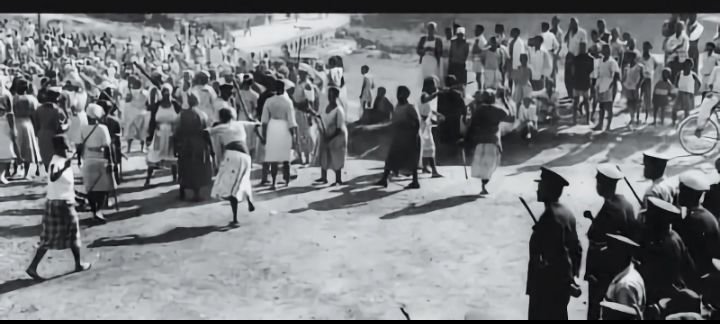
On 24 November 1929, women gathered at the compound of the warrant chief, Okugo, demanding answers and protesting the perceived threat of taxation. Their demonstration became the beginning of a much larger movement.
What started in Oloko soon spread far beyond the community.
Thousands of Women Join the Movement
Women from neighbouring communities joined the protests.
Using established networks of markets, kinship and women’s organisations, they were able to communicate rapidly across large areas.
This was one of the most remarkable aspects of the Women’s War.
The protesters were not simply a disorganised crowd. They were able to mobilise thousands of women across different communities and, in some areas, across ethnic boundaries.
The movement spread through parts of what were then the Owerri and Calabar provinces, involving Igbo, Ibibio, Annang, Ogoni, Efik, Ijaw and other communities.
Estimates of participation vary, but tens of thousands of women became involved during the wider uprising.
The Power of “Sitting on a Man”
One of the most famous protest methods used during the Women’s War was known as “sitting on a man.”
Despite the name, it did not necessarily mean physically sitting on someone.
It was a traditional form of public protest and social shaming. Women could gather at the home or workplace of a man they believed had wronged them. They would sing, dance, chant, insult or ridicule him, sometimes remaining outside his home for hours or days.
The purpose was to pressure the individual into responding to their demands.
For women living under colonial rule, this traditional method became a powerful political weapon.
British officials often failed to understand its cultural significance.
To the protesters, however, it represented collective authority.
The Protest Turns Violent
The demonstrations eventually became more confrontational.
Women attacked or destroyed some Native Court buildings and other symbols of colonial administration. In some locations, European trading establishments were looted or damaged.
Prisons were also attacked in certain areas, with protesters releasing prisoners.
The destruction alarmed colonial officials.
The British administration responded by deploying armed police and soldiers to suppress the movement.
This response turned a mass protest into a deadly confrontation.
Women Were Shot by Colonial Forces
The most tragic part of the Women’s War came when colonial security forces opened fire on protesters.
Women were killed in several locations.
At Utu Etim Ekpo, in present-day Akwa Ibom State, violence resulted in numerous deaths. At Ikot Abasi, another major confrontation reportedly resulted in dozens of women being killed.
Exact casualty figures remain debated because colonial records and oral histories do not always agree.
Some historical accounts commonly cite around 50–55 deaths, while other oral-history-based accounts suggest substantially higher numbers in particular areas. What is clear is that the colonial response resulted in significant loss of life.
This is why describing the event simply as a “riot” fails to capture its human cost.
Why Did the British Find the Women So Difficult to Stop?
The British colonial administration had experience dealing with resistance from men, chiefs and armed groups.
The Women’s War presented something different.
Women were mobilising through social institutions that already existed within their communities.
They could gather rapidly, communicate through market networks and use traditional forms of protest that carried enormous social meaning.
The movement also challenged the assumption that women were politically passive.
Historians have consequently treated the Women’s War as a major episode in the history of African women’s political activism and anti-colonial resistance.
The Colonial Government Was Forced to Respond
The uprising eventually forced the British administration to reconsider aspects of its system of indirect rule in southeastern Nigeria.
The warrant-chief system came under greater scrutiny, and changes were made to the Native Administration structure.
The Women’s War therefore achieved something important: it demonstrated that colonial policies could not simply be imposed without resistance.
The women had shown that they possessed political power of their own.
Their actions also exposed weaknesses in a colonial system that had attempted to govern complex societies through structures that did not always reflect existing local political traditions.
The Women Who Led the Resistance
Unlike many conventional wars, the Women’s War did not have one supreme commander.
It was a mass movement involving thousands of women and numerous local leaders.
Among the figures associated with the movement were women such as Nwanyeruwa, Ikonnia, Nwugo and Nwanedia.
Their leadership demonstrates an important feature of the uprising: political authority was distributed through women’s community networks rather than concentrated in a single person.
That organisation made the movement difficult to control.
Why the Aba Women’s War Matters Today
The Women’s War occupies an important place in Nigerian history because it challenges the idea that resistance to colonialism was led only by men.
Long before Nigeria became independent in 1960, Nigerian women were already organising against policies they considered oppressive.
The uprising also shows that colonial resistance was not always about armed warfare.
Sometimes it involved markets, songs, demonstrations, social pressure, boycotts and community organisation.
The women of 1929 used the political tools available to them, and when the colonial government responded with violence, their protest became one of the defining episodes of resistance in southeastern Nigeria.
The Forgotten War That Should Not Be Forgotten
The Aba Women’s War lasted from late 1929 into early 1930, but its significance survived long after the protests ended.
The colonial government had attempted to strengthen its authority through taxation, warrant chiefs and administrative reforms.
Instead, it encountered a mass movement of women willing to challenge the system.
The women were not fighting simply because they disliked taxes. Their grievances were connected to economic hardship, political exclusion, colonial administration and the erosion of established women’s institutions.
Most importantly, they demonstrated that ordinary women could organise on a massive scale and force a colonial government to reconsider its policies.
The name Aba Women’s War therefore represents much more than a forgotten colonial disturbance.
It is the story of thousands of Nigerian women who stood together, challenged British authority and paid a terrible price for their resistance.
The Historabase Editorial Team is dedicated to exploring and sharing the stories that have shaped Africa and the wider world. Our work covers African history, ancient civilizations, empires, historical figures, wars, cultures, political movements, and important events from the past.
We aim to present history in a clear, engaging, and accessible way, combining historical records with careful research to help readers better understand the people, events, and civilizations that shaped our world.