Joan of Arc was a French peasant girl who became a military figure during the later stages of the Hundred Years’ War. She claimed that she received divine visions instructing her to support the French dauphin, Charles, and help drive the English from France.
Joan’s Early Life
Joan was born around 1412 in the village of Domrémy, in the Duchy of Bar, in northeastern France.
Her parents, Jacques d’Arc and Isabelle Romée, were farmers. Joan grew up during the Hundred Years’ War, a prolonged conflict involving the English and French crowns.
France was politically divided during Joan’s childhood. The English controlled large parts of northern France, while the Burgundians, allies of England, controlled additional territory. The French royal faction supported Charles, the son and heir of Charles VI.
Joan later testified that she began hearing what she described as heavenly voices when she was around 13 years old. She associated these voices with saints, particularly Saint Michael, Saint Catherine, and Saint Margaret.
According to her testimony, the voices eventually instructed her to leave Domrémy and assist Charles.
Joan Meets the Dauphin
By 1428, Joan had become determined to reach the French-held territories and meet Charles.
She first went to Vaucouleurs, where she sought the assistance of Robert de Baudricourt, the local military commander.
Baudricourt initially rejected her requests. Joan returned later and eventually received permission to travel to the court of the dauphin.
In early 1429, she travelled to Chinon, where Charles was staying.
Joan was eventually granted an audience with him. She told Charles that she had been sent to help him and that he should proceed to Reims to be crowned king.
Her claims were investigated by theologians at Poitiers. After the examination, she was permitted to accompany the French military effort.
Joan was provided with armor and a banner and joined the French forces preparing to relieve the besieged city of Orléans.
The Siege of Orléans
The Siege of Orléans had begun in October 1428.
Orléans was strategically important to the French because its capture would have strengthened the English position along the Loire River.
Joan arrived near Orléans on 29 April 1429.
French forces subsequently attacked several English-held positions surrounding the city. Joan participated in the fighting and was wounded by an arrow during an assault on an English fortification.
Despite her injury, she returned to the fighting.
On 7 May, the French launched an attack on the English position known as Les Tourelles. Joan was wounded again, but the French captured the position.
The following day, 8 May 1429, the English withdrew from the area and the siege of Orléans ended.
The victory became one of the most important events of Joan’s short military career.
The Campaign Toward Reims
After Orléans, Joan continued to accompany the French army.
French forces captured several towns along the Loire during the campaign, including Jargeau, Meung-sur-Loire, and Beaugency.
The French then defeated an English force at the Battle of Patay on 18 June 1429.
The victories opened the way toward Reims.
Joan continued urging Charles to travel to the city for his coronation.
The French army eventually reached Reims, and on 17 July 1429, Charles was crowned Charles VII in Reims Cathedral.
Joan was present at the ceremony and held her banner near the king.
Her participation in the campaign had made her a prominent figure among supporters of Charles.
The Failed Attack on Paris
After Charles’s coronation, Joan continued campaigning with the French forces.
The army moved toward Paris, which was controlled by the Burgundians and supported by the English.
On 8 September 1429, French forces attacked Paris.
Joan was wounded during the fighting.
The French attack ultimately failed, and Charles ordered his forces to withdraw.
Afterward, Joan’s military activities became more limited.
Joan Is Captured
In May 1430, Joan travelled to Compiègne, which was under attack by Burgundian forces.
On 23 May 1430, she participated in an attempt to defend the city.
During the fighting, Joan was captured by Burgundian soldiers.
She was held by John of Luxembourg, a Burgundian nobleman.
The French king did not secure her release, and after several months she was transferred to English custody.
The English paid the ransom to the Burgundians and brought Joan to Rouen.
The Trial of Joan of Arc
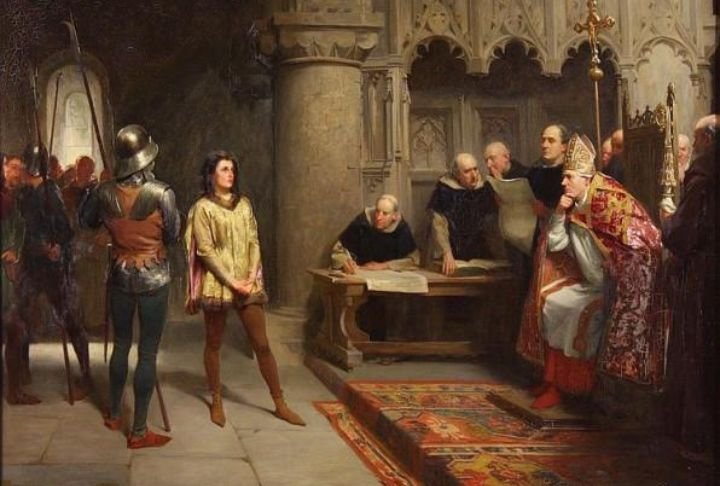
Joan’s trial began in January 1431.
The proceedings were conducted by an ecclesiastical court headed by Pierre Cauchon, the Bishop of Beauvais, who was associated with the Burgundian-English faction.
Joan faced numerous accusations, including heresy.
Much of the questioning concerned her claims of receiving divine guidance, her military activities, and her decision to wear male clothing.
The court also questioned her about her visions and religious beliefs.
Joan initially maintained that her voices came from God and the saints.
During the proceedings, she was repeatedly questioned by members of the court.
She was eventually convicted of heresy.
On 24 May 1431, Joan was taken to a place of execution and threatened with death. She signed a document of abjuration, renouncing certain claims attributed to her and agreeing to stop wearing male clothing.
Her sentence was changed to life imprisonment.
However, she subsequently resumed wearing male clothing.
The reasons for this have been debated, although Joan stated during the later stages of her trial that she had resumed wearing it after circumstances in prison.
The court treated her actions as a relapse into heresy.
On 30 May 1431, Joan was taken to the Old Marketplace of Rouen.
She was tied to a stake and burned alive.
She was approximately 19 years old.
Her execution took place while the English controlled Rouen and much of northern France.
Joan’s ashes and remains were subsequently disposed of in the Seine River, according to accounts of the execution.
The Retrial
Joan’s conviction was not the final judgment on her case.
After Charles VII had strengthened his position in France, an investigation into Joan’s original trial was requested.
The process began in the 1450s, and a new ecclesiastical inquiry examined the circumstances surrounding her conviction.
The retrial concluded in 1456 that the original proceedings had been seriously flawed.
Joan’s conviction was declared null and void.
She was formally rehabilitated approximately 25 years after her execution.
Joan of Arc Becomes a Saint
Centuries after her death, Joan’s reputation continued to grow.
She was beatified by the Catholic Church in 1909 and canonized as a saint in 1920 by Pope Benedict XV.
Her feast day is observed on 30 May, the anniversary of her execution.
Joan of Arc remains one of the most extensively studied figures of the Hundred Years’ War.
Her life lasted less than two decades, but within that short period she went from a farmer’s daughter in Domrémy to a participant in the French military campaign, witnessed the coronation of Charles VII, was captured and tried for heresy, and was executed in Rouen.
Her trial records, later retrial documents, and contemporary chronicles provide much of the historical evidence through which her extraordinary life is known today.
The Historabase Editorial Team is dedicated to exploring and sharing the stories that have shaped Africa and the wider world. Our work covers African history, ancient civilizations, empires, historical figures, wars, cultures, political movements, and important events from the past.
We aim to present history in a clear, engaging, and accessible way, combining historical records with careful research to help readers better understand the people, events, and civilizations that shaped our world.








One Comment