Among the Twelve Apostles of Jesus, few have been surrounded by a more disturbing martyrdom tradition than Saint Bartholomew. Christian tradition holds that after spending years preaching the Gospel, Bartholomew was subjected to a brutal execution in which he was allegedly skinned alive before being killed.
The story has made Bartholomew one of the most recognizable figures in Christian art, where he is often portrayed holding a knife or carrying his own skin. But how much of the story is historically established, and how much comes from later tradition?
Who Was Saint Bartholomew?
Bartholomew is named among the Twelve Apostles in the New Testament. He appears in the lists of the apostles in the Gospels of Matthew, Mark and Luke, as well as in the Acts of the Apostles.
Unlike Peter, John or Matthew, however, the New Testament provides very little information about Bartholomew’s life.
Some Christian traditions identify him with Nathanael, a man introduced in the Gospel of John. Nathanael encounters Jesus after being introduced by Philip and eventually declares Jesus to be the Son of God and King of Israel.
The Bible does not explicitly state that Nathanael and Bartholomew were the same person. Nevertheless, the identification became widely accepted in later Christian tradition.
The name Bartholomew itself is generally understood as a patronymic meaning “son of Talmai” or “son of Tolmai.” His personal name therefore remains uncertain.
According to later Christian traditions, Bartholomew became a missionary after the death and resurrection of Jesus.
Different traditions place his missionary activity in several regions, including parts of the Middle East, Arabia, India and Armenia.
One of the strongest traditions connects Bartholomew with Armenia, where he is said to have preached Christianity and converted people to the faith.
However, the details of his missionary journeys are difficult to establish from contemporary historical sources. Much of what is known about Bartholomew comes from writings produced centuries after the period in which he supposedly lived.
This distinction is important because the accounts of the apostles’ deaths were often preserved through religious traditions rather than contemporary historical records.
The Brutal Martyrdom Tradition
The most famous story about Bartholomew concerns his death.
According to a longstanding Christian tradition, Bartholomew was arrested after preaching Christianity and refusing to abandon his faith.
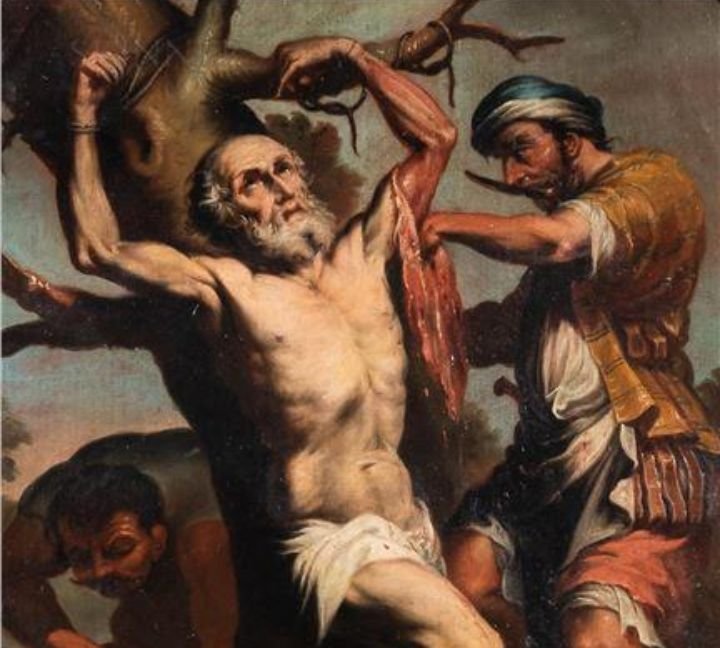
His persecutors allegedly subjected him to an exceptionally brutal form of execution: he was flayed, or skinned alive.
After being skinned, Bartholomew was reportedly beheaded or otherwise killed.
There are variations in the traditional accounts. Some versions say he was crucified before being beheaded, while others focus primarily on his flaying.
Because these accounts differ, historians cannot confidently reconstruct exactly how Bartholomew died.
What is clear is that the image of Bartholomew being flayed became deeply established in Christian tradition.
Why Was He Allegedly Skinned?
The reason for Bartholomew’s alleged execution is traditionally connected to his refusal to stop preaching Christianity.
Early Christian martyr stories commonly describe believers being persecuted because they rejected demands to worship traditional gods or abandon their Christian faith.
In Bartholomew’s case, later traditions portray him as a missionary who continued preaching despite opposition.
His execution therefore became part of the broader Christian tradition of martyrdom—the belief that some followers of Jesus were willing to die rather than renounce their faith.
However, there is no surviving contemporary account that allows historians to verify the exact circumstances of his death.
Saint Bartholomew in Christian Art
The gruesome nature of Bartholomew’s traditional martyrdom had a major influence on European art.
Artists frequently portrayed him holding a large knife, the supposed instrument used during his flaying. Even more strikingly, some works depict Bartholomew carrying or displaying his own skin.
One of the most famous representations is Michelangelo’s depiction of Saint Bartholomew in the Sistine Chapel.
In the enormous Last Judgment, Bartholomew appears holding his own skin. The face depicted on the hanging skin has traditionally been interpreted by some scholars as a self-portrait of Michelangelo, although that interpretation remains debated.
The image is deliberately unsettling. It communicates Bartholomew’s traditional martyrdom while also emphasizing the physical suffering associated with his death.
The Saint’s Relics
Traditions concerning Bartholomew’s remains are also complicated.
Different places have claimed possession of parts of his relics over the centuries. One of the most famous locations associated with his remains is Rome, particularly the Basilica of San Bartolomeo all’Isola.
Other traditions connect relics attributed to Bartholomew with locations in Armenia and elsewhere.
As with many relic traditions from late antiquity and the Middle Ages, determining the historical journey of the remains is difficult.
The existence of competing traditions does not necessarily establish that the accounts are false, but it does mean that modern historians must treat them cautiously.
The Connection With Armenia
Armenia occupies an especially important place in traditions surrounding Bartholomew.
According to Armenian Christian tradition, Bartholomew was one of the missionaries who helped introduce Christianity to Armenia.
He is therefore remembered as an important figure in Armenian Christianity.
Tradition holds that he was eventually killed in the region after converting people to Christianity.
The Armenian Apostolic Church has long honored Bartholomew as one of the major apostles associated with the Christianization of Armenia.
However, scholars continue to distinguish between later ecclesiastical traditions and evidence that can be independently verified from the earliest surviving sources.
How Reliable Is the Story?
The most important question surrounding Bartholomew’s alleged flaying is whether it actually happened.
The answer is complicated.
Bartholomew’s existence as one of the apostles is supported by the New Testament, which lists him among Jesus’ Twelve Apostles.
His later missionary journeys and death, however, are much less certain.
The earliest Christian sources do not provide a detailed account of his martyrdom. The famous story of his being skinned alive appears in later traditions.
This means the story should properly be described as a longstanding Christian tradition rather than an independently verified historical fact.
That distinction does not diminish the importance of the story. For centuries, Christians accepted Bartholomew’s martyrdom as part of the history of the early Church, and the story had a profound influence on religious art, devotion and cultural memory.
Why Bartholomew’s Story Survived
Stories of martyrdom played an important role in the development of early Christianity.
The apostles were remembered not simply as followers of Jesus but as missionaries who supposedly carried the Christian message into different parts of the ancient world.
Their willingness to suffer or die became an important part of Christian identity.
Bartholomew’s traditional death was particularly memorable because of its extreme nature. The image of an apostle being stripped of his skin became one of the most recognizable martyrdom stories in Christian tradition.
It also explains why Saint Bartholomew is sometimes associated with occupations involving leather and skin.
A Martyr Remembered for His Suffering
Today, Saint Bartholomew remains an important figure in Christianity, despite the limited historical information available about his life.
His name appears in the New Testament among the Twelve Apostles, while centuries of tradition have transformed him into a missionary, martyr and symbol of religious perseverance.
The story that he was skinned alive cannot be established with certainty from contemporary historical evidence. Nevertheless, it became one of the defining traditions associated with him.
His gruesome portrayal in Christian art, sometimes holding the knife used against him and his own skin in his hands, shows just how deeply the martyrdom tradition influenced European religious culture.
The Historabase Editorial Team is dedicated to exploring and sharing the stories that have shaped Africa and the wider world. Our work covers African history, ancient civilizations, empires, historical figures, wars, cultures, political movements, and important events from the past.
We aim to present history in a clear, engaging, and accessible way, combining historical records with careful research to help readers better understand the people, events, and civilizations that shaped our world.