In the early 20th century, lonely men searching for love, companionship, or a new beginning could turn to personal advertisements and matrimonial notices. For some, these advertisements led to marriage. For others, they may have led to something far darker.
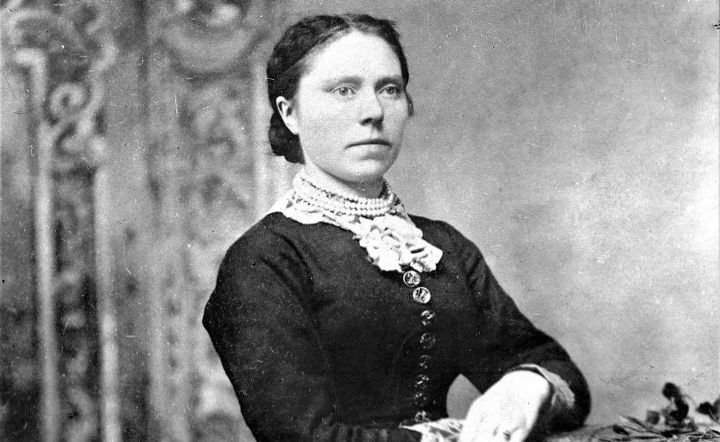
Among the most infamous figures associated with this world was Belle Gunness, a Norwegian-born woman who became notorious in the United States for a series of mysterious deaths surrounding her life. Over time, investigators came to suspect that Gunness had deliberately attracted men through advertisements, gained their trust, and then killed them for financial gain.
The exact number of her victims remains uncertain. What is known is that when authorities investigated her Indiana farm in 1908, they uncovered human remains on the property, transforming Gunness from an obscure farm owner into one of America’s most notorious suspected female serial killers.
From Norway to America
Belle Gunness was born Brynhild Paulsdatter Størseth in Norway in 1859. She came from a working-class family and later emigrated to the United States during the 1880s.
Like many European immigrants of the period, she was seeking a new life in America. She eventually settled in Chicago, where she married Mads Sorenson.
Their marriage ended in tragedy when Sorenson died in 1900. His death attracted attention because he reportedly died on a day when two of his life-insurance policies overlapped.
A physician reportedly concluded that he had suffered a cerebral hemorrhage, while suspicion later arose because Gunness was believed to have obtained insurance money following his death.
No criminal conviction resulted from Sorenson’s death, but it would become one of the earliest episodes examined when investigators later reconstructed Gunness’s history.
A Pattern of Death
After Sorenson’s death, Gunness moved to Indiana and established herself on a farm near La Porte.
There, she married Peter Gunness, a Norwegian immigrant and widower. The marriage was short-lived.
Peter Gunness died in 1902 after suffering what was described as an accident involving a heavy object falling on him. Once again, Belle Gunness was left with financial compensation.
The circumstances surrounding Peter’s death became increasingly suspicious in retrospect. Investigators later learned that Gunness had a remarkable history of deaths and financial claims surrounding her.
There were also reports of earlier deaths involving children and associates, although the historical record is complicated by conflicting accounts and sensational newspaper coverage.
What emerged was a pattern: people close to Gunness repeatedly died, while she often remained the beneficiary.
The Matrimonial Advertisements
Gunness eventually turned to matrimonial advertisements to find men who were willing to correspond with her.
She reportedly presented herself as a respectable widow who wanted companionship and marriage. However, there was an important condition.
Men interested in meeting her were expected to send money before traveling to Indiana.
The arrangement may have appeared reasonable to lonely men looking for a new life. Gunness reportedly told prospective suitors that she wanted financial security and that they should bring money or valuables with them.
Several men answered her advertisements.
Some arrived at her farm carrying their savings.
They would then disappear.
In an era before modern databases, electronic banking, DNA testing, and instant communication, a person could vanish under circumstances that were extremely difficult to investigate. Gunness’s isolated farm provided an environment where suspicious disappearances could remain hidden.
The Men Who Never Returned
Among the men connected to Gunness was George Anderson, a Norwegian immigrant who reportedly became suspicious of her behavior and eventually left her property.
His account, published after the later investigation, helped authorities understand the way Gunness allegedly interacted with potential victims.
Another man, Andrew Helgelien, became particularly important to the investigation.
Helgelien had answered Gunness’s advertisement and traveled to Indiana. He reportedly corresponded with her before arriving and sent money as requested.
After reaching the farm, he disappeared.
His brother eventually became concerned and began asking questions.
Those questions would help expose what had been happening at Gunness’s property.
The Fire of 1908
The mystery surrounding Gunness reached its climax in April 1908.
Her farmhouse caught fire during the night.
When firefighters and investigators examined the ruins, they discovered the remains of three children.
At first, authorities believed Gunness herself had also died in the fire.
A badly burned body without a head was found in the ruins and was initially identified as hers.
The apparent death of Belle Gunness created an extraordinary mystery.
Had she been murdered?
Had she killed herself?
Or had she staged her own death and escaped?
Then investigators began searching the property.
What they discovered changed the case completely.
The Graves on the Farm
Investigators found human remains buried around the Gunness property.
The discoveries included the remains of adults and children. Some victims were difficult or impossible to identify.
The investigation soon focused on men who had disappeared after traveling to Gunness’s farm.
One of the most significant discoveries was evidence associated with Andrew Helgelien.
Investigators reportedly found his remains on the property, along with evidence suggesting that he had been killed.
As more graves were uncovered, newspapers began portraying Gunness as a woman who had systematically lured men to her farm and murdered them for their money.
The nickname “Black Widow” became associated with her story.
How Many People Did Belle Gunness Kill?
This remains one of the biggest unanswered questions surrounding her history.
The exact number of victims is unknown.
Investigators discovered numerous remains, but not every victim could be identified. Some newspaper reports also produced exaggerated numbers, making it difficult for historians to separate confirmed evidence from sensational claims.
Estimates of Gunness’s victims have therefore varied considerably.
The remains found on her property strongly suggest that multiple people died there under suspicious circumstances. However, the full identity and circumstances of every death cannot be established with certainty.
That distinction is important.
Belle Gunness was never brought to trial for the suspected murders discovered on her farm. Therefore, while she is widely remembered as a serial killer, many details about her crimes remain allegations based on historical investigation rather than convictions in court.
Did Belle Gunness Escape?
The most enduring mystery is what happened to Gunness herself.
The body initially identified as hers was later questioned because of its unusual characteristics. Investigators reportedly determined that the body was significantly shorter than Gunness had been.
This raised the possibility that another woman had been killed in the fire.
If that interpretation was correct, Gunness could have staged the fire and escaped.
The theory became even more intriguing because witnesses and investigators reported possible sightings of women resembling Gunness in the years following the fire.
None of these sightings conclusively established that she survived.
Several theories emerged. Some suggested that Gunness had escaped with money. Others believed that she had actually died in the fire and that the body identification problems resulted from the condition of the remains.
More than a century later, the question remains unresolved.
A Crime Built Around Trust
What makes the Belle Gunness story particularly disturbing is not simply the number of suspected victims but the method investigators believed she used.
She allegedly exploited something ordinary: the desire for companionship.
Her matrimonial advertisements offered lonely men the possibility of marriage and a new beginning. Instead, according to the theory developed after the investigation, some of those men walked into a carefully prepared trap.
Gunness also benefited from the limitations of the era.
Communication between distant communities was slow. Financial records were less interconnected than they are today. Missing-person investigations were not supported by modern forensic databases.
A person could arrive in a rural community with money and disappear without immediately triggering a nationwide investigation.
The Legacy of Belle Gunness
The Gunness farm investigation became one of the most sensational crime stories in America during 1908.
Newspapers filled their pages with accounts of the suspected murders, the mysterious fire, and the possibility that Gunness had escaped.
Her story eventually became part of American criminal folklore.
Books, documentaries and crime histories have continued to examine the case, particularly the unanswered question of how many people she may have killed and whether she survived the fire.
But behind the legend are real people whose lives ended under mysterious circumstances.
The remains discovered at the farm provided evidence that multiple deaths had occurred there, yet the absence of a trial means that many questions can never be answered with absolute certainty.
Belle Gunness therefore occupies a peculiar place in history: a woman surrounded by deaths, money, missing men and unanswered questions.
The Historabase Editorial Team is dedicated to exploring and sharing the stories that have shaped Africa and the wider world. Our work covers African history, ancient civilizations, empires, historical figures, wars, cultures, political movements, and important events from the past.
We aim to present history in a clear, engaging, and accessible way, combining historical records with careful research to help readers better understand the people, events, and civilizations that shaped our world.












One Comment