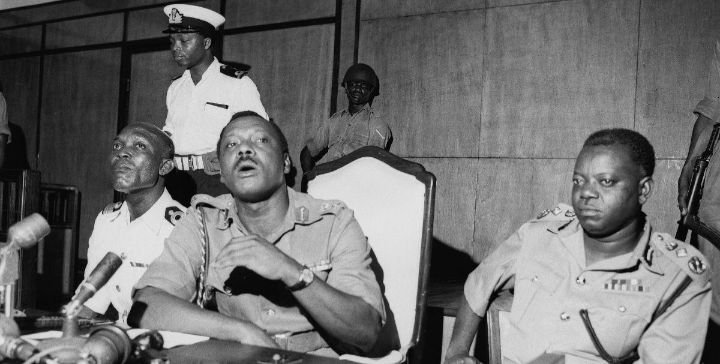
Nigeria’s first military coup on January 15, 1966, did not end with the overthrow of the civilian government. Instead, it opened a chain of events that would push the country toward military rule, ethnic violence and, eventually, the Nigerian Civil War.
Among the darkest episodes was the killing of dozens of military officers during the July 1966 counter-coup. Some accounts have popularly focused on a group of 21 officers, but the historical record shows that the number of military personnel killed was considerably higher.
The killings were not the result of a conventional military trial or officially announced executions. Many officers were murdered during mutinies and military operations as northern soldiers sought revenge for the deaths of political leaders and senior officers during the January coup.
The January Coup That Changed Nigeria
On January 15, 1966, a group of young military officers launched Nigeria’s first coup.
The plotters attacked key locations in Lagos, Kaduna and Ibadan and killed several prominent political and military figures. Among those killed were Prime Minister Sir Abubakar Tafawa Balewa, Northern Premier Sir Ahmadu Bello, Western Premier Chief Samuel Ladoke Akintola and Finance Minister Festus Okotie-Eboh.
Senior military officers were also killed, including Brigadier Zakariya Maimalari, Brigadier Samuel Ademulegun, Colonel Kur Mohammed, Lieutenant Colonel James Pam, Lieutenant Colonel Ralph Shodeinde and Lieutenant Colonel Abogo Largema.
The killings immediately created suspicion about the real purpose of the coup.
Although the plot involved officers from different backgrounds, most of the principal figures were Igbo. Because many of the people killed were northern and western political leaders, the coup quickly became widely perceived, particularly in the North, as an attempt by Igbo officers to seize political power.
Major-General Johnson Aguiyi-Ironsi, the most senior officer who survived the coup, eventually became Nigeria’s military Head of State.
Why the Coup Plotters Were Not Immediately Tried
One of the most controversial decisions of the Ironsi government was its handling of the January coup plotters.
The officers involved in the coup were arrested, but they were not immediately prosecuted. This deeply angered many northern officers who believed that soldiers responsible for killing their commanders and political leaders should face punishment.
The perception that the plotters were being protected became one of the grievances that eventually contributed to the July counter-coup.
At the same time, Ironsi’s government introduced major political changes. His government abolished Nigeria’s federal structure and replaced it with a more centralized system through Decree No. 34.
To many northern politicians and soldiers, these developments reinforced fears that the January coup had been part of a wider attempt to establish Igbo political dominance. Historians continue to debate the extent to which ethnic motives drove the January coup, but there is little doubt that ethnic suspicion became a powerful force in the months that followed.
The July 1966 Counter-Coup
By July 1966, tensions within the Nigerian Army had reached breaking point.
Northern soldiers, particularly junior officers and other ranks, had become increasingly angry over what they regarded as the failure to punish those responsible for the January killings.
On the night of July 28–29, northern soldiers began a mutiny that quickly developed into a counter-coup.
The violence spread through military formations across the country.
In Abeokuta, Lieutenant Colonel Gabriel Okonweze called a meeting of soldiers amid rumours of an impending rebellion. Agitated northern troops stormed the meeting and opened fire. Okonweze and Major John Obienu were killed, while Lieutenant E. B. Orok was also shot.
The violence was not confined to Abeokuta.
In Ibadan, the military governor of Western Nigeria, Lieutenant Colonel Francis Adekunle Fajuyi, was killed alongside Head of State Major-General Johnson Aguiyi-Ironsi.
The killings marked one of the most dramatic moments in Nigeria’s early post-independence history.
The Officers Who Were Killed
The list of officers killed during the July/August counter-coup was much longer than 21.
Historian Max Siollun’s documented list includes Aguiyi-Ironsi and Fajuyi, as well as Lieutenant Colonel Gabriel Okonweze and Lieutenant Colonel Israel Okoro.
Several majors were also killed, including Christian Anuforo, Alister Drummond, Ibanga Ekanem, Christopher Emelifonwu, Joseph Ihedigbo, Ukpo Isong, Bernard Nnamani, Theophilus Nzegwu, Peter Obi, John Obienu, David Ogunro and Donatus Okafor. Numerous captains were also among the dead.
An Eastern Regional Government publication later recorded 33 Eastern officers, seven Midwestern officers and three Western officers among the military casualties of the counter-rebellion, alongside hundreds of other ranks.
This demonstrates why the description of the incident as simply the “execution of 21 officers” can be misleading. The killings formed part of a much wider military bloodletting.
The Killing of Ironsi and Fajuyi
Perhaps the most significant deaths occurred in Ibadan.
Aguiyi-Ironsi was visiting Lieutenant Colonel Adekunle Fajuyi, the military governor of the Western Region, when the counter-coup erupted.
Fajuyi reportedly refused to abandon his guest.
As soldiers moved against Ironsi, Fajuyi chose to remain with him rather than save himself by distancing himself from the Head of State.
Both men were eventually taken away and killed.
Their deaths removed the country’s Head of State and one of its most respected military governors in a single operation.
The killings also demonstrated how far Nigeria’s political crisis had moved beyond ordinary political disagreement. Soldiers were now killing fellow soldiers based on grievances connected to the previous coup, regional loyalties and growing ethnic suspicion.
Was It Revenge?
The July counter-coup is often described as a revenge coup, particularly because many northern soldiers believed they were avenging the deaths of northern political leaders and military commanders during January.
There was certainly a strong element of revenge.
But the situation was more complicated than a simple North-versus-South conflict. Political competition, military grievances, ethnic suspicion, disagreements over Nigeria’s constitutional structure and the failure to resolve the January coup all contributed to the crisis.
The violence also affected officers who were not directly responsible for the January coup.
Some officers were killed simply because they belonged to communities or military networks associated with the Eastern Region.
This transformed the counter-coup from a struggle over military power into a much wider communal crisis.
The Road to Civil War
After Ironsi’s death, Lieutenant Colonel Yakubu Gowon eventually emerged as Nigeria’s new Head of State.
But the crisis did not end.
The killings deepened mistrust between the country’s regions. Violence against Easterners in the North increased, while thousands of people fled southward toward the Eastern Region.
By September 1966, another wave of massacres had occurred in the North. Large numbers of Easterners were killed or displaced, creating an enormous refugee crisis.
The military leadership struggled to restore confidence between the regions.
Lieutenant Colonel Chukwuemeka Odumegwu Ojukwu, the military governor of the Eastern Region, increasingly rejected Gowon’s authority.
Attempts at political reconciliation eventually failed.
In 1967, Ojukwu declared the independence of the Republic of Biafra, and Gowon’s federal government responded with military force.
The Nigerian Civil War began.
A Tragedy That Should Not Be Forgotten
The deaths of the officers during the July 1966 counter-coup were more than a military episode.
They represented the collapse of trust within the Nigerian Army and the destruction of one of the institutions that was supposed to hold the young nation together.
The January coup had killed political leaders and senior officers. The July counter-coup answered those deaths with another wave of military killings. The cycle of revenge then spread beyond the barracks into Nigerian society.
By the time the country entered the civil war in 1967, thousands had already been killed and millions had been displaced.
The story of the so-called 21 executed officers should therefore be understood within this larger tragedy. They were part of a much wider group of military personnel who lost their lives during the violent upheaval of 1966.
The Historabase Editorial Team is dedicated to exploring and sharing the stories that have shaped Africa and the wider world. Our work covers African history, ancient civilizations, empires, historical figures, wars, cultures, political movements, and important events from the past.
We aim to present history in a clear, engaging, and accessible way, combining historical records with careful research to help readers better understand the people, events, and civilizations that shaped our world.