On the night of November 4, 1605, a group of conspirators came dangerously close to carrying out one of the most infamous assassination plots in British history. Their target was the English Parliament, where King James I, members of the royal family, government officials, and leading politicians were expected to gather the following morning.
The plan was extraordinary: secretly place barrels of gunpowder beneath the House of Lords and destroy the building when Parliament opened on November 5.
The plot failed. A man named Guy Fawkes was discovered guarding the explosives in the early hours of November 5, arrested, tortured, and eventually executed alongside other conspirators.
More than four centuries later, the Gunpowder Plot remains one of the most famous acts of political conspiracy in English history. But who planned it, why did they want to destroy Parliament, and how was the plot uncovered?
England Before the Plot
To understand the Gunpowder Plot, it is necessary to understand the religious tensions of early 17th-century England.
The country had experienced decades of conflict between Catholics and Protestants. Under King Henry VIII, England had broken from the authority of the Catholic Church in Rome. His successors continued to reshape the country’s religious and political order.
By the time James I became king in 1603, Catholics faced significant restrictions. Catholic priests could be arrested, religious practices were heavily controlled, and Catholics who refused to attend official Protestant services could face financial penalties.
Many English Catholics had hoped James would be more tolerant.
James had a Catholic wife and had initially given some Catholics reason to believe that his government might adopt a less hostile approach. However, tensions remained, and Catholic hopes for major religious concessions gradually faded.
A small group of Catholics eventually decided that peaceful resistance was not enough.
Robert Catesby and the Conspiracy
The central figure behind the Gunpowder Plot was Robert Catesby, a Catholic gentleman from Warwickshire.
Catesby had already experienced conflict with the government because of his Catholic beliefs. Over time, he became convinced that dramatic action was necessary to overthrow the Protestant government.
He recruited several fellow Catholics, including Thomas Wintour, Thomas Percy, John Wright and Guy Fawkes.
The conspirators did not initially intend simply to kill the king. Their plan was much larger.
They wanted to destroy the political leadership gathered inside Parliament, seize the king’s young daughter, Princess Elizabeth, and establish a new government that would be more sympathetic to Catholicism.
The conspirators believed that destroying Parliament could create the political chaos necessary for a revolution.
Why Guy Fawkes Became the Most Famous Conspirator
Although Robert Catesby was the driving force behind the conspiracy, Guy Fawkes became its most recognizable figure.
Born around 1570 in York, Fawkes converted to Catholicism and eventually travelled to continental Europe, where he fought alongside Catholic forces against Protestant Dutch rebels.
His military experience made him particularly valuable to Catesby’s group.
Fawkes understood explosives and had experience as a soldier. When the conspirators developed their plan to destroy Parliament, he was given the dangerous task of guarding the gunpowder and igniting it at the appropriate moment.
This is why history remembers the conspiracy primarily through Fawkes’s name.
The Plan to Destroy Parliament
The conspirators needed access to the area directly beneath the House of Lords.
Thomas Percy, who had connections to the royal court, rented a property close to Parliament. The conspirators eventually obtained access to a cellar beneath the House of Lords.
They began secretly accumulating gunpowder.
Their intention was to place enough explosives beneath Parliament to destroy the building when the king and Parliament assembled.
The conspirators reportedly acquired 36 barrels of gunpowder.
For months, the group worked in secrecy.
The plan was scheduled for November 5, 1605, when Parliament was due to open.
The conspirators expected that the explosion would kill King James I, his ministers and many members of Parliament simultaneously.
They then intended to use the resulting chaos to launch their rebellion.
The Anonymous Letter
The conspiracy might have succeeded if not for a mysterious warning.
As the date approached, one of the conspirators became concerned about Catholic people who might be inside Parliament when the explosion occurred.
An anonymous letter was sent to Lord Monteagle, a Catholic member of the House of Lords, warning him to stay away from Parliament.
The letter contained a cryptic warning that he should avoid attending Parliament because danger was approaching.
Monteagle showed the letter to government officials.
The authorities began investigating.
At first, they did not know exactly what the warning meant. But the government became increasingly suspicious that an attack was being planned.
The Search Beneath Parliament
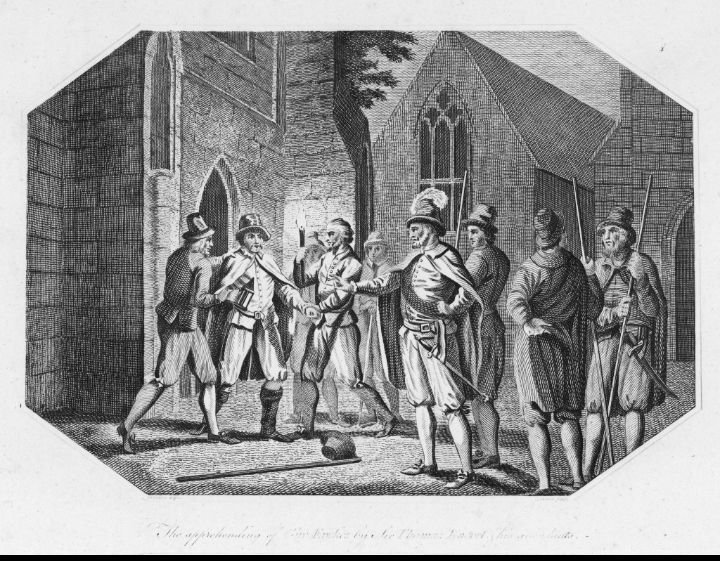
On the night of November 4, government officials searched the buildings beneath Parliament.
During an initial inspection, they noticed a man near a large quantity of firewood.
That man was Guy Fawkes.
He identified himself using the name John Johnson.
The officials became suspicious and searched the cellar again.
Behind the firewood, they discovered barrels containing gunpowder.
The conspiracy had been exposed.
Fawkes was arrested in the early hours of November 5.
The gunpowder was removed, and the planned attack was prevented.
King James I and Parliament were safe.
Fawkes Under Interrogation
Fawkes initially refused to reveal the identities of his fellow conspirators.
King James ordered that he be interrogated.
After days of questioning and torture, Fawkes eventually revealed information about the conspiracy and the people involved.
His signature on a confession document became one of the most famous pieces of evidence associated with the plot.
The authorities soon began hunting the other conspirators.
Catesby and several of his followers fled London and headed toward the Midlands.
Their plan was to raise support for an armed rebellion.
Instead, they found themselves increasingly isolated.
The Final Stand
On December 8, 1605, Catesby and several remaining conspirators reached Holbeche House in Staffordshire.
Government forces surrounded the building.
A gunfight followed.
Robert Catesby and Thomas Percy were killed.
Other conspirators were captured.
The rebellion had completely collapsed.
The government then brought the surviving conspirators back to London to face trial.
The Execution of the Conspirators
The surviving conspirators were convicted of treason.
Their punishment was brutal.
In January 1606, Guy Fawkes, Thomas Wintour, Ambrose Rookwood and Robert Keyes were executed.
The traditional punishment for treason involved hanging, drawing and quartering.
The executions were deliberately public and designed to demonstrate the power of the Crown.
The conspirators’ deaths marked the end of the Gunpowder Plot.
But the consequences of the failed attack continued for generations.
November 5 Becomes Bonfire Night
The failure of the Gunpowder Plot quickly became an annual occasion of remembrance.
Parliament passed legislation establishing November 5 as a day of public thanksgiving for the king’s survival.
Over time, celebrations developed around bonfires, fireworks and the burning of effigies.
The tradition became known as Guy Fawkes Night or Bonfire Night.
Children and adults began creating effigies of Guy Fawkes, which were traditionally burned on bonfires.
Fireworks became another major part of the celebrations, symbolizing the gunpowder that never exploded beneath Parliament.
Although the religious and political meaning of the event has changed considerably, November 5 remains deeply associated with the failed conspiracy.
Was Guy Fawkes Really the Leader?
One of the biggest misconceptions about the Gunpowder Plot is that Guy Fawkes was its leader.
He was not.
The mastermind was Robert Catesby.
Catesby recruited the conspirators, helped develop the plan and remained committed to the rebellion until his death.
Fawkes was important because of his military experience and his role in handling the explosives, but he was one member of a larger conspiracy.
His name became famous largely because he was the man discovered with the gunpowder.
What Happened to the Gunpowder?
Interestingly, the gunpowder discovered beneath Parliament did not actually explode.
The authorities confiscated it after Fawkes’s arrest.
Some historical accounts suggest that the gunpowder had deteriorated and may not have been in perfect condition. Nevertheless, the quantity was substantial enough that an explosion could have caused devastating damage if it had been successfully ignited.
The exact physical impact of such an explosion is difficult to establish with certainty today.
What is clear is that the conspirators intended to use a large quantity of explosives to destroy the House of Lords and kill the political leadership gathered there.
The Political Consequences
The Gunpowder Plot strengthened suspicion toward Catholics in England.
Although the conspiracy involved only a small group of Catholics, the government used it to justify further restrictions.
Anti-Catholic attitudes became even stronger, and Catholics continued to face legal and political disadvantages.
The plot also became a powerful piece of government propaganda.
The story of Catholic conspirators attempting to murder the king and destroy Parliament reinforced the idea that Catholicism represented a political threat to Protestant England.
Over time, however, historians have examined the event with greater complexity.
The Gunpowder Plot was not simply a story of Catholics versus Protestants. It was also a story about political exclusion, religious persecution, radicalization and the consequences of a government refusing to accommodate deep religious divisions.
A Plot That Changed History
The Gunpowder Plot ultimately failed.
Parliament survived. King James I survived. The conspirators were killed or executed, and the planned rebellion never developed.
Yet the conspiracy became far more influential in historical memory than its actual military success would suggest.
The image of Guy Fawkes standing beneath Parliament surrounded by barrels of gunpowder became one of the most recognizable symbols of political conspiracy.
Centuries later, Guy Fawkes’s image even acquired a completely different meaning. The stylized Guy Fawkes mask became associated with protest movements and resistance to authority, particularly after its appearance in popular culture and political activism.
The man once remembered as a failed Catholic conspirator was transformed into a symbol that could represent rebellion against powerful institutions.
The Legacy of November 5
More than 400 years after the Gunpowder Plot, November 5 remains a reminder of one of the most dramatic political conspiracies in British history.
The conspirators believed that a single enormous act of violence could transform England.
Instead, their plan collapsed before the first explosion.
Their failure saved the lives of the king and Parliament’s members, but it also intensified religious tensions and left a lasting mark on British political culture.
The story of Guy Fawkes, Robert Catesby and the Gunpowder Plot continues to fascinate historians because it combines secrecy, religion, politics, assassination, explosives and betrayal.
Most importantly, it demonstrates how political and religious divisions can create an environment in which desperate people begin to believe that extraordinary violence is the only path to change.
The Historabase Editorial Team is dedicated to exploring and sharing the stories that have shaped Africa and the wider world. Our work covers African history, ancient civilizations, empires, historical figures, wars, cultures, political movements, and important events from the past.
We aim to present history in a clear, engaging, and accessible way, combining historical records with careful research to help readers better understand the people, events, and civilizations that shaped our world.