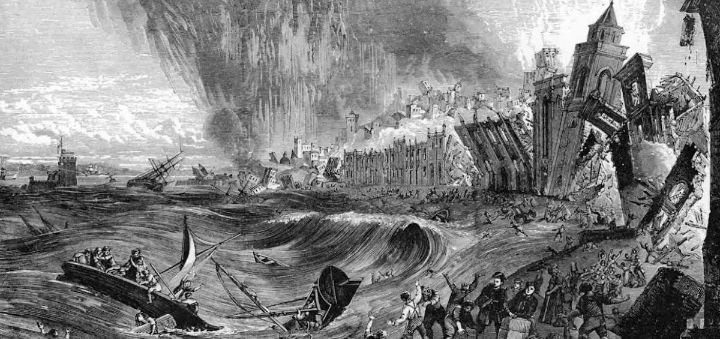
On the morning of November 1, 1755, one of the most devastating natural disasters in European history struck Lisbon, Portugal. A powerful earthquake destroyed large parts of the city, while fires and a massive tsunami followed, turning the catastrophe into a disaster of unprecedented scale.
The event became known as the Great Lisbon Earthquake of 1755. Its destruction extended far beyond Portugal, with effects reported across the Iberian Peninsula and parts of North Africa. Thousands of people died, buildings collapsed, fires raged for days, and waves swept through coastal communities.
But the Lisbon earthquake was more than a natural disaster. It changed the way Europeans thought about earthquakes, religion, government, urban planning and even the nature of human suffering.
Lisbon Before the Earthquake
In the 18th century, Lisbon was one of Europe’s most important cities. As the capital of Portugal, it benefited enormously from the country’s overseas empire and maritime trade.
The city was home to merchants, sailors, aristocrats, religious institutions and wealthy trading families. Its churches and palaces reflected Portugal’s wealth and global influence.
Lisbon’s location beside the Tagus River made it an important commercial center, but it also placed the city close to the Atlantic coast.
Much of Lisbon was densely populated, with narrow streets and buildings constructed in ways that were poorly suited to withstand a major earthquake. Many structures were made from masonry and contained heavy roofs and decorative elements that could easily collapse.
No one in Lisbon knew that the city’s greatest danger was approaching from beneath the Atlantic Ocean.
November 1, 1755: The Earthquake Strikes
November 1 was All Saints’ Day, an important religious holiday in Catholic Portugal. Many residents were attending Mass in churches across Lisbon.
At approximately 9:40 in the morning, the ground began to shake violently.
The earthquake was enormous. Modern estimates generally place its magnitude somewhere around 8.5 to 9.0, although the exact figure cannot be known because modern instruments did not exist in 1755.
The shaking lasted for several minutes and was strong enough to destroy buildings throughout Lisbon.
Churches, homes, palaces and government buildings collapsed. Streets became filled with rubble, trapping people beneath the ruins.
The destruction was especially horrifying because many people were inside churches when the earthquake struck.
Large sections of Lisbon were reduced to ruins within minutes.
The earthquake was also felt over an enormous area. Tremors were reported in other parts of Portugal and Spain, demonstrating the extraordinary power of the event.
The Fires That Followed
The earthquake itself was only the beginning.
Because the disaster occurred on a major religious holiday, thousands of candles were burning inside churches and homes. Many were knocked over during the earthquake, igniting fires.
The flames spread rapidly through the ruined city.
For several days, fires burned across Lisbon. Buildings that had survived the earthquake were consumed by flames.
The combination of collapsed structures, blocked streets and widespread fires made rescue efforts extremely difficult.
People who had escaped the initial destruction suddenly faced another threat: fire.
The Tsunami
Then came another catastrophe.
The earthquake had occurred beneath or near the Atlantic Ocean, displacing enormous amounts of water.
A tsunami followed.
As survivors gathered near the Tagus River and Lisbon’s waterfront, hoping that open spaces would provide protection from collapsing buildings and fires, they encountered a new danger.
The water began to withdraw before enormous waves rushed inland.
The tsunami swept across the lower parts of Lisbon and surrounding coastal areas, carrying debris and drowning people who had moved toward the waterfront.
The waves also affected other coastal regions of Portugal, Spain and North Africa.
The disaster therefore consisted of three major threats: the earthquake, the fires and the tsunami.
Together, they produced devastation on a scale that shocked Europe.
How Many People Died?
The exact death toll remains uncertain.
Historical estimates vary considerably, but tens of thousands of people are believed to have died in Portugal, with Lisbon suffering the greatest losses.
Some historical estimates have placed the total number of deaths as high as tens of thousands, while other estimates are lower.
The uncertainty exists because there was no modern system for recording deaths during a catastrophe of this scale. Records were destroyed, people disappeared beneath collapsed buildings, and thousands of victims may never have been formally identified.
Deaths were also reported in other parts of Portugal, Spain and North Africa.
The Lisbon earthquake was therefore not simply a city disaster. It was a regional catastrophe.
The Destruction of Lisbon
The destruction of Lisbon was extraordinary.
Some of the city’s most important buildings were damaged or destroyed, including churches, convents, palaces and libraries.
The famous Royal Palace of Ribeira, located near the Tagus River, was destroyed. The earthquake also destroyed valuable artworks, manuscripts and other cultural treasures.
The earthquake affected the heart of Portugal’s political and cultural life.
For survivors, the city they knew had effectively disappeared.
Thousands were left homeless. Food became scarce, buildings became dangerous, and fear of further earthquakes kept many people from returning to damaged structures.
Some survivors slept outdoors in temporary shelters or makeshift camps.
The Marquis of Pombal and the Response
One of the most important figures to emerge from the disaster was Sebastião José de Carvalho e Melo, better known as the Marquis of Pombal.
At the time, he was a powerful government minister under King Joseph I.
Pombal quickly took charge of the emergency response.
His approach was famously practical.
The authorities worked to recover bodies, maintain order, secure food supplies and prevent looting. The government also took steps to stop people from abandoning the city completely.
One of the famous accounts associated with Pombal describes his response to the crisis as essentially focused on burying the dead and caring for the living.
Whether every version of this statement is historically exact or not, it reflects the practical philosophy behind the government’s response.
Pombal understood that Lisbon needed not simply to survive but to be rebuilt.
Rebuilding Lisbon
The destruction provided an opportunity to redesign the city.
Rather than rebuilding Lisbon exactly as it had existed before, Pombal and his planners created a more organized urban layout.
The central area of Lisbon was reconstructed with wider streets, organized blocks and buildings designed with earthquake resistance in mind.
One of the most important innovations was the development of the Pombaline cage, a structural framework made largely from timber that was incorporated into buildings to provide greater resistance to earthquake forces.
Buildings were also subjected to tests designed to determine whether the new structures could withstand seismic activity.
These efforts made the rebuilding of Lisbon an important milestone in the history of earthquake-resistant construction.
The disaster had demonstrated that urban design could play a major role in reducing future deaths.
A New Approach to Earthquake Science
The earthquake also had an enormous impact on science.
In 1755, European society had limited scientific understanding of earthquakes. Their causes were often explained through religious or supernatural ideas.
The Lisbon catastrophe encouraged thinkers to investigate earthquakes more systematically.
Pombal’s government distributed questionnaires asking people across Portugal about what they had experienced.
They were asked about details such as:
How long the shaking lasted
The direction of the movement
Whether water levels changed
Damage to buildings
Unusual behavior of animals
The timing and size of the waves
These reports represented an early attempt to collect standardized information about a major earthquake.
For this reason, the Lisbon disaster is sometimes regarded as an important event in the development of modern seismology and disaster research.
The Religious Debate
The earthquake also created a major philosophical and religious debate.
The disaster occurred on All Saints’ Day, when many people were worshipping inside churches.
Some survivors questioned why a supposedly holy city had suffered such destruction on such an important religious occasion.
If the disaster was a punishment from God, why had churches collapsed while some other buildings survived?
These questions became particularly important during the European Enlightenment, when philosophers were increasingly questioning traditional explanations of natural events.
One of the most famous literary responses came from Voltaire, the French Enlightenment philosopher.
His 1759 novel Candide famously referenced the Lisbon earthquake and used the catastrophe to challenge the philosophical idea that the world was arranged in the best possible way.
The disaster therefore became part of a much larger European debate about God, suffering, evil and human reason.
The Earthquake’s Wider Impact
The effects of the Lisbon earthquake extended beyond Portugal.
The disaster affected trade and the Portuguese economy. Lisbon was an important center of international commerce, and its destruction disrupted economic activity.
Portugal’s colonial empire also felt the consequences.
The event became widely discussed throughout Europe. Newspapers, letters, religious publications and philosophical works spread reports of the catastrophe.
Lisbon became a symbol of the unpredictability and destructive power of nature.
The disaster also demonstrated that governments had an important responsibility to prepare for and respond to major catastrophes.
Did the Earthquake Change Europe?
In many ways, yes.
The Great Lisbon Earthquake contributed to changes in several areas.
Science: Researchers began studying earthquakes more systematically.
Urban planning: Lisbon was rebuilt using new principles designed to reduce earthquake damage.
Government: The disaster demonstrated the importance of organized state intervention during emergencies.
Philosophy: The catastrophe became an important subject in Enlightenment debates about suffering and divine providence.
Architecture: Engineers and builders became increasingly interested in structures capable of surviving earthquakes.
The disaster therefore became a turning point far beyond the physical destruction it caused.
The Legacy of the Great Lisbon Earthquake
More than 270 years later, the Great Lisbon Earthquake remains one of history’s most significant natural disasters.
The city eventually recovered. The rebuilt central district became one of the defining features of modern Lisbon.
But the memory of 1755 remained deeply embedded in Portuguese history.
The disaster demonstrated something that modern societies continue to experience: natural hazards become catastrophes when they strike vulnerable communities.
The earthquake could not have been prevented. But the scale of the destruction was influenced by building practices, population density, infrastructure and the city’s preparedness.
The Historabase Editorial Team is dedicated to exploring and sharing the stories that have shaped Africa and the wider world. Our work covers African history, ancient civilizations, empires, historical figures, wars, cultures, political movements, and important events from the past.
We aim to present history in a clear, engaging, and accessible way, combining historical records with careful research to help readers better understand the people, events, and civilizations that shaped our world.








2 Comments