Lawrence Anini remains one of the most notorious names in Nigeria’s criminal history. In the mid-1980s, the young Benin City taxi driver became the leader of a violent gang whose robberies, shootings and clashes with security forces dominated national headlines.
His story was not simply that of a criminal who suddenly appeared on Nigeria’s streets. It was a story shaped by poverty, violence, betrayal, corruption, organized crime and the weaknesses of law enforcement during a turbulent period in Nigeria’s history.
Within a remarkably short period, Anini went from driving passengers around Benin City to becoming one of Nigeria’s most wanted men.
From Taxi Driver to Criminal
Lawrence Anini was born in Benin City, Edo State, in 1960. Accounts of his early life describe him as a young man who became involved in the world of commercial transportation before eventually entering organized crime.
Driving a taxi gave Anini intimate knowledge of Benin City. He knew its streets, routes and neighborhoods, and this knowledge would later become valuable when he became involved in armed robbery.
Anini reportedly began his criminal career with relatively minor activities before becoming associated with armed robbery. He eventually formed connections with other criminals and became increasingly involved in violent crime.
The transition from taxi driver to armed robber was gradual, but once Anini entered the criminal underworld, his rise was remarkably fast.
The Rise of Anini’s Gang
By the mid-1980s, Anini had become associated with a group of armed robbers operating around Benin City.
Among the people linked to his gang was Monday Osunbor, popularly known as “Monday”; another prominent associate was Moses Ogbo. The gang targeted banks, businesses, motorists and other potential victims.
Their activities became increasingly bold.
Armed robbery was already a serious problem in Nigeria during this period, but Anini’s gang gained particular notoriety because of its willingness to confront the police.
The gang reportedly used stolen vehicles and firearms while exploiting their knowledge of Benin City’s roads to escape after robberies.
This made them difficult to apprehend.
A City Held in Fear
As Anini’s reputation grew, fear spread across Benin City.
Residents became increasingly concerned about armed robbery attacks, while commercial drivers and business owners faced the possibility of being targeted.
The gang’s activities also exposed the challenges facing Nigerian law enforcement at the time. Police units were often operating with limited resources, while armed criminals could exploit poor communication and transportation systems to escape.
Anini was no longer simply another armed robber.
He had become a symbol of the growing insecurity that authorities struggled to control.
Newspapers followed his activities closely, and his name became familiar throughout Nigeria.
The Police Were Determined to Capture Him
The authorities eventually launched an intensive search for Anini and his associates.
Police operations were conducted in and around Benin City as investigators attempted to identify the gang’s members, hideouts and networks.
But capturing Anini proved difficult.
He was familiar with the city and reportedly had connections that helped him obtain information about police movements.
This created an increasingly dangerous situation.
The more pressure the police applied, the more violent the conflict became.
The Turning Point
One of the most important developments in Anini’s story came when the relationship between him and some members of his gang deteriorated.
Criminal organizations often depend on trust, but violence, money and competition can quickly destroy those relationships.
Anini eventually became increasingly isolated.
Some of his associates were arrested or killed, while others became estranged from him.
The criminal network that had once helped him operate was gradually collapsing.
At the same time, security forces intensified their efforts to locate him.
The Famous Shootout
The final chapter of Anini’s criminal career came in December 1986.
Security forces eventually located him in Benin City.
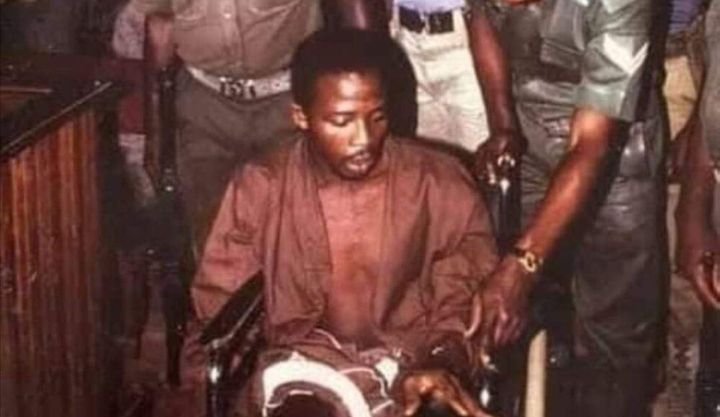
A confrontation followed, and Anini was shot and seriously wounded.
His capture marked the end of one of the most dramatic manhunts in Nigeria’s criminal history.
But even after he was captured, the authorities had to deal with the enormous public interest surrounding the case.
Nigeria wanted answers.
How had a young taxi driver become the leader of such a violent gang?
How had the group operated for so long?
And why had the police struggled to stop them earlier?
Anini in Custody
After his capture, Anini was taken into custody and subjected to interrogation.
His condition reportedly attracted significant public attention because of the seriousness of his injuries.
During this period, details about his criminal activities and associates became more widely known.
The case also became an important example of how organized armed robbery could develop into a broader security crisis.
For many Nigerians, Anini represented the frightening transformation of ordinary urban crime into heavily armed criminal activity.
Trial and Execution
Lawrence Anini was eventually tried for his crimes.
The proceedings attracted considerable attention, and his name became permanently associated with Nigeria’s history of violent armed robbery.
He was convicted and sentenced to death.
In March 1987, Lawrence Anini was executed in Benin City.
He was only in his twenties.
His death brought an end to his criminal career, but it did not end the fascination surrounding his story.
Decades later, his name remains one of the most recognizable in Nigeria’s history of armed robbery.
Why Did Anini Become So Notorious?
Anini’s notoriety cannot be explained simply by the number of crimes attributed to him.
Several factors made his story particularly memorable.
His Background
The contrast between his earlier life as a taxi driver and his later reputation as an armed robber created a dramatic narrative.
He was not born into an established criminal empire. He entered the criminal world and eventually became its most recognizable figure.
His Knowledge of Benin City
His experience as a taxi driver gave him familiarity with the city’s streets.
That knowledge could help criminals move around quickly and evade security forces.
His Gang’s Violence
Anini and his associates were associated with violent armed robberies and confrontations with police.
This made the case considerably more serious than ordinary property crime.
The Media Attention
Newspaper coverage transformed Anini from a local criminal into a national figure.
His name became synonymous with fear in Benin City and beyond.
The Anini Legacy
The story of Lawrence Anini is sometimes told as an almost legendary tale of a criminal mastermind.
But historians and researchers should be cautious about separating fact from mythology.
Over the years, stories surrounding famous criminals often become exaggerated. Rumors, newspaper reports, popular retellings and later recollections can create versions of events that differ from the historical record.
What is firmly established is that Anini became the leader of a notorious armed robbery gang, operated in Benin City during the 1980s, was pursued by Nigerian security forces, captured after being wounded, convicted and executed in 1987.
The Historabase Editorial Team is dedicated to exploring and sharing the stories that have shaped Africa and the wider world. Our work covers African history, ancient civilizations, empires, historical figures, wars, cultures, political movements, and important events from the past.
We aim to present history in a clear, engaging, and accessible way, combining historical records with careful research to help readers better understand the people, events, and civilizations that shaped our world.










One Comment