On March 22, 2014, a horrifying discovery in the Soka area of Ibadan, Oyo State, shocked Nigeria. Inside an isolated compound surrounded by thick vegetation, investigators and residents encountered decomposing bodies, human bones, skulls and personal belongings.
But the most disturbing discovery was that some people were still alive.
Several severely malnourished individuals were rescued from the area, with some reportedly found in chains. The abandoned location soon became known nationally as the “Ibadan Forest of Horror.
What happened at Soka became one of the most disturbing criminal investigations in modern Nigerian history.
Soka was not the kind of place most people associated with one of Nigeria’s largest cities. Away from the busy roads and commercial centres of Ibadan, the area contained abandoned structures and thick vegetation that provided a degree of isolation.
That isolation would become central to the horrifying discovery.
The alarm was reportedly raised after commercial motorcycle operators became concerned about missing colleagues. A search eventually led people to the abandoned property in the Soka area.
What they encountered was beyond what they expected.
Human remains were scattered around the property and surrounding bush. Police subsequently described finding decomposing corpses, skeletons and skulls. Several people who appeared to have been held captive were also rescued.
The discovery immediately raised one terrifying question:
How long had this been happening without anyone knowing?
The Survivors
The existence of survivors made the case even more disturbing.
People were reportedly discovered in extremely poor physical condition. Some had apparently been restrained, while others were found wandering around the surrounding bush.
Early reports said several rescued people were taken to hospitals for treatment. Some were so weak that they struggled to communicate with investigators and journalists.
As survivors recovered, some began describing how they had allegedly been abducted and transported to the location.
One survivor, Nafiu Shittu, reportedly said he had been abducted in Ibadan and later found himself chained inside a room. Another survivor, Titi Adeyemi, described being taken away by men who claimed to be arresting her before transporting her to the bush.
Their accounts transformed the story from a frightening discovery into a potential kidnapping investigation.
The Mystery of the Missing
Perhaps the most painful aspect of the Soka case was its connection to missing persons.
Families across Ibadan and surrounding communities had reported relatives who disappeared under unexplained circumstances. The discovery naturally raised fears that some of those missing people could have ended up at Soka.
But investigators faced an enormous challenge.
Many of the remains had decomposed, making identification extremely difficult. Authorities therefore turned to forensic examination.
Police forensic specialists and experts from the University College Hospital (UCH), Ibadan, were brought in to examine the site and recover remains for analysis. Investigators hoped that DNA testing could eventually help determine whether some of the remains belonged to people reported missing.
This forensic process was crucial because rumours about the number of victims were already spreading rapidly.
How Many People Were Killed?
The exact number of people who died at the Soka location became one of the most controversial aspects of the story.
As crowds gathered at the site, reports circulated claiming that enormous numbers of people had been murdered there. Some local estimates ran into the hundreds.
However, those claims should be treated carefully.
Contemporary reports contained widely varying figures, and some estimates were based on statements from residents or community leaders rather than completed forensic identification. One community leader, for example, estimated that around 120 people may have been killed, while acknowledging uncertainty about the actual number.
The physical discovery of human remains was not in dispute.
The exact death toll, however, required evidence.
That distinction is important when telling the history of Soka. The case was horrific enough without adding unverified numbers to the story.
Was It a Ritual-Killing Operation?
The Soka discovery quickly became associated with ritual killings.
Residents speculated that victims had been kidnapped and killed for ritual purposes, while others believed the site was primarily connected to kidnapping and organised criminal activity.
The police investigation initially focused on determining who operated the location, how victims were brought there and what had happened to those who died.
The public’s suspicion of ritual killing reflected a broader fear that existed in parts of Nigeria at the time. Stories of human sacrifice and the illegal trade in human body parts had periodically generated panic.
But suspicion was not the same as proof.
Investigators needed to establish the facts through witness testimony, physical evidence, forensic examination and, where possible, prosecutions.
Ibadan Descends Into Panic
News of the discovery spread rapidly.
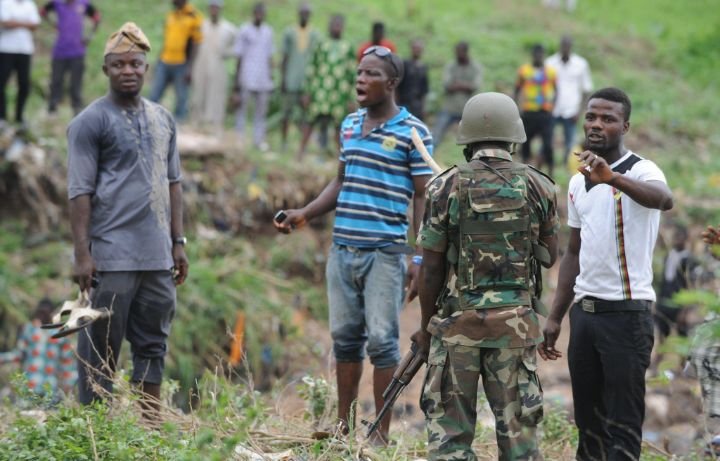
Large crowds travelled to Soka, with thousands reportedly gathering around the site. People wanted to see the location for themselves and determine whether rumours about missing relatives were true.
The atmosphere became increasingly volatile.
Some residents believed more victims were still trapped underground. Others were convinced that the people responsible were hiding nearby.
The situation eventually produced clashes around the property. Police attempted to prevent crowds from entering the crime scene, while angry residents demanded access. Contemporary reporting described injuries and damage to vehicles during the unrest.
For authorities, the situation presented two problems at once: investigating a potentially major crime while preventing public panic from creating another tragedy.
The Tragedy of Mob Justice
One of the darkest consequences of the Soka discovery occurred away from the forest itself.
Rumours began spreading that some people who appeared mentally ill were actually criminals or ritualists connected to the site.
This resulted in vulnerable people becoming targets.
Police officials publicly warned residents against attacking people simply because they suspected them of being ritual killers. Reports indicated that people perceived as mentally ill were attacked amid the panic.
It was a tragic demonstration of how quickly fear can become dangerous.
The discovery of real victims had created an environment in which unverified accusations could suddenly become deadly.
The Investigation
The Nigerian police treated the case as a murder investigation and arrested suspects.
The investigation was eventually expanded, with detectives from the Force Criminal Investigation Department joining state investigators. Forensic specialists were also brought in to examine the site and determine the causes of death.
Authorities secured the area and restricted public access so investigators could preserve evidence.
Forensic teams began mapping the site, recovering remains and examining objects believed to have belonged to victims.
The aim was to answer several fundamental questions:
Who operated the compound?
How long had it been used?
How many victims were there?
How did they die?
Were the missing people reported by families connected to the remains?
And perhaps most importantly:
Who was responsible?
Why the Case Shocked Nigeria
The Soka case frightened Ibadan because it challenged the assumption that such atrocities could not happen unnoticed in a major Nigerian city.
Ibadan was, and remains a huge urban centre, home to millions of people.
Yet behind an isolated compound, authorities discovered evidence of suffering that had apparently gone unnoticed for some time.
The case also highlighted the vulnerability of people who disappeared without immediate answers.
A person could vanish from a busy street, workplace or neighbourhood, leaving relatives desperate for information. If there was no immediate breakthrough, their disappearance could become another unresolved case.
Soka gave those fears a physical location.
The Rumours Were Almost as Dangerous as the Crime
One of the important lessons from the Soka case is the difference between what was discovered and what people believed had happened.
Human remains were found.
Survivors were rescued.
Suspects were arrested.
Forensic investigations were conducted.
But many additional claims circulated through the city without being independently established.
There were rumours of underground chambers containing hundreds of victims and claims that powerful people were involved. Police publicly rejected some of the more extreme rumours, warning that misinformation could cause further psychological trauma to families searching for missing relatives.
For historians, separating documented evidence from rumours is essential.
The truth of Soka was already horrifying.
A Dark Chapter in Ibadan’s History
The Soka discovery remains one of the most disturbing crime stories associated with Ibadan.
It exposed the terrifying possibilities created when isolated locations are exploited by criminals and vulnerable people disappear without adequate protection.
It also demonstrated how difficult it can be to identify victims after death, particularly when remains have been badly decomposed.
But perhaps the greatest tragedy was that the horror did not end with the discovery.
Families faced uncertainty over missing relatives. Survivors had to recover from traumatic experiences. Investigators had to reconstruct what had happened. And ordinary residents had to confront the fear that something so terrible could have been happening within their own city.
The Legacy of the Soka Forest
Today, the name Soka remains associated with one of the darkest criminal investigations in Ibadan’s recent history.
The abandoned compound became a symbol of fear, but it also became a reminder of the importance of forensic investigation, responsible journalism and effective protection of missing and vulnerable people.
The case is often remembered simply as the story of a “forest of horror.”
But behind that frightening nickname were real human beings, people who disappeared, people who were rescued, people whose remains were discovered and families desperately searching for answers.
The Historabase Editorial Team is dedicated to exploring and sharing the stories that have shaped Africa and the wider world. Our work covers African history, ancient civilizations, empires, historical figures, wars, cultures, political movements, and important events from the past.
We aim to present history in a clear, engaging, and accessible way, combining historical records with careful research to help readers better understand the people, events, and civilizations that shaped our world.









One Comment