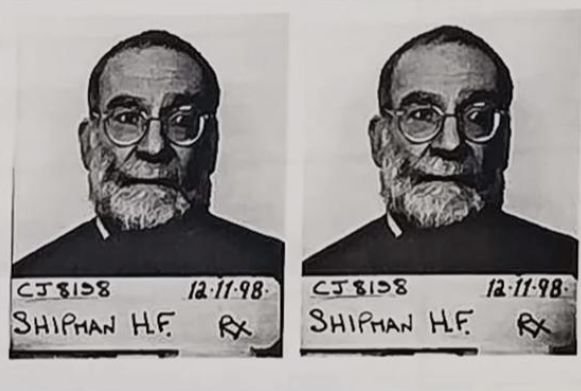
For years, Harold Shipman appeared to be exactly what his patients expected from a trusted family doctor: professional, familiar and available to people in his community.
Behind that image, however, was a crime that would eventually become one of the darkest scandals in British medical history.
Shipman was convicted in 2000 of murdering 15 patients, but a subsequent public inquiry concluded that he had killed at least 215 patients and that there was evidence giving rise to suspicion in dozens of additional deaths. The inquiry examined how a doctor could kill patients over many years without his crimes being detected.
From Medical Student to Family Doctor
Harold Frederick Shipman was born in Nottingham, England, in 1946. He studied medicine and qualified as a doctor in the 1970s.
He began working as a junior doctor at Pontefract General Infirmary before entering general practice. In 1974, he joined a medical practice in Todmorden, West Yorkshire.
Later, Shipman moved to Hyde, Greater Manchester, where he established himself as a general practitioner.
To the outside world, he had built a conventional medical career. He treated families, visited patients in their homes and became a familiar figure within the community.
That familiarity would eventually become one of the most disturbing aspects of the case.
The Deaths That Went Unnoticed
The Shipman Inquiry later examined deaths occurring over a period of more than two decades.
According to the inquiry’s findings, Shipman’s killings began in the 1970s and continued for years. Many of his victims were elderly patients, and their deaths could initially appear natural because they were already receiving medical care.
The inquiry found that Shipman had killed at least 215 patients.
The final investigation also identified another group of deaths in which there was a real suspicion that Shipman may have been responsible, but the evidence was insufficient for the inquiry to make a positive finding.
This distinction is important because the frequently cited figure of approximately 250 victims includes deaths that could not all be established to the same evidentiary standard.
Kathleen Grundy and the Turning Point
The case began to unravel following the death of Kathleen Grundy, an elderly woman from Hyde.
Grundy died in June 1998 after a visit from Shipman.
Her death initially did not immediately expose the doctor. But her daughter, a solicitor, later became concerned after learning that a will apparently made by Grundy left a large portion of her estate to Shipman.
The document was highly suspicious because it contradicted an earlier will.
Questions about the will eventually led investigators to examine Grundy’s death more closely.
Her body was exhumed, and forensic examination found evidence consistent with a fatal injection of diamorphine.
The investigation then shifted toward Shipman himself.
The Typewritten Will
The forged will became one of the most important pieces of evidence against Shipman.
He had not simply been accused of causing Grundy’s death; investigators discovered that he had also attempted to benefit financially from her estate.
The jury eventually convicted him of forging Grundy’s will in addition to the murder charge relating to her death.
The discovery opened the door to a much larger investigation.
Police began examining other patients who had died under Shipman’s care.
Patterns started to emerge.
The 1998 Investigation
Before Shipman’s eventual arrest, concerns about the number and circumstances of his patients’ deaths had already reached authorities.
In March 1998, another doctor reported concerns to the local coroner.
Greater Manchester Police investigated but concluded that there was insufficient evidence of criminal activity.
The later Shipman Inquiry criticized the investigation and concluded that three patients would probably have been saved if the investigation had been properly conducted and supervised.
This failure became a major part of the subsequent public inquiry.
The question was no longer simply how Shipman had killed his patients, but how warning signs had remained undetected for so long.
Arrest and Trial
Shipman was arrested in September 1998.
Investigators examined numerous deaths associated with his medical practice. Eventually, prosecutors selected 15 murder cases for trial.
The trial began at Preston Crown Court in October 1999.
The prosecution argued that Shipman had deliberately administered lethal doses of diamorphine to his patients and had then recorded misleading information about their deaths.
The evidence presented at trial included medical records, forensic findings and the circumstances surrounding the deaths.
On 31 January 2000, a jury found Shipman guilty of murdering 15 women and forging Kathleen Grundy’s will.
He received 15 life sentences, with the judge recommending that he should never be released.
The Inquiry Reveals a Much Larger Picture
Shipman’s conviction concerned 15 murders, but authorities suspected that his crimes extended far beyond those cases.
The British government established the Shipman Inquiry, chaired by High Court judge Dame Janet Smith, to investigate his activities and examine how the system had failed to detect them.
The inquiry’s first report, published in 2002, concluded that Shipman had killed at least 215 patients.
The investigation examined his medical career, the circumstances of individual deaths and the systems responsible for registering and investigating deaths.
Later work identified 218 victims whom the inquiry determined he had killed, while the inquiry also found a further group of deaths where suspicion existed but the evidence was not strong enough for a definitive conclusion. Parliament later summarized the inquiry’s findings as suggesting that Shipman had probably killed around 250 people, of whom 218 could be identified.
How Did He Remain Undetected?
The Shipman case exposed weaknesses in Britain’s system for certifying and investigating deaths.
At the time, doctors could have significant responsibility for certifying deaths among their own patients. Elderly people dying at home did not necessarily undergo detailed forensic investigation.
The inquiry found that existing arrangements had failed to deter Shipman or detect his crimes.
Its later reports examined death certification, cremation procedures and the role of coroners, eventually making extensive recommendations for reform.
The case therefore became more than the story of one criminal doctor. It became a study of how institutional safeguards can fail when unusual patterns are not recognized.
Why Did Shipman Kill?
One of the most difficult questions remains his motive.
The inquiry investigated Shipman’s behavior and the circumstances surrounding his crimes, but no simple explanation fully accounted for the killings.
Financial motives were evident in the Grundy case because of the forged will, but they did not explain the wider pattern of deaths.
The sheer number of victims also made the case particularly difficult to understand.
Rather than providing a simple psychological explanation, the historical record shows a disturbing combination of opportunity, trust and weaknesses in the systems responsible for monitoring deaths.
The End of Harold Shipman
Shipman was imprisoned at Wakefield Prison.
On 13 January 2004, he was found dead in his prison cell after taking his own life.
He was 57.
His death meant that many questions about his crimes could never be answered directly by him.
There was no further criminal trial covering the hundreds of deaths examined by the inquiry. Instead, the public inquiry became the principal mechanism through which investigators reconstructed the scale of his activities.
A Legacy of Reform
The Shipman case permanently changed discussions about medical accountability and death investigation in Britain.
The inquiry produced six reports and examined hundreds of individual deaths. It also produced recommendations intended to strengthen safeguards around death certification, cremation procedures and the investigation of suspicious deaths.
The most disturbing element of the Shipman story was not simply that a doctor committed murder. It was that his professional position gave him extraordinary access to vulnerable people and created an environment in which deaths could initially appear ordinary.
For his patients, he was supposed to represent care and protection.
Instead, investigators concluded that he had abused that trust on a scale almost impossible to comprehend.
The Historabase Editorial Team is dedicated to exploring and sharing the stories that have shaped Africa and the wider world. Our work covers African history, ancient civilizations, empires, historical figures, wars, cultures, political movements, and important events from the past.
We aim to present history in a clear, engaging, and accessible way, combining historical records with careful research to help readers better understand the people, events, and civilizations that shaped our world.







One Comment