Long before he scored goals in the English Premier League and represented the Netherlands, Collins John was a child growing up amid one of West Africa’s most devastating conflicts.
Born in Zwedru, Liberia, in 1985, John experienced the Liberian Civil War as a young boy. His childhood was marked by violence, the death of his father and a dangerous journey that eventually took him and his family to Europe.
Years later, he would become a professional footballer.
But one extraordinary detail from his childhood followed him into his teenage football career: contemporary accounts from his time at FC Twente reported that John had been shot in the leg as a child and that the bullet was still lodged there.
A Childhood During the Liberian Civil War
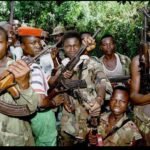
The First Liberian Civil War began in 1989, when Collins John was only a few years old.
The conflict developed into a brutal struggle involving Charles Taylor’s National Patriotic Front of Liberia and government forces, with civilians caught in the middle. Fighting spread across much of the country, displacing large numbers of people and leaving communities devastated.
For John’s family, the war became deeply personal.
His father was killed during the conflict in 1991. In a 2004 interview with the Evening Standard, John recalled that his family lost contact with his father during the fighting before learning that he had died. His mother subsequently decided to flee Liberia with her children.
John was approximately eight years old when the family eventually made the journey out of Liberia.
They travelled by boat toward Sierra Leone before continuing their journey to the Netherlands, where they entered the refugee system. John later described spending about two years in a government centre while the family’s case was processed.
For a child who had grown up surrounded by war, Europe represented an entirely different world.
And it was there that football began to change his life.
The Bullet in His Leg
One of the most remarkable details associated with John’s childhood comes from contemporary reports during his teenage years.
In a 2003 discussion about the young FC Twente prospect, a person familiar with his story claimed that John had been shot by a soldier when he was seven years old and that the bullet remained in his right leg. The same account stated that doctors expected the bullet to be removed approximately a month later.
Another discussion about John at the time specifically referred to the same story, identifying him as the player who still had a bullet in his leg after being shot as a child.
Because these surviving accounts are contemporary but informal sources rather than medical records, the precise circumstances of the shooting and the timing of the bullet’s removal cannot be established with the same certainty as John’s documented football career.
Nevertheless, the story became part of the extraordinary history surrounding the young footballer.
It also reflected the violence that had shaped his early life.
Football Became His Escape
After arriving in the Netherlands, John began developing his football ability.
He entered the youth system at FC Twente and quickly emerged as a promising striker. By the age of 17, he had made his senior debut.
His progress was remarkably fast.
During the 2002–03 season, he made 17 Eredivisie appearances and scored twice. The following season, his goalscoring increased dramatically, helping establish him as one of the Netherlands’ most promising young forwards.
While his football career was accelerating, the memories of Liberia remained part of his personal history.
Yet John generally avoided discussing the war in detail.
In interviews, he made it clear that he preferred to concentrate on football rather than continually revisit his traumatic childhood.
That attitude became particularly noticeable when he began receiving attention from major European clubs.
From FC Twente to the Premier League
In January 2004, Fulham signed John from FC Twente.
He was only 18 years old.
His arrival in England attracted attention partly because of his physical ability and goalscoring potential, but there was another reason his story stood out. Behind the young striker was a refugee childhood shaped by the Liberian conflict.
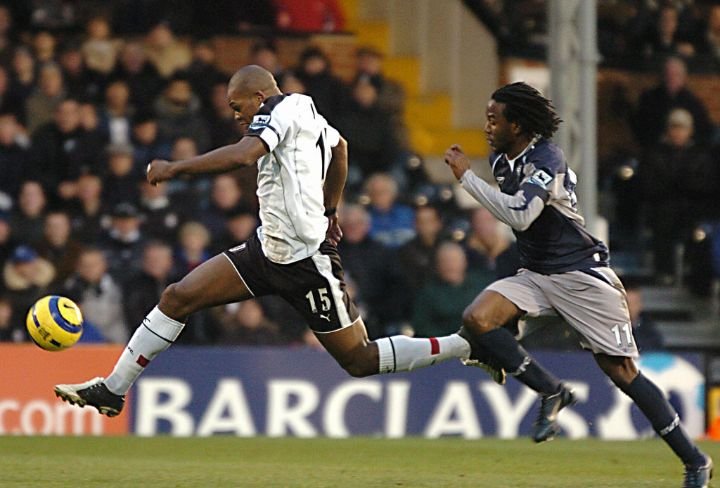
John made his Premier League debut for Fulham against Chelsea at Stamford Bridge on March 20, 2004.
The teenager from Liberia had reached one of the biggest football stages in the world.
His career at Fulham eventually produced 23 goals in 111 appearances across competitions. He enjoyed his most productive periods during the middle of his Fulham career and became one of the club’s notable young attacking players of the era.
In November 2005, he scored a spectacular volley against Middlesbrough that was subsequently considered for BBC Goal of the Season recognition.
The journey from war-torn Liberia to the Premier League was already extraordinary.
But John was not finished.
Representing the Netherlands
Despite being born in Liberia, John developed his football career in the Netherlands and represented the country internationally.
He played for the Dutch youth teams before receiving his senior international debut in 2004.
He appeared for the Netherlands against Sweden and later Liechtenstein that year.
His greatest international achievement came with the Netherlands Under-21 team.
In 2006, John was part of the Dutch squad that won the UEFA European Under-21 Championship in Portugal.
The squad included several players who would go on to have significant careers in European football.
For John, the achievement represented a remarkable transformation.
A boy who had fled Liberia as a refugee had become a European champion.
The War He Left Behind
The Liberian Civil War officially ended in 1997, but the country remained deeply affected by years of violence.
John’s personal experience was only one story among hundreds of thousands created by the conflict.
For him, however, the consequences were permanent.
His father was dead.
His family had been forced from their home.
He had grown up in circumstances where, according to his own account to the Evening Standard, remaining in Liberia as he became older could have meant being forced into the conflict.
Football provided another path.
Instead of becoming a participant in the war he had escaped, John became a professional footballer.
A Story Bigger Than Football
Collins John’s career eventually took him beyond Fulham. He played for clubs in England, the Netherlands, Belgium, the United States, Azerbaijan, Iran and Poland.
His career later became less prominent than it had appeared during his early years, but his journey remained unusual.
The image of the young Liberian refugee developing into a Premier League striker is powerful enough on its own.
The reported bullet in his leg adds another extraordinary layer to the story.
It is important, however, not to allow that detail to overshadow the historical reality behind it. The strongest documented evidence concerns John’s childhood during the Liberian Civil War, the death of his father, his family’s escape to the Netherlands and his subsequent rise through Dutch football. The surviving contemporary accounts are the main sources for the story about the bullet.
Ultimately, Collins John’s history is not simply the story of a footballer who reportedly played while carrying a bullet.
It is the story of a child whose early life was disrupted by war, whose family became refugees, and who eventually found a different future through football.
From Liberia to the Netherlands.
From a refugee centre to FC Twente.
From FC Twente to the Premier League.
And eventually, to the Netherlands national team.
His football career became a remarkable chapter in a life that had begun under circumstances no child should have experienced.
The Historabase Editorial Team is dedicated to exploring and sharing the stories that have shaped Africa and the wider world. Our work covers African history, ancient civilizations, empires, historical figures, wars, cultures, political movements, and important events from the past.
We aim to present history in a clear, engaging, and accessible way, combining historical records with careful research to help readers better understand the people, events, and civilizations that shaped our world.